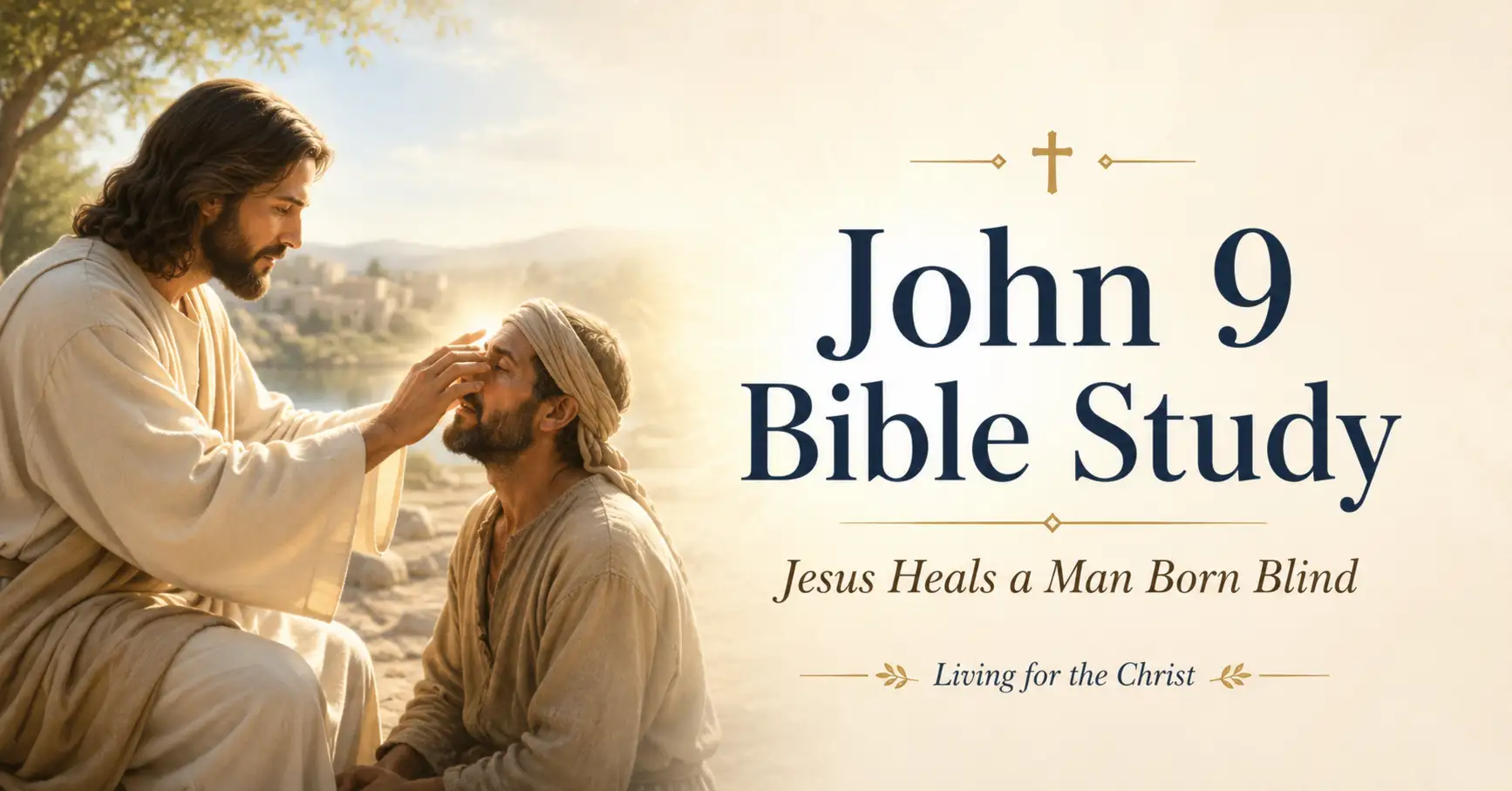
John 9 Bible Study: Jesus Heals a Man Born Blind
John chapter 9 records one of the most powerful healing accounts in the Gospel of John. Jesus gives physical sight to a man who had been blind from birth, but this chapter is about much more than a physical miracle.
As the man begins to see with his eyes, he also begins to understand who Jesus truly is. Meanwhile, the Pharisees, who claimed to possess spiritual understanding, became increasingly blind because they refused to accept the truth standing before them.
John 9 shows us that Jesus is the Light of the world. He opens blind eyes, seeks those who have been rejected, exposes religious pride, and brings people out of spiritual darkness and into saving faith.
“One thing I know, that, whereas I was blind, now I see.”
John 9:25
Key Themes in John Chapter 9
John 9 teaches us several important truths:
- Suffering is not always caused by a specific personal sin.
- Jesus is the Light of the world.
- God can work through circumstances we do not understand.
- True faith grows as we learn more about Jesus.
- Religious knowledge cannot replace a genuine relationship with Christ.
- Fear of people can prevent us from speaking the truth.
- Following Jesus may result in rejection from others.
- Jesus seeks and receives those whom the world casts out.
- Spiritual blindness is more serious than physical blindness.
- Those who recognize their need can receive spiritual sight.
📖 Read Me Next
Continue the Gospel of John Bible study series with:
Historical Background of John 9
John 9 takes place in Jerusalem and follows the confrontation between Jesus and the religious leaders in John 8. The chapter divisions in our Bibles were added later, but John does not tell us exactly how much time passed between the two accounts.
Several historical details help us better understand the events of this chapter.
The Pool of Siloam
The Pool of Siloam was located near the southern end of ancient Jerusalem’s City of David. Archaeologists uncovered the stepped remains of a large Second Temple-period pool there in 2004. The discovery helps us understand that Siloam was a real and prominent location in the Jerusalem of Jesus’ time.
John explains that the name Siloam means “Sent.” This fits an important theme throughout the Gospel of John: Jesus is the One sent by the Father.
Jesus, the One who was sent, sent the blind man to the pool called Sent.
The Sabbath Controversy
John tells us that Jesus made clay and healed the man on the Sabbath. The Pharisees interpreted His actions as unlawful work.
Later Jewish rabbinic writings list kneading among activities prohibited on the Sabbath. Some interpreters believe the Pharisees could have classified Jesus’ mixing of dirt and saliva as a form of kneading. Healing a condition that was not considered immediately life-threatening could also be challenged under strict traditional interpretations.
These later writings should be used carefully because they were compiled after the New Testament period. However, they help explain why the religious leaders focused on Jesus making clay instead of rejoicing that a man born blind could see.
Jesus had not violated the righteous purpose of God’s Sabbath. Instead, He exposed how human traditions could be used to ignore mercy and reject the work of God.
Being Put Out of the Synagogue
The man’s parents were afraid that anyone who confessed Jesus as the Christ would be put out of the synagogue.
The synagogue was more than a place attended once a week. It was connected to worship, teaching, community, family relationships, and public life. Exclusion could therefore carry serious religious and social consequences.
Scholars continue to debate the exact form and historical process of synagogue exclusion in the first century. John clearly presents it as a real threat, but we should not claim to know every detail of how formally it would have been carried out.
This background helps explain why the man’s parents were afraid and why the healed man’s willingness to defend Jesus required courage.
John 9:1-2 – Who Sinned?
“And as Jesus passed by, he saw a man which was blind from his birth. And his disciples asked him, saying, Master, who did sin, this man, or his parents, that he was born blind?”
As Jesus passed by, He saw a man who had been blind from birth.
The chapter begins with Jesus seeing someone whom many people may have overlooked. John does not record the man calling out to Jesus or asking to be healed. Instead, the account emphasizes that Jesus saw him and took the initiative.
The disciples assumed that the man’s blindness must have been caused by someone’s personal sin. They asked whether the man had sinned or whether his parents had sinned.
Their question reflected a common belief that physical suffering was always the direct punishment for a particular sin.
The Bible does teach that suffering entered the world through humanity’s fall into sin. It also teaches that sinful choices can sometimes produce painful consequences. However, we should never assume that every illness, disability, tragedy, or hardship is God’s punishment for a particular sin.
The disciples’ question focused on assigning a cause for the man’s condition. Jesus redirected their attention toward the work God was about to accomplish.
Reflection
When we see someone suffering, do we respond with compassion, or do we begin trying to determine what that person must have done wrong?
John 9:3 – The Works of God Revealed
“Jesus answered, Neither hath this man sinned, nor his parents: but that the works of God should be made manifest in him.”
Jesus was not saying that the man or his parents had never committed any sin. Every person is a sinner.
He was correcting the assumption that the man’s blindness was the direct result of a particular sin committed by either him or his parents.
The man’s condition would become an occasion for God’s power and mercy to be revealed.
This does not mean that we should tell every suffering person that God caused their pain merely to make an example of them. Jesus was speaking about this particular situation and the work He was about to accomplish.
Jesus did not give the disciples a complete explanation for every mystery surrounding human suffering. Instead, He focused on what God was going to do in the present.
We may not always understand why God allows certain difficulties. However, suffering does not place anyone beyond His reach. God can reveal His grace, faithfulness, strength, and transforming power even through painful circumstances.
Reflection
Are you spending more time asking why something happened than asking how God wants to work in your life now?
John 9:4-5 – Jesus Is the Light of the World
“I must work the works of him that sent me, while it is day: the night cometh, when no man can work. As long as I am in the world, I am the light of the world.”
Jesus understood that His earthly ministry was moving toward the cross. There was an urgency to accomplish the work the Father had given Him.
Jesus had already declared:
“I am the light of the world.”
John 8:12
Now He was preparing to demonstrate that truth through a visible miracle.
The man had never seen natural light, but he was about to encounter the One who gives both physical and spiritual sight.
Jesus did not merely point people toward the light. He declared that He is the Light.
Without Christ, we remain in spiritual darkness. Human wisdom cannot give us saving knowledge of God. We need Jesus to open our eyes to the truth of the gospel.
Reflection
Are you walking in the light Christ has given you, or are you resisting something He has already shown you?
John 9:6-7 – The Man Washes in the Pool of Siloam
“When he had thus spoken, he spat on the ground, and made clay of the spittle, and he anointed the eyes of the blind man with the clay, and said unto him, Go, wash in the pool of Siloam, which is by interpretation, Sent. He went his way therefore, and washed, and came seeing.”
Jesus made clay, placed it on the man’s eyes, and told him to wash in the Pool of Siloam.
The mud itself did not contain healing power. The water did not earn the man his healing. Jesus was the source of the miracle.
The man responded to Jesus with obedience. He went, washed, and returned seeing.
Imagine what this moment must have been like. For the first time, he could see light, colors, faces, buildings, and the world around him.
He left the place blind and returned with sight.
The man obeyed Jesus before he fully understood who Jesus was. His knowledge of Christ would continue to grow throughout the chapter.
Obedience does not earn God’s grace, but genuine faith takes Christ at His word.
Reflection
Is Jesus asking you to obey Him in an area where you do not yet understand every detail?
John 9:8-12 – The Neighbors Question the Miracle
The man’s neighbors were amazed when they saw him.
Some asked whether he was truly the man who had previously sat and begged. Others thought he only looked like him.
The man repeatedly answered:
“I am he.”
The transformation was so dramatic that some people could hardly believe he was the same person.
When they asked how his eyes had been opened, the man answered:
“A man that is called Jesus made clay, and anointed mine eyes.”
At this point, the man described Jesus as “a man.”
He knew what Jesus had done, but he did not yet fully understand who Jesus was.
We can see a progression in his understanding throughout the chapter:
- “A man that is called Jesus” – John 9:11
- “He is a prophet” – John 9:17
- A man sent from God – John 9:30-33
- Jesus reveals His identity, and the man believes and worships Him – John 9:35-38
The man’s physical eyes were opened immediately, but his spiritual understanding developed as he continued responding to the truth he had received.
Christian growth is often progressive. A new believer may not immediately understand every doctrine or passage of Scripture. As we continue listening to Christ, studying His Word, and responding in faith, our understanding grows deeper.
Reflection
How has your understanding of Jesus grown since you first believed?
🎬 Watch: Blind for the Glory of God – John 9:1-12
In this message, John MacArthur examines Jesus’ healing of the man born blind and explains what the passage teaches about suffering, God’s glory, and the compassion and power of Christ. Watch the video below for a deeper look at John 9:1-12 and how Jesus used this man’s condition to reveal the works of God.
John 9:13-16 – The Pharisees Investigate the Healing
The people brought the formerly blind man to the Pharisees because Jesus had healed him on the Sabbath.
The Pharisees were not primarily interested in celebrating the man’s healing. They focused on the fact that Jesus had made clay and opened his eyes on the Sabbath.
Some declared:
“This man is not of God, because he keepeth not the sabbath day.”
Others asked:
“How can a man that is a sinner do such miracles?”
This caused division among them.
The Pharisees interpreted Jesus’ actions through their Sabbath traditions. Instead of allowing the miracle to make them reconsider their judgment of Jesus, some allowed their existing judgment of Jesus to determine how they interpreted the miracle.
The Sabbath was intended as a gift from God, but religious leaders had surrounded it with additional rules and interpretations. Their concern for outward regulations had become separated from compassion, mercy, and recognition of God’s work.
Their theology left no room for the possibility that they were wrong about Jesus.
This is a serious warning. It is possible to know religious language, attend worship services, study Scripture, and still resist God when He confronts our pride.
Religious activity cannot substitute for a humble heart.
Reflection
Are there traditions, assumptions, or personal opinions that you have placed on the same level as Scripture?
John 9:17 – “He Is a Prophet”
The Pharisees asked the man what he believed about Jesus.
He answered:
“He is a prophet.”
His understanding had grown.
Jesus was no longer merely “a man that is called Jesus.” The healed man now recognized that Jesus spoke and acted with authority from God.
He did not yet understand everything, but he refused to deny what he knew.
God often gives us enough light to take the next step of faith. The question is whether we will respond honestly to the truth we have received.
John 9:18-23 – The Man’s Parents Are Afraid
The religious leaders refused to believe that the man had truly been born blind, so they questioned his parents.
His parents confirmed two facts:
- This was their son.
- He had been born blind.
However, they refused to explain how he had received his sight.
They said:
“He is of age; ask him.”
John explains that they answered this way because they were afraid of the religious leaders. Anyone who confessed that Jesus was the Christ could be put out of the synagogue.
Their fear is understandable. Exclusion could affect their place in the religious community and their relationships with others.
However, fear kept them from openly standing with their son or acknowledging what Jesus had done.
Fear of people can cause us to remain silent when we should speak.
Proverbs 29:25 warns:
“The fear of man bringeth a snare.”
We may fear rejection, embarrassment, criticism, lost relationships, or being misunderstood. Jesus calls us to value His approval above the approval of others.
Reflection
Have you ever remained silent about Christ because you were afraid of how someone might respond?
John 9:24-25 – “Whereas I Was Blind, Now I See”
The Pharisees called the man a second time and said:
“Give God the praise: we know that this man is a sinner.”
The expression “Give God the praise” was a solemn demand that the man tell the truth before God. A similar expression appears in Joshua 7:19.
The religious leaders were not sincerely inviting the man to praise God for the miracle. They were pressuring him to accept their conclusion that Jesus was a sinner.
There is deep irony in their demand. They told the man to speak truthfully while attempting to make him deny the clearest truth he knew.
The man answered:
“Whether he be a sinner or no, I know not: one thing I know, that, whereas I was blind, now I see.”
The man did not pretend to know everything. He simply testified about what Jesus had done for him.
He could not answer every theological argument, but no one could take away his testimony.
This is encouraging for believers who feel nervous about sharing their faith. You may not know how to answer every objection. You may not understand every difficult passage of Scripture.
But you can tell others what Christ has done for you.
A personal testimony does not replace the gospel or the authority of Scripture. However, it can point people toward the Savior who changed your life.
The man’s testimony was simple:
- I was blind.
- Jesus came to me.
- Jesus opened my eyes.
- Now I see.
Every Christian has a similar spiritual testimony. We were spiritually blind, but Christ opened our eyes to the truth of the gospel.
Reflection
How would you describe what Jesus has done in your life?
John 9:26-27 – The Man Challenges the Pharisees
The Pharisees continued questioning him:
“What did he to thee? how opened he thine eyes?”
The man had already answered their question.
Their repeated questioning showed that they were not sincerely searching for truth. They were searching for something they could use against Jesus.
The man replied:
“I have told you already, and ye did not hear.”
He then asked whether they also wanted to become Jesus’ disciples.
His question angered them.
Their problem was not simply a lack of evidence. They did not want to follow where the evidence led.
People sometimes claim that they would believe in Jesus if they had more proof. Evidence is important, but unbelief is not always merely an intellectual problem. It can also be a problem of the heart.
The Pharisees faced evidence they could not explain, yet they continued resisting Christ.
John 9:28-29 – Religious Pride
The Pharisees insulted the man and said:
“Thou art his disciple; but we are Moses’ disciples.”
They claimed to follow Moses while rejecting the One about whom Moses wrote.
Jesus had already told them:
“For had ye believed Moses, ye would have believed me: for he wrote of me.”
John 5:46
The Pharisees trusted their religious heritage, position, education, and knowledge. They assumed these things proved they were right with God.
However, knowing biblical information is not the same as knowing God.
A person can admire Moses, quote Scripture, defend religious traditions, and still reject Jesus Christ.
The Scriptures ultimately point us toward Christ. When Bible knowledge makes us proud rather than humble, something has gone terribly wrong.
Reflection
Does your knowledge of Scripture make you more humble, loving, and obedient to Christ?
John 9:30-33 – The Healed Man Reasons With the Pharisees
The man was amazed that the religious leaders claimed not to know where Jesus came from.
He reasoned that no one had ever heard of someone opening the eyes of a person born blind. He concluded:
“If this man were not of God, he could do nothing.”
His understanding had grown again. He now recognized that Jesus had come from God.
In verse 31, the man said:
“Now we know that God heareth not sinners: but if any man be a worshipper of God, and doeth his will, him he heareth.”
These words were spoken by the healed man as part of his argument. They were not given by Jesus as a complete teaching about prayer.
The Bible does teach that deliberate, unrepentant sin affects a person’s fellowship with God. Psalm 66:18 says:
“If I regard iniquity in my heart, the Lord will not hear me.”
However, Scripture also shows that God hears the repentant sinner who cries out for mercy. In Luke 18, the publican prayed:
“God be merciful to me a sinner.”
Jesus said that this man went home justified.
The healed man’s main point was that God would not authenticate someone living in rebellion by empowering him to perform such an extraordinary sign.
The religious experts should have recognized this, but the man they considered uneducated was reasoning more clearly than they were.
God often uses humble people to expose the foolishness of human pride.
John 9:34 – Cast Out for Telling the Truth
The Pharisees responded:
“Thou wast altogether born in sins, and dost thou teach us?”
They returned to the same false assumption with which the disciples had begun the chapter. They treated the man’s blindness from birth as proof that he had been under a special judgment for sin.
Instead of answering his reasoning, they insulted him.
John then says:
“And they cast him out.”
In light of the earlier threat about being put out of the synagogue, this may indicate that he was excluded from their religious community. However, the passage does not describe the exact formal process.
The man suffered rejection because he refused to deny what Jesus had done.
Following Christ may cost us the approval of others. Some people may reject us, misunderstand us, or distance themselves from us because of our faith.
But rejection by people does not mean rejection by God.
The religious leaders cast the man out, but Jesus was about to seek him personally.
John 9:35 – Jesus Finds the Rejected Man
“Jesus heard that they had cast him out; and when he had found him, he said unto him, Dost thou believe on the Son of God?”
Jesus heard what had happened and went looking for the man.
This is one of the most comforting moments in the chapter.
When the religious community rejected him, Jesus found him.
The man may have lost acceptance among influential religious leaders, but he gained something far greater: a personal encounter with Jesus Christ.
Jesus does not abandon those who suffer for confessing the truth about Him.
Psalm 27:10 says:
“When my father and my mother forsake me, then the Lord will take me up.”
People may turn away from us, but Christ remains faithful.
Translation Note for John 9:35
The KJV and NKJV read “Son of God” in John 9:35. Many modern translations, including the ESV, NIV, and NET, read “Son of Man.”
This difference comes from a variation among ancient Greek manuscripts. Modern critical editions commonly favor “Son of Man,” while the manuscript tradition behind the KJV reads “Son of God.”
Either reading leads to the same central event in the passage: Jesus reveals His identity to the man, and the man responds with faith.
Reflection
Have you experienced rejection for following Christ? How does it comfort you to know that Jesus seeks and receives His people?
John 9:36-38 – “Lord, I Believe”
The man asked:
“Who is he, Lord, that I might believe on him?”
Jesus answered:
“Thou hast both seen him, and it is he that talketh with thee.”
The man responded:
“Lord, I believe.”
Then he worshiped Jesus.
This is the high point of the man’s journey through the chapter.
He had progressed from knowing Jesus as a man, to believing He was a prophet, to recognizing that He came from God. Now Jesus revealed Himself to him personally.
The man believed and worshiped Him.
Jesus received his worship.
Throughout Scripture, faithful servants of God and holy angels refuse to receive worship that belongs to God. Jesus did not correct the man or turn away his worship.
Jesus is not merely a teacher, prophet, miracle worker, or religious leader. He is worthy of faith and worship.
The chapter’s deepest emphasis is not limited to the man receiving physical sight. Jesus also led him to spiritual sight, faith, confession, and worship.
Physical healing transformed his earthly circumstances. Faith in Christ transformed his eternal future.
Reflection
Do you only admire Jesus for what He can do, or have you trusted and worshiped Him as Lord?
John 9:39 – Spiritual Sight and Spiritual Blindness
Jesus said:
“For judgment I am come into this world, that they which see not might see; and that they which see might be made blind.”
Jesus did not come because He wanted people to remain spiritually blind. His presence revealed the true condition of every heart.
Those who recognized their spiritual need received sight. Those who proudly claimed that they already understood everything became more hardened in their blindness.
The humble man knew he needed help. The Pharisees believed they needed nothing.
The gospel brings salvation to those who receive Christ, but it also exposes the unbelief of those who reject Him.
Light does not create what is inside a room. It reveals what is already there.
In the same way, Jesus reveals what is in the human heart.
John 9:40-41 – “Are We Blind Also?”
Some of the Pharisees asked Jesus:
“Are we blind also?”
Jesus answered:
“If ye were blind, ye should have no sin: but now ye say, We see; therefore your sin remaineth.”
Jesus was not teaching that ignorance automatically makes a person sinless.
The Pharisees claimed to possess spiritual knowledge. They believed they could judge Jesus accurately, yet they rejected the truth God placed before them.
Because they insisted that they could see, they would not admit their need for spiritual sight.
Their pride prevented them from coming to Christ.
The first step toward spiritual sight is recognizing that we are spiritually blind without Jesus.
We cannot save ourselves through religious knowledge, good works, church attendance, family background, baptism, or outward morality.
We need Jesus to open our eyes, forgive our sins, and give us eternal life.
The Pharisees believed they were qualified to judge Jesus. In reality, Jesus was exposing the judgment already present in their own hearts.
The Progression of the Man’s Faith
The healed man’s understanding of Jesus developed throughout the chapter.
“A Man That Is Called Jesus”
At first, he knew Jesus as the man who had placed clay on his eyes and told him to wash.
“He Is a Prophet”
He then recognized that Jesus spoke and acted with authority from God.
“If This Man Were Not of God, He Could Do Nothing”
As the man faced opposition, his confidence grew. He openly defended Jesus before the religious leaders.
“Lord, I Believe”
Finally, Jesus revealed Himself to the man. He believed and worshiped Christ.
This progression reminds us that spiritual growth often occurs as we respond faithfully to what God has already shown us.
The man did not have every answer at the beginning. But he continued moving toward the truth rather than away from it.
The Pharisees moved in the opposite direction. The more evidence they received, the more determined they became to reject Jesus.
No one remains neutral toward Christ forever. We are either moving toward Him in faith or hardening ourselves against Him.
What John 9 Teaches About Suffering
John 9 warns us against making careless assumptions about suffering.
We should not automatically conclude that someone’s illness, disability, financial hardship, family difficulty, or tragedy is a direct punishment for a particular sin.
The disciples initially saw the man’s condition as a theological question. Jesus saw the man and responded with compassion.
We may not receive a complete explanation for every hardship in this life. But John 9 shows us several comforting truths:
- God sees those whom others overlook.
- Suffering does not make someone less valuable.
- Pain does not place anyone beyond God’s mercy.
- God can work through circumstances we do not understand.
- Jesus is present with His people in suffering.
- Our greatest need is not merely relief from earthly pain but reconciliation with God.
John’s comparison between physical sight and spiritual sight does not mean that physical blindness is sinful or that a blind person is spiritually blind.
Jesus specifically rejected the assumption that this man’s physical condition resulted from a particular sin.
A person with physical sight may remain spiritually blind, while a person with a disability may possess deep faith and spiritual understanding.
Religious Knowledge Without Spiritual Sight
The Pharisees had knowledge, authority, and religious influence. Yet they failed to recognize the Messiah.
They investigated the miracle but refused to follow the evidence.
They questioned the man, questioned his parents, questioned him again, insulted him, and finally cast him out.
Their problem was not a lack of evidence. It was spiritual pride.
Religious pride says:
- I already understand everything.
- I cannot be corrected.
- My traditions must be right.
- Anyone who disagrees with me must be ignorant.
- I do not need mercy.
- I do not need to repent.
Saving faith says:
- I was blind.
- I cannot save myself.
- I need Jesus.
- Christ has shown me mercy.
- Lord, I believe.
The Gospel Message in John 9
The blind man’s physical condition provides a picture of humanity’s spiritual need.
We are born into a fallen world and are spiritually blind because of sin. We cannot open our own spiritual eyes or make ourselves right with God.
Jesus came into the world as the Light.
He lived the sinless life we could never live. He died on the cross, bearing the judgment our sins deserved. He was buried and rose again on the third day.
Salvation is not earned through religious works, church attendance, baptism, family background, or trying to become a better person.
We are saved by God’s grace when we repent and place our faith in Jesus Christ.
Ephesians 2:8-9 says:
“For by grace are ye saved through faith; and that not of yourselves: it is the gift of God: not of works, lest any man should boast.”
Like the man in John 9, we must come to the point where we can honestly say:
“Lord, I believe.”
True faith means more than believing that Jesus existed or that He performed miracles. It means trusting Him as Lord and Savior.
Jesus still opens spiritually blind eyes.
He still forgives sinners.
He still seeks those who have been rejected.
He still brings people out of darkness and into His marvelous light.
Living It Out
Admit Your Spiritual Need
The Pharisees remained blind because they insisted that they could already see. Ask God to reveal any area where pride may be keeping you from receiving correction.
Respond With Compassion Instead of Blame
The disciples initially wanted to know whose sin had caused the man’s condition. Jesus redirected their attention toward God’s work.
When someone is suffering, be careful not to make assumptions. Listen, show compassion, pray, and offer practical help.
Obey What Christ Has Shown You
The man went and washed before he fully understood who Jesus was.
Take the next step of obedience even when you do not understand every detail.
Tell Others What Jesus Has Done
You do not need to know the answer to every question before sharing your testimony.
Begin with what you know: Christ has shown you mercy.
Do Not Allow Rejection to Silence You
The man stood by the truth even when the religious leaders insulted and rejected him.
Ask God for courage to remain faithful when others oppose your faith.
Keep Growing in Your Understanding of Jesus
Do not remain satisfied with a shallow understanding of Christ.
Continue studying Scripture, praying, obeying, and learning who He truly is.
Worship Jesus as Lord
The goal is not merely to receive help from Jesus.
The goal is to know Him, trust Him, obey Him, follow Him, and worship Him.
Reflection Questions for John 9
- Why did the disciples assume the man’s blindness was caused by a particular sin?
- What does Jesus’ response teach us about making assumptions concerning suffering?
- Why is it significant that Jesus called Himself the Light of the world before healing the man?
- What did the man’s obedience reveal about his response to Jesus?
- How did the man’s understanding of Jesus grow throughout the chapter?
- Why were some of the Pharisees unwilling to accept the evidence before them?
- How did fear affect the response of the man’s parents?
- What can we learn from the man’s simple testimony in John 9:25?
- What did it cost the man to stand by the truth?
- How did Jesus respond after the religious leaders cast him out?
- Why is the man’s response in John 9:38 so important?
- What is the difference between physical blindness and spiritual blindness in this chapter?
- Are there any areas where pride may be preventing you from receiving correction?
- What part of your testimony could you share with someone this week?
- Can you honestly say to Jesus, “Lord, I believe”?
Memory Verse
“He answered and said, Whether he be a sinner or no, I know not: one thing I know, that, whereas I was blind, now I see.”
John 9:25
Discipleship Challenge
Take time this week to write down your testimony in three simple parts:
- What your life was like before you trusted Christ.
- How you came to understand and believe the gospel.
- How Jesus has changed your life.
Your testimony does not need to be dramatic or complicated.
Be honest, keep the focus on Jesus, and explain what He has done.
Then pray for an opportunity to share your testimony with someone who needs the hope of the gospel.
Key Takeaways From John 9
| Passage | Main Truth | Personal Application |
|---|---|---|
| John 9:1-3 | Suffering is not always caused by a specific personal sin. | Respond to suffering with compassion rather than blame. |
| John 9:4-5 | Jesus is the Light of the world. | Look to Christ for spiritual truth and direction. |
| John 9:6-7 | The man responded to Jesus with obedience. | Obey what Christ has clearly shown you. |
| John 9:8-12 | The man openly testified about his healing. | Tell others what Jesus has done in your life. |
| John 9:13-23 | Religious pride and fear can keep people from confessing the truth. | Value God’s approval above human approval. |
| John 9:24-34 | The man refused to deny what he knew. | Stand firmly on the truth even when challenged. |
| John 9:35-38 | Jesus sought the rejected man and revealed Himself to him. | Believe in and worship Jesus as Lord. |
| John 9:39-41 | Those who admit their blindness can receive spiritual sight. | Humbly recognize your need for Christ. |
Helpful Cross-References
- Psalm 27:10 – The Lord receives those who have been forsaken.
- Psalm 66:18 – Cherished sin affects our fellowship with God.
- Psalm 146:8 – The Lord opens the eyes of the blind.
- Proverbs 29:25 – The fear of man brings a snare.
- Isaiah 29:18 – The blind would see out of obscurity.
- Isaiah 35:5 – The eyes of the blind would be opened.
- Isaiah 42:6-7 – The Messiah would open blind eyes and bring people out of darkness.
- Luke 4:18 – Jesus announces recovery of sight to the blind.
- Luke 18:13-14 – God receives the sinner who cries out for mercy.
- John 1:4-9 – Jesus is the true Light.
- John 5:39-46 – The Scriptures testify about Jesus.
- John 8:12 – Jesus is the Light of the world.
- John 10:27-28 – Christ knows and keeps His sheep.
- John 12:35-36 – Believe in the Light while you have the Light.
- 2 Corinthians 4:3-6 – God shines the light of the gospel into our hearts.
- Ephesians 2:8-9 – Salvation is by grace through faith, not works.
- 1 Peter 2:9 – Believers are called out of darkness into God’s marvelous light.
Closing Prayer
Father, thank You for sending Jesus into the world as the Light. Without Him, I would remain spiritually blind and separated from You.
Please forgive me for the times I have judged others, trusted in my own understanding, or allowed pride to keep me from receiving correction.
Help me respond to those who are suffering with compassion rather than assumptions. Remind me that every person is valuable and worthy of love.
Open my eyes to see Jesus more clearly. Help me obey what You have shown me, even when I do not understand every detail.
Give me courage to stand for the truth when others reject or oppose it. Keep the fear of people from silencing my testimony.
Thank You that Jesus seeks those who have been cast out and receives everyone who comes to Him in faith.
Help me remember what Christ has done in my life, and give me opportunities to share that testimony with others.
May my life declare, “I was blind, but now I see.”
Lord Jesus, I believe. Help me trust You, follow You, and worship You more faithfully each day.
In Jesus’ name, amen.