

Are Christians Supposed to Judge? What the Bible Really Says About Judging Others
One of the most commonly quoted Bible verses today is:
“Do not judge, or you too will be judged.” – Matthew 7:1
You have probably heard this verse used to mean that Christians should never say something is sinful, never correct another believer, and never make a moral judgment about someone’s behavior.
But is that really what Jesus meant?
When we look at the rest of Scripture – and even the verses immediately following Matthew 7:1 – the answer is no.
The Bible does not teach Christians to abandon judgment altogether. Instead, Scripture teaches us to reject hypocritical, self-righteous, harsh, and presumptuous judgment while practicing righteous discernment according to God’s Word.
Jesus Himself said:
“Stop judging by mere appearances, but instead judge correctly.” – John 7:24
If you enjoy looking at questions like this directly through Scripture, you can explore more answers in our Bible Questions section.
It is also important to understand what the Bible actually defines as sin, because Christians are not free to invent their own standards of right and wrong.
So the real question is not simply:
“Should Christians judge?”
The better question is:
What kind of judgment does God forbid, and what kind of judgment does He require?
Let’s look at what the Bible actually says.
The Short Answer: Are Christians Supposed to Judge?
Yes – but not in the way the world often thinks of judgment.
Christians are called to:
- Discern between truth and error.
- Recognize good and evil according to Scripture.
- Identify false teaching.
- Examine spiritual fruit.
- Confront serious sin among fellow believers when necessary.
- Restore Christians who have fallen into sin.
- Make wise decisions about whom we trust and follow.
- Test spiritual claims and teachings.
- Exercise church discipline when Scripture requires it.
- Receive biblical correction ourselves with humility.
But Christians are not called to:
- Look down on others.
- Condemn people as though we were God.
- Judge someone’s heart or hidden motives.
- Hypocritically criticize sins while refusing to deal with our own.
- Treat personal preferences as biblical commands.
- Pronounce someone’s eternal destiny based merely on our assumptions.
- Publicly shame people when a matter should be handled privately.
- Hold unbelievers to the same standard of church accountability as believers.
- Use “discernment” as an excuse for gossip, cruelty, or pride.
There is a significant difference between biblical discernment and self-righteous condemnation.
Understanding that difference clears up much of the confusion surrounding this subject.
What Did Jesus Mean When He Said “Do Not Judge”?
Jesus’ teaching in Matthew 7 is often quoted without its surrounding verses.
Jesus said:
“Do not judge, or you too will be judged.” – Matthew 7:1
But He continued by warning that the same standard we use against others will be used against us.
Then Jesus gave the famous illustration of someone noticing a speck in another person’s eye while having a plank in his own.
Jesus says:
“You hypocrite, first take the plank out of your own eye, and then you will see clearly to remove the speck from your brother’s eye.” – Matthew 7:5
Notice what Jesus doesn’t say.
He doesn’t say:
“Ignore the speck in your brother’s eye forever.”
Instead, He says:
First deal with the plank in your own eye. Then you will be able to help your brother with the speck in his.
The problem is hypocrisy.
Jesus is warning against approaching someone else’s sin while refusing to acknowledge our own.
Before correcting another Christian, we should examine ourselves.
We might ask:
- Am I guilty of something similar?
- Am I approaching this person because I love them or because I want to criticize them?
- Have I prayed about this?
- Am I using Scripture or merely my own opinion?
- Am I speaking with humility?
- Would I want someone to approach me this way?
Biblical correction begins with self-examination.
What About Matthew 7:6?
Immediately after warning against hypocritical judgment, Jesus says:
“Do not give dogs what is sacred; do not throw your pearls to pigs.” – Matthew 7:6
Whatever specific application we make of this verse, one thing is clear:
Jesus expected His followers to exercise discernment.
To obey this command, a Christian has to evaluate a situation and respond wisely.
That is another reason Matthew 7 cannot mean:
“Christians must never evaluate anything or anyone.”
The same chapter that says “Do not judge” also tells believers to recognize false prophets by their fruit.
Jesus was condemning sinful judgment – not biblical discernment.
Jesus Actually Told Us to Judge Correctly
John 7:24 provides an important balance:
“Stop judging by mere appearances, but instead judge correctly.”
Jesus did not say:
“Never judge anything.”
He said to judge correctly.
In our John 7 Bible Study, I go deeper into this passage and Jesus’ teaching about righteous judgment.
Christians cannot obey many commands in Scripture without making judgments.
For example, how could we identify false teachers without examining their teaching?
Jesus warned:
“Watch out for false prophets.” – Matthew 7:15
A few verses later He said:
“By their fruit you will recognize them.” – Matthew 7:20
Recognizing someone’s spiritual fruit requires discernment.
Likewise, Scripture tells believers to:
- Test teachings.
- Avoid deception.
- Recognize false doctrine.
- Choose wise companions.
- Avoid certain sinful influences.
- Correct brothers and sisters who fall into sin.
None of those things are possible without making some form of judgment.
The issue is whether our judgment agrees with God’s judgment revealed in Scripture.
🎬 Watch: What Does the Bible Mean When It Says “Do Not Judge”?
Matthew 7:1 is often quoted as though Jesus commanded Christians never to make any kind of judgment. This short video from Got Questions Ministries takes a closer look at what Jesus meant and helps explain the difference between hypocritical judgment and biblical discernment.
Christians Are Commanded to Test False Teaching
Discernment is especially important when it comes to spiritual teaching.
The Bible repeatedly warns Christians not to believe every teacher simply because someone claims to speak for God.
First John 4:1 says:
“Do not believe every spirit, but test the spirits to see whether they are from God.”
The Bereans were praised in Acts 17:11 because they examined the Scriptures to see whether what Paul taught was true.
First Thessalonians 5:21 says:
“Test them all; hold on to what is good.”
Jesus also warned that false prophets would appear harmless outwardly while inwardly being dangerous.
That means Christians should not decide whether a teacher is trustworthy based merely on:
- Charisma.
- Popularity.
- Emotional preaching.
- Large crowds.
- Social media following.
- Claims of miracles.
- A Christian label.
- How sincere someone appears.
Teaching must be compared with Scripture.
This is not sinful judgment.
It is biblical obedience.
At the same time, Christians should be careful not to label someone a false teacher merely because we disagree over a secondary issue.
Serious accusations require serious biblical evidence.
Christians Do Not Decide What Is Sin
This distinction is extremely important.
Christians do not have the authority to invent moral standards.
God determines what is right and wrong.
When Scripture clearly calls something sinful, saying that it is sinful is not the same thing as personally condemning someone.
Scripture identifies behaviors such as sexual immorality, adultery, greed, drunkenness, hatred, theft, lying, idolatry, and many others as sinful.
But sin goes even deeper than outward behavior.
As I explain in What Is Sin According to the Bible?, sin involves going against God’s character, commands, and will.
A Christian who says:
“The Bible teaches that this behavior is sinful”
is appealing to God’s revealed standard.
However, that does not give Christians permission to be cruel, mocking, prideful, or hateful toward someone involved in that sin.
Truth and love are not enemies.
Ephesians 4:15 tells believers to speak “the truth in love.”
We should never remove truth in the name of love.
But we should never remove love in the name of truth either.
We Must Remember That We Are Sinners Too
One of the greatest protections against self-righteous judgment is remembering the gospel.
Romans 3:23 tells us:
“For all have sinned and fall short of the glory of God.”
Christians are not people who earned God’s approval by being better than everyone else.
We are sinners who desperately needed a Savior.
Our salvation comes through Jesus Christ, not through our moral superiority.
That should completely change the way we approach someone caught in sin.
Instead of thinking:
“How could you do something like that?”
we should remember:
“Apart from God’s grace, I also desperately need forgiveness.”
When we understand our own dependence upon grace, correction becomes much more humble.
Christians Are Called to Correct Other Believers

Some people say:
“Only God can judge me.”
It is sometimes used as though Christians should never address another believer’s sin.
But Scripture repeatedly teaches otherwise.
Galatians 6:1 says:
“If someone is caught in a sin, you who live by the Spirit should restore that person gently.”
Notice the goal.
It isn’t humiliation.
It isn’t punishment.
It isn’t winning an argument.
The goal is restoration.
And the manner is gentleness.
The same verse warns the person doing the correcting to watch themselves so that they are not tempted.
Biblical correction should therefore contain three things:
Truth, humility, and restoration.
If our goal is simply to embarrass someone, prove that we’re right, or feel spiritually superior, our attitude is already wrong.
Jesus Gave Instructions for Confronting Sin
Matthew 18:15-17 gives Christians another important example.
Jesus taught that when a fellow believer sins, the first step should ordinarily be approaching that person privately.
This is very different from immediately broadcasting someone’s failure publicly.
The basic progression Jesus describes is:
- Speak to the person privately.
- If necessary, involve one or two others.
- If serious unrepentant sin continues, the matter can eventually involve the church.
This process demonstrates that biblical correction is supposed to seek repentance and reconciliation – not public humiliation.
Whenever possible, correction should be handled quietly and lovingly.
What Is Church Discipline?
Church discipline sometimes sounds harsh because it is often misunderstood.
Biblical church discipline is not supposed to be revenge.
It is a process designed to:
- Protect the church from serious unrepentant sin.
- Call a professing believer to repentance.
- Preserve the church’s witness.
- Protect other believers from harmful influence.
- Seek restoration when possible.
Matthew 18:15-17 provides one biblical framework.
First Corinthians 5 provides another example involving serious public immorality in the Corinthian church.
Paul’s concern was not merely that someone had sinned.
The serious problem was that obvious sin was being openly tolerated without repentance.
Church discipline should never be used to control people over personal preferences or minor disagreements.
But neither should churches ignore serious, ongoing, unrepentant sin among those who profess to follow Christ.
What If Someone Refuses to Repent?
Sometimes loving correction does not result in immediate repentance.
A Christian may lovingly confront someone, pray for them, provide Scripture, and still see that person refuse to change.
At that point, our responsibility is not to force repentance.
Only God can change a heart.
Depending on the seriousness of the situation, biblical responses may include:
- Continuing to pray for the person.
- Setting appropriate boundaries.
- Seeking wise counsel.
- Involving church leadership when appropriate.
- Following biblical church discipline when serious unrepentant sin is involved.
- Refusing to participate in or enable sinful behavior.
Love does not mean pretending destructive behavior is acceptable.
Sometimes love requires boundaries.
At the same time, even discipline should leave room for repentance and restoration.
The Church Has a Responsibility to Judge Serious Sin Within the Church
One of the clearest passages on this subject is 1 Corinthians 5.
The Corinthian church was tolerating serious sexual immorality among someone claiming to be a believer.
Paul strongly rebuked them for ignoring it.
Then he made an important distinction between judging those inside and outside the church.
Paul asks:
“What business is it of mine to judge those outside the church? Are you not to judge those inside?” – 1 Corinthians 5:12
Then he says:
“God will judge those outside.” – 1 Corinthians 5:13
This is one of the clearest biblical answers to the question of Christian judgment.
There is a difference between:
Recognizing sin in the world
and
exercising spiritual accountability within the church.
The church has a special responsibility toward those who claim to follow Christ.
Should Christians Judge Other Christians Differently From Unbelievers?
Yes.
According to 1 Corinthians 5, there is an important distinction.
Christians should recognize that sin remains sin regardless of who commits it.
But church accountability applies especially to those who profess faith in Christ.
An unbeliever has never claimed to live under Christian discipleship.
We therefore should not be surprised when someone who does not follow Christ does not live according to Christian standards.
Our primary message to unbelievers is not:
“Start acting more Christian.”
It is:
“You need reconciliation with God through Jesus Christ.”
Behavior modification cannot save anyone.
The gospel changes the heart, and a changed heart should progressively produce a changed life.
Christians Should Not Expect Unbelievers to Live Like Christians
This is an area where Christians sometimes get the order backward.
We can become extremely focused on correcting the behavior of people who have never claimed to follow Christ.
But someone without Christ has a much deeper problem than a particular sinful behavior.
They need reconciliation with God.
That doesn’t mean Christians should remain silent about morality or never speak about what Scripture teaches.
But our ultimate goal should not merely be making unbelievers behave more Christian.
They need the gospel.
Jesus came to save sinners.
Once the Holy Spirit transforms a person’s heart, their life should progressively begin to reflect that new relationship with Christ.
There Are Things Christians Should Not Judge
Although Scripture permits and sometimes requires righteous judgment, the Bible also places clear limits on us.
Do Not Judge Someone’s Heart
Only God perfectly knows a person’s thoughts, motives, intentions, and heart.
First Corinthians 4:5 warns believers against making premature judgments because the Lord will ultimately expose what is hidden and reveal the motives of the heart.
We can evaluate someone’s words and actions.
We cannot perfectly know everything happening inside their heart.
That belongs to God.
Do Not Judge Disputable Matters
Romans 14 deals with believers disagreeing about matters of conscience.
Some believers ate certain foods while others abstained.
Some regarded certain days differently.
Paul warned believers not to despise or judge one another over these matters.
There are biblical commands that are clearly right or wrong.
But there are also issues where sincere Christians may reach different conclusions.
We should be very careful not to turn:
“This is what I believe is wisest”
into:
“Every Christian must do this or they are sinning.”
This is closely connected with the danger of legalism and turning personal convictions into rules for other Christians.
Personal convictions should never be elevated to the same authority as Scripture.
Do Not Judge Hypocritically
This brings us back to Matthew 7.
There is something deeply wrong with loudly criticizing another person’s sin while excusing our own.
Romans 2:1 warns against condemning others while practicing the same things ourselves.
Before correcting someone else, we should ask God to search our own hearts.
That doesn’t mean we must become perfectly sinless before we can help another believer.
If that were the requirement, nobody could ever correct anyone.
It means we must approach correction with repentance and humility rather than hypocrisy.
Do Not Judge With Pride
Jesus repeatedly confronted the religious leaders of His day because they often looked down upon others while seeing themselves as righteous.
One powerful example is found in Luke 18:9-14.
Jesus described a Pharisee who thanked God that he was not like other sinful people.
Meanwhile, a tax collector humbly pleaded:
“God, have mercy on me, a sinner.”
Jesus said the humble man went home justified before God.
One of the clearest signs that our judgment has become sinful is when it makes us feel spiritually superior.
Biblical discernment should produce humility because God’s Word reveals our own need for grace too.
Judgment, Discernment, Correction, and Condemnation Are Not the Same Thing
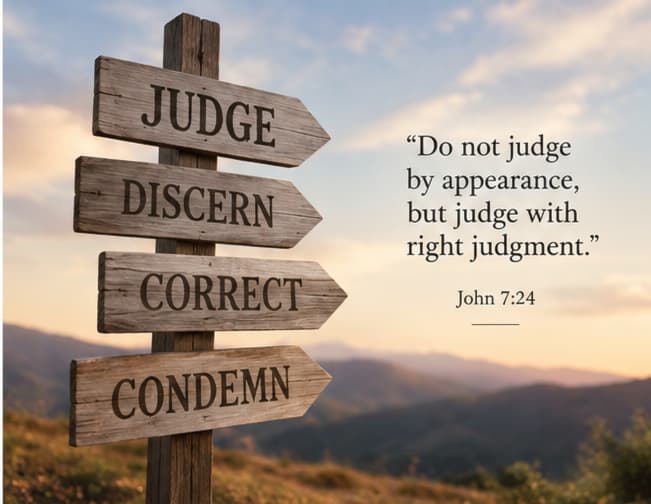
These words are often treated as though they mean the same thing, but biblically they can be very different.
Discernment
Discernment asks:
“What is true? What is false? What does Scripture say?”
Its goal is wisdom.
Correction
Correction says:
“Something is wrong here, and I want to help restore you.”
Its goal is repentance and restoration.
Righteous Judgment
Righteous judgment evaluates a teaching, behavior, or situation according to God’s Word rather than appearances or personal preferences.
Its goal is truth and obedience.
Condemnation
Self-righteous condemnation says:
“I am better than you. You are hopeless. I have the right to write you off.”
Final condemnation belongs to God, not us.
Discernment recognizes danger.
Correction seeks restoration.
Righteous judgment applies Scripture.
Self-righteous condemnation delights in failure or assumes authority that belongs to God.
Christians should practice biblical discernment, correction, and righteous judgment while rejecting self-righteous condemnation.
What About “Only God Can Judge Me”?
There is some truth hidden inside this popular saying.
God is the ultimate Judge.
Romans 14:10 reminds us that we will all stand before God’s judgment seat.
Christians do not have God’s authority to pronounce final judgment over another person’s soul.
But saying:
“Only God can judge me”
does not mean nobody can ever tell us that we are wrong.
God often uses:
- Scripture.
- Pastors.
- Christian friends.
- Parents.
- Church leaders.
- Fellow believers.
to expose sin and bring correction into our lives.
Sometimes loving someone means telling them something they don’t want to hear.
And sometimes humility means being willing to listen.
Christians Must Be Willing to Receive Correction Too
It is easy to ask:
“When am I allowed to correct someone else?”
A harder question is:
“How do I respond when someone corrects me?”
Scripture speaks repeatedly about the importance of receiving wise correction.
Proverbs 12:1 connects loving discipline with loving knowledge.
Proverbs 15:31-32 teaches that those who listen to life-giving correction grow in wisdom.
Psalm 141:5 even describes the rebuke of a righteous person as something beneficial.
A spiritually mature Christian should not automatically become defensive whenever someone raises a concern.
That does not mean every accusation is correct.
We should still compare everything with Scripture.
But humility asks:
“Is there any truth here that I need to hear?”
Sometimes God may use another believer to show us something about ourselves that we could not see.
Is Calling Sin “Sin” Unloving?
Not when it is done biblically.
Imagine watching someone unknowingly walk toward serious danger.
Would love remain silent?
Of course not.
In the same way, Christians should not pretend that sin is harmless when God says otherwise.
However, how we speak matters.
Second Timothy 2:24-25 teaches that the Lord’s servant should not be quarrelsome but kind, patiently instructing opponents with gentleness.
Our attitude matters to God just as much as our willingness to speak truth.
Being technically correct does not excuse being cruel.
Jesus Was Full of Both Grace and Truth
John 1:14 describes Jesus as being full of grace and truth.
That balance should characterize His followers too.
Truth without grace can become harshness.
Grace without truth can become compromise.
Jesus never pretended sin wasn’t serious.
But He also showed extraordinary compassion toward sinners.
In John 8, when the woman caught in adultery was brought before Jesus, He exposed the hypocrisy of her accusers while also telling her to leave her life of sin.
Grace did not redefine sin.
Truth did not eliminate compassion.
Jesus demonstrated both.
What About Judging People on Social Media?
I think this deserves special attention today because social media makes it incredibly easy to judge people we have never met.
We may see:
- A ten-second video clip.
- A screenshot.
- A controversial quote.
- Someone else’s accusation.
- A viral post.
- A pastor’s isolated statement.
- A celebrity’s mistake.
Then within minutes, thousands of people may be attacking someone they know almost nothing about.
Christians should be especially cautious about participating in this kind of behavior.
Before commenting or sharing something, ask:
- Do I know the full context?
- Is this information verified?
- Am I assuming someone’s motives?
- Am I spreading gossip?
- Does this actually concern me?
- Would Scripture call me to address this publicly?
- Am I helping anyone by adding another angry comment?
- Am I treating someone made in God’s image as entertainment?
Biblical discernment is not the same thing as joining an online pile-on.
Sometimes the wisest and most Christlike response is simply not to participate.
And if someone we personally know has sinned against us, Matthew 18 normally points toward dealing with the matter personally rather than immediately exposing it publicly.
Beware of Gossip Disguised as Discernment
Christians can sometimes give gossip a spiritual label.
We may say:
“I’m just concerned.”
“People need to know.”
“We need to pray about this.”
“I’m exercising discernment.”
But if we are spreading unverified information, discussing someone’s private failures unnecessarily, or enjoying the scandal, it may be gossip rather than discernment.
Biblical discernment should protect people from deception.
Gossip spreads information that other people often have no need to know.
Before sharing something negative about someone, ask:
“Does this person actually need this information in order to act biblically?”
If the answer is no, silence may be wiser.
Commonly Misunderstood Bible Verses About Judging
Several verses frequently appear in conversations about judgment.
Matthew 7:1 – “Do Not Judge”
This does not forbid all moral discernment.
The surrounding verses condemn hypocritical judgment and command self-examination first.
John 7:24 – “Judge Correctly”
Jesus explicitly commands righteous judgment rather than judgment based merely on appearances.
Romans 14:4
This passage warns Christians against judging one another over disputable matters and conscience issues.
It should not be used to erase clear biblical commands.
James 4:11-12
James warns believers against arrogantly speaking against and judging one another while forgetting that God is the ultimate Lawgiver and Judge.
1 Corinthians 5:12-13
Paul distinguishes between church accountability for professing Christians and God’s judgment of those outside the church.
When all of these passages are read together, Scripture presents a balanced picture.
Christians must neither abandon discernment nor become self-righteous judges.
Before Correcting Someone, Ask These Questions
Before confronting another Christian, examine your own heart.
Is Scripture Clear About This?
Or am I judging someone based on my personal preference, tradition, or opinion?
Have I Examined My Own Life First?
Am I ignoring the same kind of problem in myself?
What Is My Motive?
Do I genuinely want this person restored, or do I want to prove them wrong?
Have I Prayed for Them?
Correction should rarely begin before prayer.
Is This My Responsibility to Address?
Not every sin you notice becomes your personal assignment.
Do I Actually Know the Facts?
Avoid correcting someone based on rumors or assumptions.
Should This Be Handled Privately?
Matthew 18 encourages private correction whenever appropriate.
Am I Speaking Gently?
Galatians 6:1 specifically tells believers to restore others gently.
Am I Prepared to Listen Too?
You may not understand the entire situation.
Would I Want Someone to Approach Me This Way?
Humility should shape the entire conversation.
Is My Goal Restoration?
If you secretly want humiliation rather than repentance, stop and examine your heart.
When Should I Say Something?
Not every situation requires confrontation.
But speaking up may be appropriate when:
- Scripture clearly identifies the behavior as sinful.
- The person claims to follow Christ.
- The sin is serious or ongoing.
- You have a meaningful relationship with the person.
- The behavior is harming others.
- The person is misleading other believers.
- False teaching is being promoted publicly.
- Church leadership has a responsibility to act.
- Silence would allow serious harm or deception to continue.
At the same time, wisdom may call for silence when:
- The issue is merely your personal preference.
- You do not have enough information.
- You are reacting emotionally.
- You are relying on gossip.
- The issue does not concern you.
- The matter is already being appropriately handled.
- Your goal is to embarrass the person.
- You are unwilling to speak gently.
Ecclesiastes reminds us there is:
“A time to be silent and a time to speak.” – Ecclesiastes 3:7
Wisdom involves knowing the difference.
What If Someone Says “You’re Judging Me”?
Sometimes that accusation may be correct.
We should be willing to examine ourselves.
Maybe our tone was harsh.
Maybe we assumed something we didn’t know.
Maybe pride entered our heart.
Maybe we spoke when we should have listened.
If so, we should repent.
But sometimes people use:
“Don’t judge me”
simply because they do not want their behavior questioned.
In those situations, we should remember that faithfully explaining what Scripture teaches is not automatically sinful judgment.
We simply need to make sure we are representing God’s Word accurately and doing it with humility and love.
Restoration Should Always Matter
James 5:19-20 gives us a beautiful picture of why Christians sometimes confront sin.
James speaks about someone wandering from the truth and another person bringing them back.
The goal is not to win an argument.
It is to help someone return to the truth.
That should shape every difficult conversation between believers.
Before correcting someone, ask:
“Do I want to see this person restored to fellowship with God?”
If the answer is yes, your approach will likely look very different from someone whose primary goal is simply proving another person wrong.
A Helpful Biblical Pattern for Judgment
When we put these passages together, a helpful pattern emerges.
First, Judge Yourself
Examine your own heart and repent of your own sin.
Second, Judge According to Scripture
Do not replace God’s standards with personal preferences.
Third, Get the Facts
Do not judge based merely on appearances, rumors, or assumptions.
Fourth, Evaluate Actions and Teaching Carefully
You can evaluate what someone says and does without pretending you perfectly know their heart.
Fifth, Correct Fellow Believers Gently When Necessary
The goal should be repentance and restoration.
Sixth, Keep Private Matters Private Whenever Possible
Not every failure belongs on social media.
Seventh, Accept Correction Yourself
Humility must work both ways.
Eighth, Remember That God Is the Final Judge
We never take His place.
Ninth, Lead People Toward Christ
Winning an argument means very little if we fail to point someone toward the Savior.
Christianity Is Not About Good People Pointing Fingers at Bad People
This is an important truth for both Christians and unbelievers.
Christianity is not the story of good people looking down upon bad people.
It is the story of sinful people who need a Savior.
Romans 3 teaches that all have sinned.
Romans 6:23 says:
“For the wages of sin is death, but the gift of God is eternal life in Christ Jesus our Lord.”
Every one of us stands in need of God’s mercy.
Jesus died for sinners and rose again so that those who trust in Him can be forgiven and reconciled to God.
If you are wondering whether you truly belong to Christ, I encourage you to read How Can I Know If I Am Saved? Biblical Signs of True Salvation.
That is why Christians should never speak about sin with a spirit of superiority.
We are not standing above sinners pointing downward.
We are sinners pointing other sinners toward the Savior who rescued us.
What Christians Should Never Forget
Every Christian who corrects another person should remember:
We needed mercy too.
We still need mercy.
The gospel leaves no room for spiritual arrogance.
Jesus didn’t save us because we were righteous enough.
He saved sinners.
That means when we see someone trapped in sin, our response shouldn’t be:
“Look how terrible they are.”
It should be:
“They need the same Savior I need.”
That perspective completely changes the way Christians judge.
Key Takeaways
The Bible does not teach that Christians should never judge anything.
Instead, Scripture teaches us to:
- Reject hypocritical judgment.
- Reject self-righteous condemnation.
- Avoid assuming we know someone’s heart.
- Avoid judging believers over disputable matters.
- Judge teachings and actions according to Scripture.
- Recognize false teachers and harmful spiritual fruit.
- Test spiritual claims rather than believing everything.
- Address serious unrepentant sin within the church.
- Correct fellow Christians gently.
- Receive correction ourselves.
- Avoid gossip disguised as discernment.
- Be extremely cautious about judging people online.
- Handle private matters privately whenever possible.
- Seek restoration rather than humiliation.
- Remember that God alone is the ultimate Judge.
Jesus did not tell Christians to abandon discernment.
He told us:
“Judge correctly.” – John 7:24
And when correction becomes necessary, we should never forget that the person standing in front of us is someone made in the image of God – and someone who needs grace just as much as we do.
Reflection Questions
- When I correct others, is my motivation love or pride?
- Do I examine my own heart before pointing out someone else’s sin?
- Have I ever treated a personal preference as though it were a biblical command?
- Am I willing to receive correction when another Christian approaches me?
- Do my conversations about sin point people toward Jesus or merely toward their failures?
- Is there someone I have judged unfairly because I assumed I knew their motives?
- Have I ever participated in gossip while calling it discernment?
- Do I judge people online without knowing the full story?
- Am I more interested in proving people wrong than seeing them restored?
- Do I balance truth with grace when discussing difficult issues?
A Prayer for Wisdom and Discernment
Father,
Give me wisdom to recognize truth from error and courage to stand for what Your Word teaches. Guard my heart from pride, hypocrisy, gossip, and self-righteousness.
Help me examine myself before criticizing others. When another believer needs correction, help me speak with gentleness, humility, and love.
Keep me from judging people’s hearts or treating my opinions as though they were Your commands.
Give me humility to receive correction when I need it.
Help me know when to speak and when to remain silent.
Above all, remind me that I am also a sinner saved by grace. Help everything I say and do point people toward Jesus.
In Jesus name,
Amen.
📖 Read Me Next
If you would like to continue studying what Scripture says about sin, discernment, salvation, and Christian living, these are good places to go next:
➜ What Is Sin According to the Bible?
Learn how Scripture defines sin, where sin begins, and why understanding sin is essential to understanding the gospel.
➜ John 7 Bible Study – Jesus Offers Living Water
Take a deeper look at John 7:24 and Jesus’ instruction to judge correctly rather than merely by appearances.
➜ Legalism: When Rule-Keeping Replaces Jesus
Learn the difference between genuine biblical obedience, personal convictions, and adding man-made rules to God’s Word.
➜ How Can I Know If I Am Saved? Biblical Signs of True Salvation
Examine what Scripture teaches about genuine salvation and truly belonging to Jesus Christ.
➜ Explore More Bible Questions
Find more Scripture-based answers to questions about Christianity, salvation, doctrine, and Christian living.
Final Thought
Christians are not called to walk through life saying:
“Nothing is wrong, and nobody can judge anything.”
Neither are we called to become self-appointed spiritual prosecutors constantly searching for someone else’s faults.
There is a better, biblical way.
Know God’s Word.
Examine yourself first.
Get the facts.
Discern carefully.
Speak truth.
Show grace.
Receive correction.
Seek restoration.
Point people toward Christ.
And always remember that the final Judge is not us.
It is God.