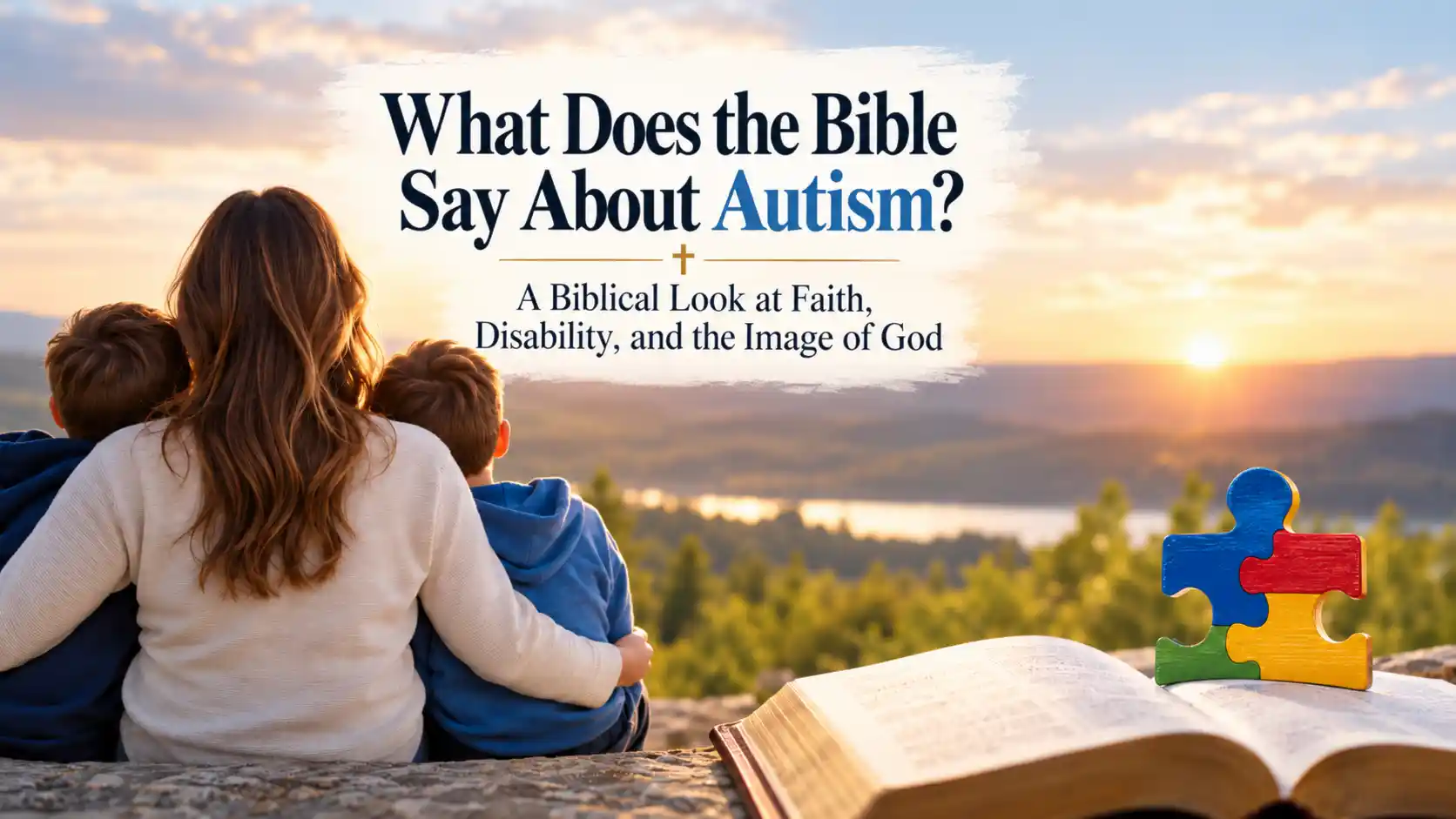
What Does the Bible Say About Autism? A Biblical Look at Faith, Disability, and the Image of God
The Bible never uses the word autism. Autism is a modern diagnosis, and it would be a mistake to take the behavior of someone in Scripture and try to diagnose that person thousands of years later.
But that does not mean the Bible has nothing meaningful to say about autism.
Scripture speaks clearly about the value of every human life, disability, suffering, compassion, belonging, faith, salvation, and the responsibility God’s people have toward those who may experience the world differently from them.
This subject is also deeply personal for me.
I am the mother of two autistic sons.
Autism isn’t merely something I have read about in articles or books. It is part of our family’s everyday life. At the same time, I know that no two autistic people are exactly alike, and my family’s experience cannot represent every autistic person or every family.
There is also something I want to make absolutely clear at the beginning of this discussion:
Autism is not caused by demons. It is not demonic oppression. It is not demonic possession.
Autism is a developmental condition involving differences in brain development, and scientific research has established a strong genetic contribution to autism. Genetic factors play a major role, although autism is genetically complex and there is no single “autism gene.”
Christians can believe everything Scripture teaches about Satan, demons, and spiritual warfare without turning a developmental condition into a spiritual one.
Those are separate issues.
So as we consider autism through a biblical lens, we need to begin with truth and compassion rather than fear, superstition, or assumptions.
Some of the questions Christian families may wrestle with are difficult:
- Does God understand someone who cannot communicate easily?
- Can a nonspeaking autistic person know God?
- Is autism caused by sin?
- Is autism demonic?
- Should Christians pray for autism to be healed?
- Can someone with a significant intellectual disability be saved?
- How should churches welcome autistic children and adults?
- Is an autistic child being disobedient, or could that child be overwhelmed?
- Does an autistic Christian have to behave like everyone else to be spiritually mature?
Scripture gives us strong truths upon which we can stand.
But where the Bible does not give us a specific answer, we should never claim that God has revealed something He has not.
Key Biblical Truths About Autism
- Every autistic person is created in the image of God. — Genesis 1:27
- Autism is not caused by demons, demonic oppression, or demonic possession.
- Disability is not proof that a person or the person’s parents committed a particular sin. — John 9:1–3
- God knows a person more completely than anyone else can. — Psalm 139:1–4
- Human worth does not depend upon speech, intelligence, independence, or productivity.
- The members of Christ’s body who may appear weaker are described as indispensable. — 1 Corinthians 12:22
- Christians should never make someone’s healing a test of that person’s faith.
- The church should make room for people whose needs, communication, or behavior may look different from what is typical.
- God is perfectly just and completely understands every person’s abilities, limitations, and level of understanding.
What Is Autism?
Autism spectrum disorder, or ASD, is a developmental disability caused by differences in the brain.
Autistic people may experience differences involving communication, social interaction, behavior, learning, interests, and sensory processing. The abilities and support needs of autistic people vary tremendously.
Some autistic people speak fluently, work, marry, raise families, and live independently.
Others may use few spoken words or none at all and communicate through gestures, pictures, sign language, typing, or communication devices.
Some autistic people require relatively little assistance in everyday life.
Others require substantial lifelong support.
Autism and intellectual disability are also not the same thing.
An autistic person may or may not have an intellectual disability.
There is no single autistic experience.
And there is certainly no separate category of human worth based upon someone’s communication ability, intelligence, independence, or disability.
For more information about autism itself, the CDC provides an overview of autism spectrum disorder.
Autism Has a Strong Genetic Basis
This is another area where misinformation can lead people in the wrong direction.
Autism has a strong genetic basis.
Scientists have associated many different genetic variations with autism. There is not one single gene responsible for autism, and the genetics involved can be extremely complex.
Some genetic variations associated with autism may be inherited, while others can arise spontaneously.
That means saying autism has a genetic basis does not mean that a parent simply “passed down an autism gene.”
Autism is much more complex than that.
Genetic factors contribute substantially to autism, although researchers continue studying the many biological pathways involved.
You can learn more from MedlinePlus Genetics’ overview of autism spectrum disorder.
Scientists continue to study how genetics and other biological and environmental factors interact in autism.
What is important for this discussion is that autism is a developmental condition.
It is not a demonic one.
Autism is not produced by demons.
It is not the result of demonic oppression.
It is not evidence of demonic possession.
Christians should not replace what we know about human development and genetics with frightening spiritual explanations that Scripture itself never gives us.
Does the Bible Mention Autism?
No.
There is no passage in Scripture that specifically describes autism as we understand it today.
Occasionally people try to identify biblical characters as autistic because they see certain personality traits or behaviors that remind them of autism.
People have suggested Moses, Paul, Ezekiel, and various other biblical figures.
We simply do not know.
Having difficulty speaking, preferring solitude, possessing an intense personality, behaving unusually, or struggling socially is not enough to diagnose autism—especially in someone who lived thousands of years ago.
We should resist turning biblical characters into modern diagnoses Scripture itself never gives them.
A better question is not:
“Who in the Bible was autistic?”
It is:
“What biblical truths apply to autistic people today?”
There is much more Scripture can tell us there.
Autistic People Are Made in the Image of God
The most important biblical truth about any human being appears near the beginning of Scripture:
“So God created man in his own image…”
— Genesis 1:27
Our value does not come from our intelligence.
It does not come from our ability to speak.
It does not come from how productive we are.
It does not come from whether we can live independently.
It does not come from social skills, academic achievements, careers, appearance, or our ability to fit comfortably into society.
The world often measures success by achievement, status, wealth, independence, and what a person is able to accomplish. But success in God’s eyes is very different from success in the world’s eyes.
Human beings possess dignity because they are created in the image of God.
That includes the autistic child who speaks early and excels academically.
It includes the autistic adult living independently.
And it includes the autistic person who does not speak, needs help with everyday activities, and may require lifelong care.
God does not measure human value according to the standards the world often uses.
Psalm 139 says:
“For you formed my inward parts; you knitted me together in my mother’s womb.”
— Psalm 139:13
No autistic person is invisible to God.
Even when another person’s thoughts are difficult for us to understand, God knows that person completely.
Is Autism Caused by Sin?
No particular sin committed by a parent or child should be blamed for autism.
Jesus confronted this kind of thinking when His disciples encountered a man who had been blind from birth.
They asked:
“Rabbi, who sinned, this man or his parents, that he was born blind?”
— John 9:2
Jesus replied:
“It was not that this man sinned, or his parents…”
— John 9:3
Jesus did not accept their assumption that this man’s disability must have been caused by a particular person’s sin.
I cover this passage in much greater detail in my John 9 Bible Study: Jesus Heals a Man Born Blind.
Scripture does teach that humanity lives in a fallen world. Romans 8 describes creation itself as experiencing corruption while awaiting restoration.
But that is completely different from pointing at a particular child and saying:
“This happened because you sinned.”
Or telling parents:
“God gave your child autism because you did something wrong.”
Scripture gives us no authority to say that.
Christian parents should not carry guilt that God has not placed upon them.
Autism Is Not Demonic
Christians need to be clear about this because associating autism with demons can cause deep hurt to autistic people and their families.
Autism is not demonic.
Autism is not caused by a demon.
Autism is not demonic oppression.
Autism is not demonic possession.
Autistic traits are not evidence that a demon is present.
A child’s lack of eye contact is not evidence of a demon.
Repetitive movements, often called “stimming,” are not evidence of a demon.
Being nonspeaking is not evidence of a demon.
Sensory sensitivities are not evidence of a demon.
Meltdowns are not evidence of a demon.
Difficulty with social interaction is not evidence of a demon.
Having intense interests is not evidence of a demon.
Autism is a developmental condition involving differences in the brain and has a substantial genetic component.
Christians certainly believe Satan and demons exist because Scripture teaches that they do.
But believing in spiritual warfare does not require Christians to attribute neurological or developmental differences to demons.
If you want to understand what Scripture actually teaches about spiritual battles, read my guide to winning spiritual warfare.
The Bible itself distinguishes demonic activity from physical illnesses and other conditions.
Matthew 4:24 describes people suffering from different illnesses and pains and separately mentions those who were demon-possessed, along with people experiencing seizures and paralysis.
Scripture did not simply place every unusual physical or behavioral condition into the category of demonic activity.
Neither should we.
An autistic person can face temptation and spiritual struggles just like anyone else.
But autism itself is not a spiritual attack.
It is not something Satan placed inside a child.
It is not evidence that an autistic person needs an exorcism.
It is not something that should be treated through deliverance ministry.
And parents should never be told that they somehow opened a spiritual door that allowed a demon to cause their child’s autism.
Those claims are not supported by Scripture, and they can deeply hurt autistic people and their families.
But What About Bible Stories Where Demons Caused Unusual Behavior?
This is where Christians need to be especially careful.
The Bible contains genuine accounts of demonic possession.
For example, Mark 9 describes a boy suffering terribly while under the influence of an evil spirit.
But Scripture tells us what was happening in that particular situation.
We have no biblical authority to take behaviors described in a specific account of demonic activity and then declare that a modern developmental condition has the same cause.
We also should not look at an autistic person’s behavior and decide that because something superficially resembles a biblical account, it must have the same cause.
Similarity in an outward behavior does not establish the same cause.
A person having difficulty speaking does not mean that person has a demon.
A person behaving in a way we find unusual does not mean that person has a demon.
A person becoming distressed or overwhelmed does not mean that person has a demon.
Autism and demonic possession are not interchangeable concepts.
They should never be treated as though they are.
Christians do need biblical discernment, but discernment does not mean assigning spiritual causes to things simply because we do not understand them. I discuss biblical discernment more fully in Are Christians Supposed to Judge? What the Bible Really Says About Judging Others.
Can an Autistic Person Know God?
Yes.
Nothing in Scripture teaches that autism prevents someone from knowing or loving God.
Many autistic Christians understand the gospel, read Scripture, pray, worship, serve, and follow Christ.
Autism may affect the way someone communicates or processes information, but different communication is not the same thing as an absence of thought, emotion, understanding, or faith.
This becomes particularly important when discussing people who speak very little or do not use spoken language.
A person’s inability to tell us everything happening inside his or her mind does not mean God does not know.
Psalm 139 says:
“O LORD, you have searched me and known me!”
— Psalm 139:1
And:
“Even before a word is on my tongue, behold, O LORD, you know it altogether.”
— Psalm 139:4
God’s ability to know someone is not limited by that person’s ability to speak.
What About Nonspeaking Autistic People?
Christians should never assume that the ability to speak equals the ability to understand.
Some autistic people communicate through speech.
Others communicate using gestures, signs, pictures, typing, communication devices, or other methods.
We should therefore be extremely cautious about deciding what another person does or does not understand simply because that person cannot explain it verbally.
There is also a larger spiritual truth:
God is not limited by our ability to observe another person’s mind.
We see behavior.
God sees what we cannot see.
First Samuel 16:7 reminds us:
“Man looks on the outward appearance, but the LORD looks on the heart.”
That verse is not specifically about autism, but its principle should make us humble about judging another person’s spiritual condition by outward appearances alone.
Can Someone With an Intellectual Disability Be Saved?
This question deserves particular care.
Autism and intellectual disability are not interchangeable.
Many autistic people do not have an intellectual disability.
But some people have both autism and significant intellectual disability. This can cause families to wonder how salvation applies to someone who may not be capable of explaining the gospel in the way Christians ordinarily expect.
Scripture clearly teaches:
“For by grace you have been saved through faith. And this is not your own doing; it is the gift of God.”
— Ephesians 2:8
Salvation is found in Jesus Christ. If you want a fuller explanation of what Scripture teaches about salvation, start with What Is the Gospel?
At the same time, Scripture does not give us a passage explicitly explaining every circumstance involving a person whose cognitive abilities prevent a typical understanding or expression of faith.
Christians have reached different theological conclusions about this question.
Some Christians believe Scripture indicates that God takes a person’s capacity for understanding into account. Luke 12:47–48, for instance, describes differing levels of accountability related to what someone knew.
Christians sometimes use the phrase age of accountability, although Scripture never gives us a specific age at which accountability begins.
Profound intellectual disability also cannot be neatly answered by assigning an age.
Where Scripture does not explain every detail, we should be careful not to pretend that it does.
But we do know the character of God.
Abraham asked:
“Shall not the Judge of all the earth do what is just?”
— Genesis 18:25
God knows perfectly what each person understands.
He knows every person’s abilities.
He knows every limitation.
He knows the heart.
And He will always judge rightly.
Families can entrust the people they love to Him.
Does God Love an Autistic Person Differently?
No.
Romans 8 gives Christians an extraordinary assurance:
“For I am sure that neither death nor life, nor angels nor rulers, nor things present nor things to come, nor powers… nor anything else in all creation, will be able to separate us from the love of God in Christ Jesus our Lord.”
— Romans 8:38–39
Autism is not a barrier between a believer and Christ.
Communication difficulties are not a barrier.
Sensory needs are not a barrier.
Intellectual limitations are not stronger than God’s grace.
And being different from the people around you does not make you less precious to Him.
Should Christians Pray for Autism to Be Healed?
Christians can bring every concern to God in prayer.
Parents can pray about communication, anxiety, sleep, safety, health, relationships, learning, sensory difficulties, independence, and anything else affecting their child.
There is nothing wrong with asking God for healing.
But there is an important difference between asking God for something and promising that God will do something He has not promised to do.
A Christian should never tell an autistic person or parent:
“If you had enough faith, the autism would disappear.”
Scripture does not teach that every faithful Christian receives physical healing during this lifetime.
Paul prayed repeatedly for his “thorn in the flesh” to be removed, but God answered:
“My grace is sufficient for you, for my power is made perfect in weakness.”
— 2 Corinthians 12:9
Christians can pray boldly while allowing God to determine the answer.
And a person’s autism should never be blamed on inadequate prayer or insufficient faith.
Autism Does Not Make Someone Less Important to the Church
Paul describes believers as members of one body in 1 Corinthians 12.
He writes:
“The eye cannot say to the hand, ‘I have no need of you.'”
— 1 Corinthians 12:21
Then:
“On the contrary, the parts of the body that seem to be weaker are indispensable.”
— 1 Corinthians 12:22
Churches sometimes unintentionally create environments where certain kinds of people fit more easily than others.
Someone who can sit quietly through a long service fits easily.
Someone who enjoys loud worship music fits easily.
Someone comfortable making small talk fits easily.
Someone who quickly understands unwritten social expectations fits easily.
But what happens when someone doesn’t?
The answer should never be that the person matters less.
The church belongs to Christ, not merely to the people who find its environment easiest to navigate.
How Churches Can Better Welcome Autistic People
Welcoming autistic people means more than putting the words “Everyone is welcome” on a church website.
Churches should consider whether their actual environment communicates that same message.
For some autistic people, sounds, lights, crowds, smells, touch, temperature, unexpected changes, or multiple sources of stimulation can become overwhelming.
Churches can show practical love by:
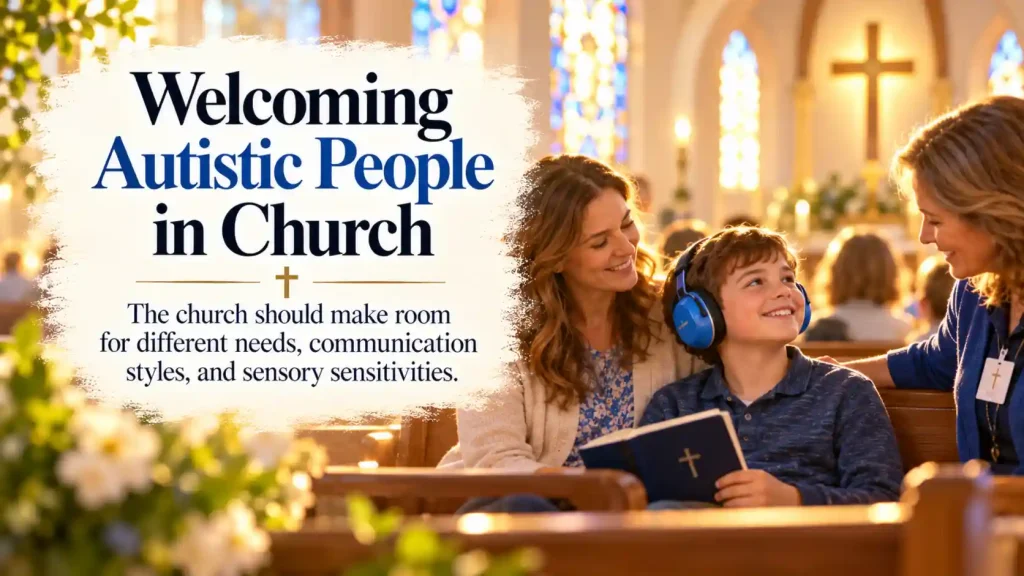
- Providing a quieter place where someone can go when the sanctuary becomes overwhelming.
- Understanding that headphones or ear protection may make participation possible.
- Not requiring eye contact as proof that someone is listening.
- Allowing movement and appropriate sensory tools.
- Giving clear instructions instead of relying entirely on unspoken expectations.
- Letting families know ahead of time when routines will change.
- Teaching children’s ministry workers about autism.
- Avoiding the assumption that movements or vocalizations are intentional disruption.
- Finding meaningful ways for autistic adults to serve according to their gifts.
- Speaking directly to autistic people instead of speaking only to the caregiver beside them.
- Asking autistic people or their families what would help rather than assuming what they need.
These accommodations do not lower the importance of worship.
They remove unnecessary barriers that can make participation more difficult.
Autistic Children in Sunday School and Children’s Ministry
Think about what a typical children’s ministry environment may involve:
A crowded room.
Several children talking at once.
Music.
Bright lights.
Group games.
Transitions between activities.
Craft materials.
Unexpected touching.
Rapid instructions.
And an expectation that everyone will sit quietly at particular times.
For many children, that environment works perfectly well.
For an autistic child, several sources of sensory input may become overwhelming at the same time.
Churches don’t need to eliminate structure or expectations.
But teachers may need to reconsider what participation looks like.
An autistic child might listen better while standing or moving.
A child might need headphones during music.
Another may benefit from visual instructions explaining what happens next.
A child who cannot verbally answer a Bible question may still understand the lesson.
A child who needs to leave the room briefly may not be refusing to participate.
Instead of asking:
“How do we get this child to act like all the other children?”
Ask:
“How can we help this child learn about Jesus and participate successfully?”
That change in perspective matters.
Is It Disobedience—or Could It Be Sensory Overload?
Autistic children still need loving guidance, teaching, correction, and appropriate boundaries.
But every difficult behavior should not automatically be interpreted as intentional disobedience.
An autistic child who covers his ears and cries during loud worship may be overwhelmed by the sound.
A child who suddenly tries to leave a crowded room may need to escape overwhelming sensory input.
A child who does not immediately respond to an instruction may still be processing what was said.
A child who becomes extremely distressed when a familiar routine changes may be struggling to cope with an unexpected transition.
Sometimes what appears from the outside to be “bad behavior” may actually be someone’s way of communicating:
“This is too much.”
That doesn’t mean removing every expectation.
It means understanding what is actually happening before deciding how to respond.
James 1:19 tells us:
“Let every person be quick to hear, slow to speak, slow to anger.”
Instead of immediately asking:
“How do I stop this behavior?”
Sometimes we should first ask:
“What is this person trying to communicate?”
Compassion and discipline do not have to be opposites.
What Christian Parents of Autistic Children Need to Hear
Christian parents sometimes carry burdens God never asked them to carry.
You may wonder whether you did something wrong.
You may have prayed for years for something to change.
You may watch other children reach milestones your child hasn’t reached.
You may worry about adulthood.
You may wonder whether your child will ever live independently.
You may wonder who will care for your child when you are no longer here.
You may wonder how much your child understands about God.
And perhaps someone has said something hurtful to you in God’s name.
Maybe someone implied that your child’s autism resulted from something you did.
Maybe someone told you that you didn’t pray enough.
Maybe someone suggested your child needed “deliverance.”
Hear this clearly:
Your child’s autism is not evidence that you opened a spiritual door.
Your child’s autism is not evidence that your family is under demonic oppression.
Your autistic child does not have a demon because he or she is autistic.
You do not need to carry that fear.
Scripture does not place that burden upon you.
You may rejoice in your child while acknowledging genuine difficulties.
You may thank God for your child while praying for struggles to improve.
You may celebrate progress and still admit that some days are exhausting.
You may deeply love your child and still have moments when parenting feels very hard.
Those things do not contradict one another.
And your child’s life does not have to look like someone else’s life to have value and purpose.
A Word Directly to Autistic Christians
If you are autistic and reading this, I hope you hear this clearly:
There is nothing demonic about you because you are autistic.
You are not spiritually contaminated.
You are not possessed because your brain works differently.
You do not need someone to “cast autism out” of you.
You do not have to become less autistic before you can belong to Christ.
Your worth does not depend upon how comfortable you are in social situations.
It does not depend upon whether you make eye contact.
It does not depend upon whether you enjoy crowded church gatherings.
It does not depend upon how easily you understand other people’s emotions.
It does not depend upon whether your worship looks like someone else’s worship.
Perhaps you prefer studying Scripture quietly instead of participating in a large group.
Perhaps church fellowship exhausts you.
Perhaps certain worship environments are physically overwhelming.
Perhaps people have mistakenly interpreted your communication style as rude, distant, uninterested, or spiritually immature.
People may misunderstand you.
God does not.
Psalm 139 begins:
“O LORD, you have searched me and known me!”
You are known by God.
And if you belong to Christ, you belong to His body.
If you are unsure what it means to truly belong to Christ, you may also want to read How Can I Know If I Am Saved? Biblical Signs of True Salvation.
You are not merely someone the church should tolerate or accommodate.
You are someone who can be part of the church.
Your gifts matter.
Your faith matters.
Your presence matters.
Autistic Christians Should Not Be Expected to Look Exactly Like Everyone Else
Sometimes Christians confuse cultural behavior with spiritual maturity.
A person who does not make much eye contact may still be listening carefully.
Someone who does not show emotion in an expected way may still care deeply.
Someone who finds fellowship exhausting may still love other believers.
Someone who needs predictable routines may still trust God.
Someone whose prayers sound different from yours may still genuinely be praying.
Someone who cannot tolerate loud worship music can still worship God.
We should be careful not to create spiritual tests Scripture never created.
Jesus said:
“By this all people will know that you are my disciples, if you have love for one another.”
— John 13:35
Love sometimes means learning another person’s needs rather than demanding that everyone behave exactly like us.
Were Any People in the Bible Autistic?
We don’t know.
And we should not claim that we do.
People sometimes point to a biblical character’s personality, communication style, intense interests, unusual behavior, or difficulty relating to others and suggest that person must have been autistic.
That goes beyond Scripture.
We can learn from the people God chose to include in His Word without attempting to give them modern medical diagnoses.
What the Bible Does Not Say About Autism
Because autism is not specifically discussed in Scripture, Christians need to be especially careful about claims made in God’s name.
- The Bible does not teach that autism is caused by demons.
- It does not teach that autism is demonic oppression.
- It does not teach that autism means someone is demon-possessed.
- It does not teach that an autistic child’s parents opened a spiritual door.
- It does not teach that autism resulted from a parent’s particular sin.
- It does not teach that enough prayer will necessarily make an autistic person non-autistic.
- It does not teach that lack of healing demonstrates a lack of faith.
- It does not teach that a nonspeaking person cannot know God.
- It does not teach that intelligence determines someone’s value.
- It does not teach that independence determines someone’s worth.
- It does not allow us to diagnose biblical characters with autism based upon a few personality traits.
Where Scripture speaks, Christians should speak confidently.
Where Scripture does not speak, we should be humble.
Autism Is Not a Measure of Someone’s Spiritual Worth
Perhaps this is the most important truth Christians should understand.
God does not divide human beings into people whose lives are valuable and those whose lives are less valuable.
Jesus repeatedly noticed people society overlooked.
He stopped for people others wanted Him to ignore.
He touched people others avoided.
He welcomed children when His disciples attempted to send them away.
And He taught His followers to look beyond the world’s usual measures of importance.
James writes:
“If you really fulfill the royal law according to the Scripture, ‘You shall love your neighbor as yourself,’ you are doing well.”
— James 2:8
Autistic people do not merely exist as objects of the church’s ministry.
They can be part of the church.
They can worship.
They can serve.
They can encourage others.
They can use the gifts God has given them.
They can be brothers and sisters in Christ.
And autistic people who require extensive lifelong care remain people of immeasurable worth.
Frequently Asked Questions About Autism and the Bible
Is autism mentioned in the Bible?
No. Autism is a modern diagnostic term and is not specifically mentioned in Scripture. We should not attempt to diagnose biblical characters based upon limited descriptions of their behavior.
Is autism genetic?
Autism has a strong genetic basis.
Many different genetic variants have been associated with autism, and genetic factors contribute substantially to autism.
That does not mean every autistic person has one identifiable “autism gene,” nor does it mean every genetic factor was inherited directly from a parent.
Is autism caused by sin?
No particular sin committed by an autistic person or the person’s parents should be blamed for autism.
John 9:1–3 directly challenges the assumption that an individual’s disability necessarily resulted from that person’s sin or the parents’ sin.
Is autism caused by demons?
No.
Autism is not caused by demons.
It is not demonic oppression.
It is not demonic possession.
Autism is a developmental condition involving differences in the brain and has a strong genetic component.
Is an autistic person’s behavior evidence of demonic possession?
No.
Autistic behaviors such as reduced eye contact, repetitive movements, sensory distress, communication differences, stimming, or meltdowns are not evidence of demonic possession.
Does an autistic person need deliverance ministry because of autism?
No.
Autism itself is not spiritual bondage from which someone needs to be delivered.
Christians should not attempt to “cast autism out” of an autistic person or teach that autism is caused by an evil spirit.
Can autistic people be Christians?
Yes.
Autism does not prevent someone from trusting Jesus Christ, following Him, worshiping, praying, or participating in the body of Christ.
Can a nonspeaking autistic person know God?
We should not assume that lack of spoken communication tells us everything someone understands.
Scripture teaches that God knows people far more completely than human beings do.
Should Christians pray for autistic people?
Yes.
Christians can pray for autistic people just as we pray for anyone we love—for their faith, health, needs, struggles, protection, communication, relationships, growth, and well-being.
But we should never tell someone that failure to become non-autistic proves a lack of faith.
Does an autistic person have less value because they need lifelong care?
Absolutely not.
Human worth comes from being created in God’s image, not from independence, intelligence, employment, speech, academic achievement, or productivity.
Should autistic children be disciplined?
Autistic children still need loving guidance and appropriate boundaries.
However, parents and teachers should try to understand whether a behavior represents intentional disobedience, difficulty understanding an instruction, communication frustration, anxiety, or sensory overload before deciding how to respond.
Does an autistic child need to sit still in church to worship God?
Not necessarily.
Movement, sensory tools, headphones, or short breaks may help some autistic children participate.
Outward stillness should not automatically be treated as proof that a child is listening, learning, or worshiping.
A Final Word
The Bible does not give us a medical explanation of autism.
Modern science does tell us that autism is a developmental condition involving differences in brain development and that genetics play a substantial role.
And we can say something else without hesitation:
Autism is not caused by demons.
It is not demonic oppression.
It is not demonic possession.
Christians should not frighten autistic people or their families by turning autism into something Scripture never says it is.
What Scripture does tell us is something far more important about the person who is autistic:
That person bears the image of God.
Autism does not make someone less human.
It does not make someone less deserving of dignity.
It does not mean someone’s parents sinned.
It does not place someone beyond God’s knowledge.
It does not determine someone’s spiritual worth.
And it does not give the church permission to overlook them.
As the mother of two autistic sons, I know these questions are more than theological exercises.
They affect real children.
Real adults.
Real parents.
Real families.
And real churches.
There are things about autism that I understand because I have lived alongside it, and there are many experiences other autistic people and families have that are different from ours.
But one truth does not change from person to person:
Every human being is created in the image of God.
For Christians, the question should not simply be:
“What does the Bible say about autism?”
We should also ask:
“How does Jesus call me to love the autistic person God has placed in front of me?”
That answer is much clearer.
“You shall love your neighbor as yourself.”
— Mark 12:31
A Prayer for Autistic People and Their Families
Heavenly Father,
Thank You for creating every person in Your image and for knowing each of us completely.
I pray for autistic children and adults and for the families who love and care for them. Help them know that their worth is not determined by how they communicate, what they accomplish, how independent they are, or whether they fit the expectations of the world.
Protect autistic people and their families from teachings that bring fear, guilt, or shame. Help Your church understand clearly that autism is not demonic, is not demonic oppression, and is not evidence of possession.
Give parents wisdom, patience, strength, and peace. Give churches compassion and understanding so that autistic children and adults are truly welcomed, valued, and included.
For autistic Christians, remind them that they are fully known by You. Help them know that they do not have to become like everyone else in order to be loved by You or to have a place in the body of Christ.
And for those who do not yet know Jesus, draw them to the truth of the gospel and the salvation found in Christ alone.
Help all of us to see people as You see them and to love our neighbors with patience, humility, compassion, and truth.
In Jesus’ name,
Amen.
Read Next
If this article was helpful, you may also want to read:
Success in God’s Eyes vs. the World’s: What Really Matters?
The world often measures people by accomplishments, status, money, and independence. Scripture gives us a very different picture of what truly matters to God.
John 9 Bible Study: Jesus Heals a Man Born Blind
Take a closer look at the passage where Jesus rejected the assumption that a man’s disability was caused by his sin or his parents’ sin.
Winning Spiritual Warfare
Learn what Scripture actually teaches about spiritual warfare and how Christians should respond to genuine spiritual battles.
What Is the Gospel?
If you want to understand what the Bible teaches about sin, Jesus Christ, salvation, grace, and faith, begin here.