John 11 Bible Study: Jesus Raises Lazarus and Declares “I Am the Resurrection and the Life”
Welcome back to our Gospel of John Bible Study here on Living for the Christ.
In John 10, Jesus revealed Himself as the Good Shepherd who knows His sheep, gives them eternal life, and promises that no one can snatch them from His hand.
Now, in John 11, Jesus demonstrates just how powerful that Shepherd truly is.
A close friend becomes sick.
Two grieving sisters send word to Jesus.
Jesus does not immediately come.
Lazarus dies.
And by the time Jesus arrives in Bethany, Lazarus has already been in the tomb for four days.
From a human perspective, the situation appears hopeless.
But Jesus declares:
“I am the resurrection and the life.” – John 11:25
Then He walks to the tomb and does what no ordinary man could do.
He calls the dead back to life.
John 11 is about far more than the resurrection of Lazarus. It teaches us about the sovereignty of God, the timing of Jesus, the reality of death, the compassion of Christ, saving faith, and the resurrection awaiting everyone who belongs to Him.
If you are studying through John with us, you can also browse the complete Gospel of John Bible Study series here.
Key Themes in John 11
- Jesus has authority over death.
- God’s timing is not always our timing.
- A delay from God does not mean a lack of love.
- Jesus is the Resurrection and the Life.
- Believers have hope beyond physical death.
- Jesus is deeply compassionate toward those who grieve.
- Miracles reveal God’s glory but do not automatically produce saving faith.
- Jesus deliberately moves toward the cross.
- God can accomplish His purposes even through the words and actions of people who oppose Him.
- The raising of Lazarus points forward to the resurrection of Jesus Himself.
Why John 11 Matters Today
Almost everyone eventually faces circumstances that make us ask:
Lord, why didn’t You do something sooner?
Mary and Martha knew Jesus loved Lazarus.
They knew Jesus could heal.
They sent for Him.
Yet Jesus did not arrive before Lazarus died.
That can feel painfully familiar.
We pray.
We wait.
We believe God is able.
And yet the answer does not come when or how we expected.
John 11 reminds us that God’s delay is not proof of God’s absence.
Jesus knew exactly what was happening.
He loved Martha.
He loved Mary.
He loved Lazarus.
And yet He waited.
What looked like a devastating delay would become the setting for one of the greatest demonstrations of His glory before the cross.
We cannot assume that because God has not acted according to our timetable, He has stopped caring.
We often see only the present moment.
God sees the entire story.
The Connection Between John 10 and John 11
John 10 ends with Jesus across the Jordan, away from the religious leaders who had attempted to seize Him.
Many people there believed in Him.
Then John 11 begins with urgent news from Bethany:
Lazarus is sick.
Bethany was near Jerusalem, placing Jesus once again close to the religious leaders who wanted Him dead.
Returning would be dangerous.
Yet Jesus goes.
The Good Shepherd who said He would lay down His life for His sheep is now moving steadily toward the events that will lead to the cross.
John 11 therefore serves as an important turning point in the Gospel.
Jesus raises Lazarus.
Many believe.
The religious leaders become increasingly determined to kill Jesus.
The miracle that demonstrates Jesus’ power over death also accelerates the human events leading toward His own death.
Historical Background – Bethany, Lazarus, Mary, and Martha
Lazarus lived in Bethany with his sisters, Mary and Martha.
Bethany was a village close to Jerusalem. John tells us it was approximately fifteen stadia away, roughly two miles.
Mary and Martha appear elsewhere in the New Testament and clearly had a close relationship with Jesus.
John identifies Mary as the woman who would anoint Jesus with perfume and wipe His feet with her hair, an event John describes more fully in Chapter 12.
When Lazarus becomes seriously ill, the sisters know exactly whom they want to contact.
Jesus.
Their message is simple:
“Lord, he whom You love is ill.” – John 11:3
Notice what they do not do.
They do not give Jesus instructions.
They simply tell Him about the need.
They trust that Jesus knows what should be done.
John 11:1-6 – Lazarus Becomes Sick
When Jesus hears that Lazarus is ill, He says:
“This illness does not lead to death. It is for the glory of God.”
Lazarus does physically die.
So what does Jesus mean?
He is speaking about the ultimate outcome.
Death will not have the final word in this situation.
The sickness will become an occasion through which the glory of God is revealed and the Son of God is glorified.
Then John tells us something very important:
“Now Jesus loved Martha and her sister and Lazarus.” – John 11:5
Immediately after telling us that Jesus loved them, John says:
“So, when He heard that Lazarus was ill, He stayed two days longer in the place where He was.”
That may sound strange.
Jesus loved them, so He waited.
We might expect the passage to say:
Jesus loved them, so He immediately rushed to Bethany.
Instead, Jesus remains where He is.
Why Did Jesus Wait?
Jesus was not indifferent.
He was not confused.
He had not forgotten Lazarus.
And He was not powerless.
Jesus knew what He intended to do.
His delay would accomplish purposes the disciples, Mary, and Martha could not yet see.
Lazarus would not merely recover from sickness.
Jesus would publicly demonstrate His authority over death itself.
📌 Truths to Remember
- God’s love is not measured by how quickly He answers.
- God’s delays are not necessarily God’s denials.
- Jesus sees circumstances we cannot see.
- God may accomplish something greater than what we originally asked for.
- Faith sometimes requires trusting Christ before we understand what He is doing.
This does not mean that every difficult situation will end with the earthly outcome we want.
John 11 does not promise that every sick Christian will recover or every tragedy will be reversed during this life.
It points us toward something even greater:
For everyone who belongs to Christ, death itself will ultimately be defeated.
When God Doesn’t Answer the Way We Expected

Mary and Martha had a reasonable request.
They loved their brother.
They knew Jesus could heal.
Yet Lazarus died.
Sometimes Christians assume that if we have enough faith, pray correctly, or truly trust God, He must give us the outcome we request.
Scripture never makes that promise.
Biblical faith does not mean believing God must obey our plans.
Faith means trusting God even when His plans differ from ours.
God knows what we do not know.
He sees the beginning and the end.
And although we may not understand His purposes in every circumstance, we can trust His character.
That does not make suffering painless.
Mary and Martha still cried.
Jesus Himself would soon weep with them.
Christian faith does not require pretending pain does not hurt.
It means grieving with hope because Christ has defeated the ultimate power of death.
John 11:7-16 – Jesus Returns Toward Judea
After waiting two days, Jesus tells His disciples:
“Let us go to Judea again.”
The disciples immediately remember what happened there.
People had recently tried to stone Jesus.
Returning seems dangerous.
Jesus responds by speaking about walking in the light rather than stumbling in darkness.
He knows His appointed time.
His enemies cannot shorten or extend God’s sovereign plan by even one moment.
Jesus then tells the disciples:
“Our friend Lazarus has fallen asleep, but I go to awaken him.”
The disciples misunderstand.
They assume Jesus means natural sleep.
Jesus then tells them plainly:
“Lazarus has died.”
Throughout Scripture, sleep is sometimes used as a picture of physical death, particularly because death is temporary for those who will be raised.
But Jesus is not teaching that Lazarus’ soul simply ceased to exist.
He is describing death from the perspective of what He is about to do.
For Jesus, awakening Lazarus from death will be no more impossible than waking someone from sleep.
Thomas Speaks
Thomas then says:
“Let us also go, that we may die with Him.”
Thomas is often remembered primarily for his later doubts after the resurrection.
But here we see another side of him.
He recognizes the danger and appears willing to follow Jesus anyway.
Thomas does not fully understand what is about to happen, but he follows.
Sometimes discipleship means following Christ even when the path ahead appears frightening.
John 11:17-24 – Martha Meets Jesus
When Jesus arrives, Lazarus has already been in the tomb for four days.
Many people have gathered to comfort Mary and Martha.
When Martha hears that Jesus is approaching, she goes out to meet Him.
Her first words reveal both grief and faith:
“Lord, if You had been here, my brother would not have died.” – John 11:21
Mary will later say almost exactly the same thing.
These sisters believed Jesus could have prevented Lazarus’ death.
Their statement carries sorrow.
Perhaps confusion.
Possibly even disappointment.
Yet Martha does not turn away from Jesus.
She continues:
“But even now I know that whatever You ask from God, God will give You.”
Jesus tells her:
“Your brother will rise again.”
Martha responds that she knows Lazarus will rise in the resurrection on the last day.
She believes in a future resurrection.
But Jesus is about to show her that resurrection is not merely an event.
Resurrection is connected directly to who He is.
John 11:25-27 – “I Am the Resurrection and the Life”

Jesus tells Martha:
“I am the resurrection and the life.” – John 11:25
Notice what He does not say.
He does not merely say:
“I can perform a resurrection.”
He says:
I AM the resurrection.
Life itself is found in Christ.
This is another of the great “I AM” statements in John’s Gospel.
Jesus continues:
“Whoever believes in Me, though he die, yet shall he live.”
Then:
“Everyone who lives and believes in Me shall never die.”
Jesus is not saying believers will never experience physical death.
Lazarus was already physically dead.
He is speaking about eternal life.
Physical death cannot destroy the life Christ gives.
For the believer, death is not the end.
Jesus has authority beyond the grave.
This connects beautifully with what Jesus had already promised in John 10:
“I give them eternal life, and they will never perish.”
You can explore this subject more deeply in What Is Eternal Life in the Bible?.
Jesus Does Not Merely Give Life – He Is Life
This is one of the most important truths in John 11.
Christianity is not ultimately about receiving benefits from Jesus while remaining separate from Him.
Eternal life is found in Christ.
Jesus said:
“I am the resurrection and the life.”
John began his Gospel with the same truth:
“In Him was life.” – John 1:4
Jesus is not merely a teacher pointing toward eternal life.
He is the One through whom eternal life comes.
To understand more about the identity and deity of Christ, read Who Is Jesus? Understanding His True Identity as God and Savior.
“Do You Believe This?”
After making one of the greatest declarations in Scripture, Jesus asks Martha a very personal question:
“Do you believe this?”
Christianity involves real historical truths.
Jesus lived.
Jesus died.
Jesus rose again.
But the Gospel also demands a personal response.
Martha answers:
“Yes, Lord; I believe that You are the Christ, the Son of God.”
Notice that Martha confesses faith before Lazarus walks out of the tomb.
She still does not know exactly what Jesus is about to do.
Yet she believes who Jesus is.
That is an important picture of faith.
Faith does not require knowing exactly what Jesus will do next.
Faith trusts who Jesus is.
Ask Yourself
Do I trust Jesus only when I understand what He is doing?
Or do I trust Him because I know who He is?
John 11:28-32 – Mary Comes to Jesus
Martha returns and quietly tells Mary:
“The Teacher is here and is calling for you.”
Mary immediately gets up and goes to Him.
The people mourning with her follow, assuming she is going to the tomb.
When Mary reaches Jesus, she falls at His feet.
Then she says:
“Lord, if You had been here, my brother would not have died.”
It is the same statement Martha made.
But Mary’s response is filled with visible grief.
She is weeping.
Those around her are weeping.
Jesus is standing in the middle of human sorrow.
And what happens next gives us one of the shortest yet most profound verses in Scripture.
John 11:33-35 – Jesus Wept
“Jesus wept.” – John 11:35
Jesus knew Lazarus was about to walk out of the tomb.
Yet Jesus still wept.
Why?
Because knowing the final outcome does not make suffering meaningless.
Jesus sees the devastation sin and death have brought into His creation.
He sees people He loves grieving.
And He responds with genuine compassion.
What the Tears of Jesus Teach Us
Jesus is not cold toward human suffering.
He is not detached from grief.
He is not standing far away telling Martha and Mary that they should simply stop crying because everything will eventually be fine.
He enters their sorrow.
He weeps.
This reveals something beautiful about Christ.
The One who has power to raise the dead is also the One who stands beside grieving people and cries.
Power and compassion meet perfectly in Jesus.
Is It Wrong for Christians to Grieve?
No.
John 11 gives us a clear answer.
Jesus Himself wept.
Christian grief is not the same as hopelessness.
Paul later tells believers not to grieve as others do who have no hope.
He does not say:
Do not grieve.
He says we grieve differently because of our hope in Christ.
Christians can cry.
Christians can miss someone deeply.
Christians can feel the weight of death.
But we do not have to believe the grave gets the final word.
The resurrection changes how believers face death.
🎬 Watch: I Am the Resurrection and the Life, Part 1 (John 11:17–36) — This message takes a deeper look at Jesus’ words to Martha, His compassion toward Mary, and what it means that He is the Resurrection and the Life.
John 11:36-37 – Different Responses to Jesus’ Tears
Some of those watching Jesus say:
“See how He loved him!”
Others ask:
Could not the One who opened the eyes of the blind man have prevented Lazarus from dying?
That question connects John 11 directly with John 9, where Jesus healed the man born blind.
They knew Jesus had extraordinary power.
And yet they did not understand why He had allowed Lazarus to die.
We often ask the same kind of question.
If God can do something, why doesn’t He?
John 11 does not provide a simple answer to every situation of suffering.
But it does show us that God’s apparent silence does not equal helplessness.
And His delay does not equal indifference.
John 11:38-40 – Jesus Approaches the Tomb
Jesus comes to Lazarus’ tomb.
It is described as a cave with a stone lying against it.
Jesus gives an unexpected command:
“Take away the stone.”
Martha immediately objects.
Lazarus has been dead for four days.
She understands what opening the tomb will mean.
Jesus answers:
“Did I not tell you that if you believed you would see the glory of God?”
This verse should not be turned into a promise that believing hard enough guarantees whatever miracle we request.
Jesus is speaking specifically to Martha in the context of what He had already told her about Lazarus.
Faith is not a force we use to make miracles happen.
Faith trusts the One who has the power to do what He has promised.

John 11:41-42 – Jesus Prays to the Father
The stone is removed.
Jesus lifts His eyes and says:
“Father, I thank You that You have heard Me.”
Jesus explains that He speaks aloud because of the people standing nearby:
“that they may believe that You sent Me.”
Jesus’ prayer demonstrates His relationship with the Father and helps those watching understand that His mission is from God.
Throughout John’s Gospel, Jesus repeatedly speaks of being sent by the Father.
His miracles are not random displays of supernatural power.
They are signs pointing toward His identity.
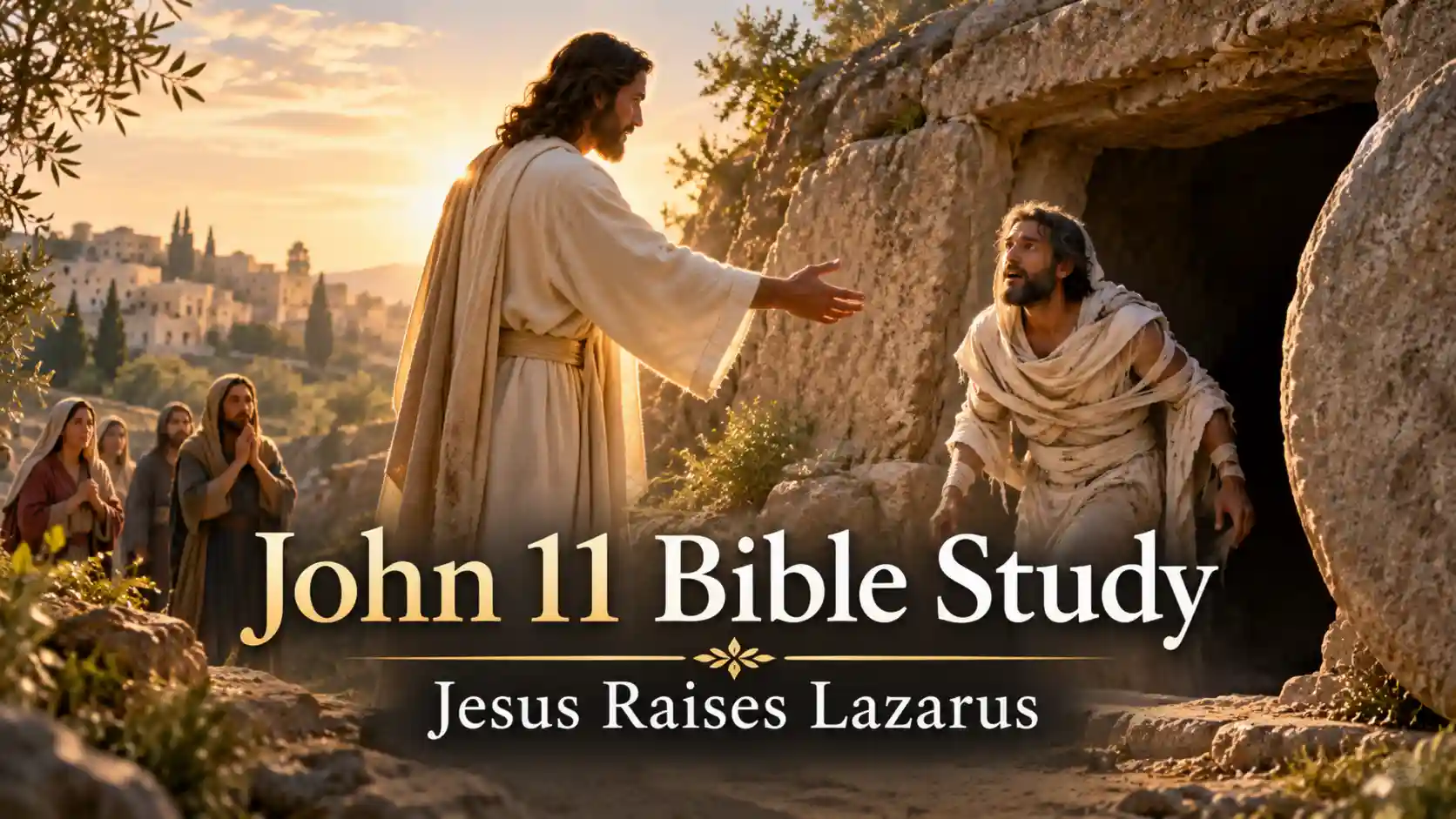
John 11:43-44 – “Lazarus, Come Out!”
Jesus cries with a loud voice:
“Lazarus, come out.”
And Lazarus comes out.
The man who had been dead for four days walks from the tomb.
He is still wrapped in burial cloths.
Jesus says:
“Unbind him, and let him go.”
Imagine standing there.
The mourners had come to comfort two grieving sisters.
They had watched Jesus cry.
They had seen the stone removed.
Now the man whose funeral they had been mourning is standing in front of them alive.
Jesus has demonstrated unmistakable authority over death.
📌 What This Miracle Reveals
- Jesus possesses authority over death.
- No situation is beyond His power.
- Jesus’ word brings life.
- His miracles reveal His identity.
- Physical death does not place someone beyond Christ’s authority.
- Jesus is exactly who He told Martha He is: the Resurrection and the Life.
Lazarus’ Resurrection and Jesus’ Resurrection Are Not Exactly the Same
There is an important distinction between what happened to Lazarus and what would soon happen to Jesus.
Lazarus was restored to ordinary physical life.
He would eventually die again.
Jesus’ resurrection is different.
Jesus rose never to die again.
He conquered death permanently.
The New Testament describes Jesus as the firstfruits of those who will be raised.
The raising of Lazarus therefore points beyond itself.
It gives us a glimpse of something even greater.
A day is coming when Christ will raise His people.
Lazarus walked from one tomb.
Jesus promises a resurrection that will ultimately bring His people into everlasting life with Him.
The Voice That Called Lazarus Will One Day Call the Dead
Earlier in John’s Gospel, Jesus said:
“An hour is coming when all who are in the tombs will hear His voice and come out.” – John 5:28-29
John 11 gives us a small picture of that future reality.
Jesus stands outside a tomb.
He speaks.
The dead man hears the voice of the Son of God.
And he comes out.
Death cannot refuse the command of Christ.
That is why the Christian hope is so much greater than simply hoping our lives become easier.
Our hope reaches beyond this life.
Our Savior has authority over the grave itself.
John 11:45-46 – The Miracle Produces Two Responses
After Lazarus is raised:
“Many of the Jews therefore… believed in Him.”
But others go to the Pharisees and report what Jesus had done.
Once again, the same evidence produces different responses.
Some believe.
Others move toward greater opposition.
This is an important theme throughout John’s Gospel.
Miracles can demonstrate the identity of Christ.
But seeing a miracle does not automatically produce saving faith.
A heart determined to resist Jesus can witness extraordinary evidence and continue resisting Him.
John 11:47-48 – The Religious Leaders Respond
The chief priests and Pharisees gather the council.
Their reaction is remarkable.
They do not seem primarily concerned with determining whether the miracle actually happened.
Instead they ask:
“What are we to do? For this man performs many signs.”
Their concern becomes political.
They fear that if more people believe in Jesus, Rome may intervene and threaten their position and nation.
Their response shows how strongly people can cling to power, position, and control.
A man has been raised from the dead.
Yet rather than falling down before Jesus, they discuss how to stop Him.
Evidence does not guarantee repentance.
A person can be confronted with truth and still refuse to surrender.
John 11:49-53 – Caiaphas Speaks More Than He Understands
Caiaphas, the high priest that year, tells the council:
“It is better for you that one man should die for the people, not that the whole nation should perish.”
Caiaphas is speaking politically.
His reasoning is essentially that sacrificing Jesus would protect their nation and their position.
But John explains that Caiaphas spoke more truth than he understood.
Jesus really would die for others.
Not merely to preserve a political system.
He would die as the sacrificial Savior.
Jesus would give His life for sinners and gather God’s scattered people together.
This is another example of God’s sovereignty.
Caiaphas has his own intentions.
Yet God is accomplishing a far greater purpose.
Human beings cannot overthrow God’s plan.
Even the actions of those opposing Jesus ultimately move history toward the cross where Christ will accomplish redemption.
To understand why Jesus’ death is the heart of the Christian message, read What Is the Gospel?.
John 11:53 – The Plot to Kill Jesus Intensifies
John writes:
“So from that day on they made plans to put Him to death.”
This is one of the great ironies of John 11.
Jesus gives life to a dead man.
The religious leaders respond by planning to kill the Giver of Life.
But even this will not defeat Him.
Jesus has already told us:
“I lay down My life… No one takes it from Me.”
The cross will not be an accident.
Jesus will willingly give Himself according to the Father’s redemptive plan.
John 11 therefore moves us unmistakably toward Calvary.
John 11:54-57 – Jesus Withdraws Until the Appointed Time
Jesus no longer walks openly among the leaders in Judea.
He withdraws to a region near the wilderness.
Passover is approaching.
People entering Jerusalem begin wondering whether Jesus will come to the feast.
Meanwhile, the chief priests and Pharisees have given orders that anyone who knows where Jesus is should report Him.
The tension is building.
John 11 ends almost like the final moments before a storm.
The resurrection of Lazarus has revealed the glory and authority of Jesus.
But it has also intensified the opposition against Him.
The cross is drawing closer.
Why Didn’t Jesus Simply Prevent Lazarus From Dying?
This is one of the biggest questions in John 11.
Jesus could have healed Lazarus before he died.
He had healed people from a distance before.
So why allow Lazarus to die?
The chapter gives us several reasons.
1. God’s Glory Would Be Revealed
Jesus said the situation would be used for God’s glory.
2. The Disciples’ Faith Would Be Strengthened
Jesus told His disciples:
“For your sake I am glad that I was not there, so that you may believe.”
They already believed in Him, but their faith still needed to grow.
3. Jesus Would Reveal Something Greater About Himself
Martha knew Jesus could heal.
Now she would learn something greater:
Jesus is the Resurrection and the Life.
4. The Miracle Would Point Toward Jesus’ Own Resurrection
Lazarus coming from the tomb prepares readers for the far greater resurrection still to come.
5. The Miracle Would Move Events Toward the Cross
The raising of Lazarus intensifies the determination of the religious authorities to kill Jesus.
God’s plan of redemption is moving forward.
What John 11 Does NOT Teach
John 11 contains incredible promises, but we must be careful not to make the chapter say something it does not say.
It Does Not Teach That Christians Will Never Suffer
Mary and Martha loved Jesus.
Jesus loved them.
They still experienced tremendous grief.
It Does Not Teach That Enough Faith Guarantees Physical Healing
Lazarus was raised because Jesus sovereignly chose to raise him.
Faith is not a technique for controlling God.
It Does Not Teach That Grief Shows Weak Faith
Jesus Himself wept.
It Does Not Teach That God’s Love Means Immediate Answers
Jesus deliberately waited before traveling to Bethany.
It Does Not Teach That Physical Death Is the End
This is the great hope of the chapter.
Jesus is the Resurrection and the Life.
What John 11 Reveals About Jesus
John 11 gives us an extraordinary picture of Christ.
Jesus Is Sovereign
He knows Lazarus’ condition and knows what He intends to do.
Jesus Is Compassionate
He weeps with those who are grieving.
Jesus Is the Son of God
Martha confesses Him as the Christ and Son of God.
Jesus Is the Resurrection
Resurrection power is found in Him.
Jesus Is the Life
Eternal life does not exist apart from Christ.
Jesus Has Authority Over Death
One command from Jesus brings Lazarus from the grave.
Jesus Is Moving Willingly Toward the Cross
The opposition surrounding Him grows, but He remains completely within the Father’s plan.
Practical Applications From John 11
Trust God’s Character When You Cannot Understand His Timing
You may not know why God has allowed something.
Mary and Martha didn’t either.
What they eventually discovered was that Jesus had never stopped loving them.
Bring Your Grief to Jesus
Mary fell at Jesus’ feet and cried.
She did not need to hide her pain.
Neither do we.
Do Not Confuse God’s Silence With God’s Absence
Jesus seemed late.
He was not.
Remember That Death Does Not Have the Final Word
Christians do not place their hope in avoiding physical death forever.
Our hope is resurrection.
Believe Jesus for Who He Is
Martha confessed Christ before she saw Lazarus raised.
Faith rests in the identity and promises of Jesus.
Remember That Evidence Alone Cannot Change a Hardened Heart
Some who witnessed or learned about Lazarus believed.
Others plotted against Jesus.
We need more than information.
We need hearts transformed by God’s grace.
When You Are Waiting on God
Perhaps you are living in the space between the message Mary and Martha sent and the moment Jesus finally arrived.
You have prayed.
You have waited.
You know God can act.
But nothing seems to be happening.
John 11 does not promise that your story will end exactly like Lazarus’.
But it does remind you of something even more important:
Jesus is still Jesus while you wait.
He remains good.
He remains sovereign.
He remains compassionate.
He remains the Resurrection and the Life.
And no circumstance – not even death itself – is greater than Him.
The Gospel in John 11
John 11 points directly toward the heart of the Gospel.
Humanity’s greatest problem is not simply sickness, disappointment, or difficult circumstances.
Our greatest problem is sin and death.
Sin entered the world, and death came through sin.
Every person eventually faces the grave.
But God did not leave sinners without hope.
Jesus Christ, the eternal Son of God, came into the world.
He lived the sinless life we could never live.
He willingly went to the cross and bore the penalty for sin.
He died.
He was buried.
And He rose again.
Jesus did not merely teach resurrection.
He conquered death Himself.
Everyone who places their faith in Christ receives eternal life.
If you are unsure whether you truly belong to Christ, read How Can I Know If I Am Saved? Biblical Signs of True Salvation.
The same Savior who called Lazarus from the tomb offers eternal life to sinners today.
Key Takeaways From John 11
| Truth | Passage | What It Means for Us |
|---|---|---|
| Jesus loved Lazarus, Mary, and Martha even while He delayed | John 11:5-6 | God’s timing should not be confused with a lack of love |
| Jesus knew what He intended to do | John 11:11-15 | Christ is never surprised by our circumstances |
| Martha confessed Jesus as the Christ | John 11:27 | Faith rests in who Jesus is |
| Jesus is the Resurrection and the Life | John 11:25 | Eternal life is found in Christ |
| Jesus wept | John 11:35 | Jesus is compassionate toward human grief |
| Jesus called Lazarus from the grave | John 11:43-44 | Christ has authority over death |
| Many believed after seeing the miracle | John 11:45 | Jesus’ works testify to His identity |
| Others hardened themselves against Him | John 11:46-53 | Evidence alone does not guarantee repentance |
| Caiaphas unknowingly spoke of Christ dying for others | John 11:49-52 | God sovereignly accomplishes His redemptive plan |
| The leaders began plotting Jesus’ death | John 11:53 | The story is moving toward the cross |
Common Questions About John 11
Why Did Jesus Wait Two Days Before Going to Lazarus?
Jesus deliberately waited because He knew that Lazarus’ death and resurrection would reveal God’s glory, strengthen faith, and demonstrate His authority over death.
His delay was purposeful, not uncaring.
Why Did Jesus Cry If He Knew He Would Raise Lazarus?
Jesus’ knowledge of the coming miracle did not make the grief surrounding Him meaningless.
His tears reveal genuine compassion and show us that sorrow and faith can exist together.
Was Lazarus Resurrected Into His Eternal Body?
No.
Lazarus was restored to ordinary mortal life and would eventually die again.
Jesus’ resurrection was different. Christ rose in victory over death never to die again.
Does “Whoever Believes in Me Shall Never Die” Mean Christians Won’t Physically Die?
No.
Jesus is speaking about eternal life.
Believers may experience physical death, but death cannot separate them from the eternal life they possess in Christ.
Does John 11 Promise God Will Raise Our Loved Ones Now If We Have Enough Faith?
No.
The raising of Lazarus was a specific miraculous sign revealing the identity and authority of Jesus.
Christians are promised something greater than guaranteed immediate earthly healing: the future resurrection of everyone who belongs to Christ.
📖 Memory Verse
“I am the resurrection and the life. Whoever believes in Me, though he die, yet shall he live.” – John 11:25
Write this verse somewhere you will see it throughout the week.
When fear, grief, or uncertainty comes, remember:
Your hope is not merely that difficult circumstances will improve.
Your hope is a Person.
Jesus Christ is the Resurrection and the Life.
Cross-References for John 11
Jesus Gives Life
- John 1:4
- John 5:21
- John 5:24-29
- John 10:28
- John 14:6
- John 17:3
The Future Resurrection
- Daniel 12:2
- 1 Corinthians 15:20-23
- 1 Corinthians 15:51-57
- 1 Thessalonians 4:13-18
- Revelation 21:1-4
Hope in Grief
- Psalm 34:18
- Psalm 147:3
- 1 Thessalonians 4:13-14
- 2 Corinthians 1:3-4
God’s Sovereignty
- Genesis 50:20
- Romans 8:28
- Ephesians 1:11
Jesus’ Death for His People
- Isaiah 53:4-6
- John 10:11
- Romans 5:8
- 1 Peter 2:24
Reflection Questions
- Is there an area of my life where I feel like God has waited too long to act?
- Have I mistaken God’s delay for God’s absence?
- What does Jesus’ treatment of Mary and Martha teach me about bringing grief to Him?
- Do I believe Jesus is good even when I don’t understand His timing?
- What does “I am the resurrection and the life” mean personally to me?
- Am I afraid of death in a way that causes me to forget the resurrection Christ has promised?
- Do I trust Jesus primarily because of what I want Him to do for me, or because of who He is?
- Is there a disappointment I need to bring honestly before Christ?
- What does Jesus weeping teach me about His compassion?
- How does the raising of Lazarus strengthen my confidence in Christ’s power?
- What does the response of the religious leaders teach me about the danger of a hardened heart?
- If Jesus asked me today, “Do you believe this?” how would I answer?
Discipleship Challenge
Read John 11 slowly at least twice this week.
As you read, make three lists.
What Jesus Knows
Write down everything Jesus knows before anyone else understands what is happening.
What Jesus Does
Notice His actions:
- He waits.
- He goes.
- He teaches.
- He comforts.
- He weeps.
- He prays.
- He commands.
- He gives life.
What People Do
Notice the different responses around Him:
- Martha believes.
- Mary weeps at His feet.
- Some believe after seeing Lazarus.
- Others report Jesus to His enemies.
- Religious leaders plot against Him.
Then ask yourself:
Which response most resembles mine when Jesus confronts me with truth?
Finish by praying about one situation where God’s timing has been difficult for you to understand.
Instead of only asking God to change the circumstances, ask Him to strengthen your trust in Him while you wait.
🙏 Prayer
Lord Jesus,
Thank You for being the Resurrection and the Life.
Thank You that death does not have the final word for those who belong to You.
When I do not understand Your timing, help me remember that You see what I cannot see.
When my prayers seem unanswered, keep me from assuming that You have forgotten me or stopped caring.
Help me trust Your character even when I cannot understand Your plan.
Thank You for the compassion You showed Mary and Martha. Thank You that You are not distant from our grief but that You understand sorrow and meet us in our pain.
When I grieve, remind me that I do not grieve without hope.
When I am afraid, remind me that You have authority over death.
When my faith is weak, bring me back to Your words:
“I am the resurrection and the life.”
Help me believe not merely because of what I hope You will do for me, but because of who You are.
Thank You for going willingly to the cross, bearing the penalty for sin, and rising again in victory.
Keep my eyes fixed on You until the day when faith becomes sight and death is finally defeated forever.
In Jesus’ name,
Amen.
Final Encouragement
John 11 begins with sickness.
Then waiting.
Then death.
Then grief.
For a moment, everything appears hopeless.
But Jesus has been in control of the story the entire time.
He walks to a tomb that everyone else sees as the end.
He speaks.
And death has to obey Him.
That is the hope of everyone who belongs to Christ.
Our hope is not that we will escape every painful experience in this life.
Our hope is greater.
Jesus Christ is the Resurrection and the Life.
The grave is not stronger than Him.
Death is not stronger than Him.
And whatever you are facing today, your story does not ultimately end with the grave if you belong to Christ.
The One who called Lazarus from the tomb is the same Savior who promises eternal life to everyone who believes in Him.
Read Me Next
- John 10 Bible Study – Jesus the Good Shepherd and the Door of the Sheep
- Continue Through the Gospel of John Bible Study Series
- What Is Eternal Life in the Bible?
- Who Is Jesus? Understanding His True Identity as God and Savior
- What Is the Gospel?
- How Can I Know If I Am Saved? Biblical Signs of True Salvation
➡️ Next: John 12 – Mary Anoints Jesus, the Triumphal Entry, and Jesus Prepares for His Death
Let’s Talk
Which part of John 11 speaks to you the most?
Is it Jesus’ delay, His words to Martha, His tears with Mary, or the moment He calls Lazarus from the tomb?
And how does Jesus’ declaration, “I am the resurrection and the life,” change the way you think about suffering, death, and eternity?