
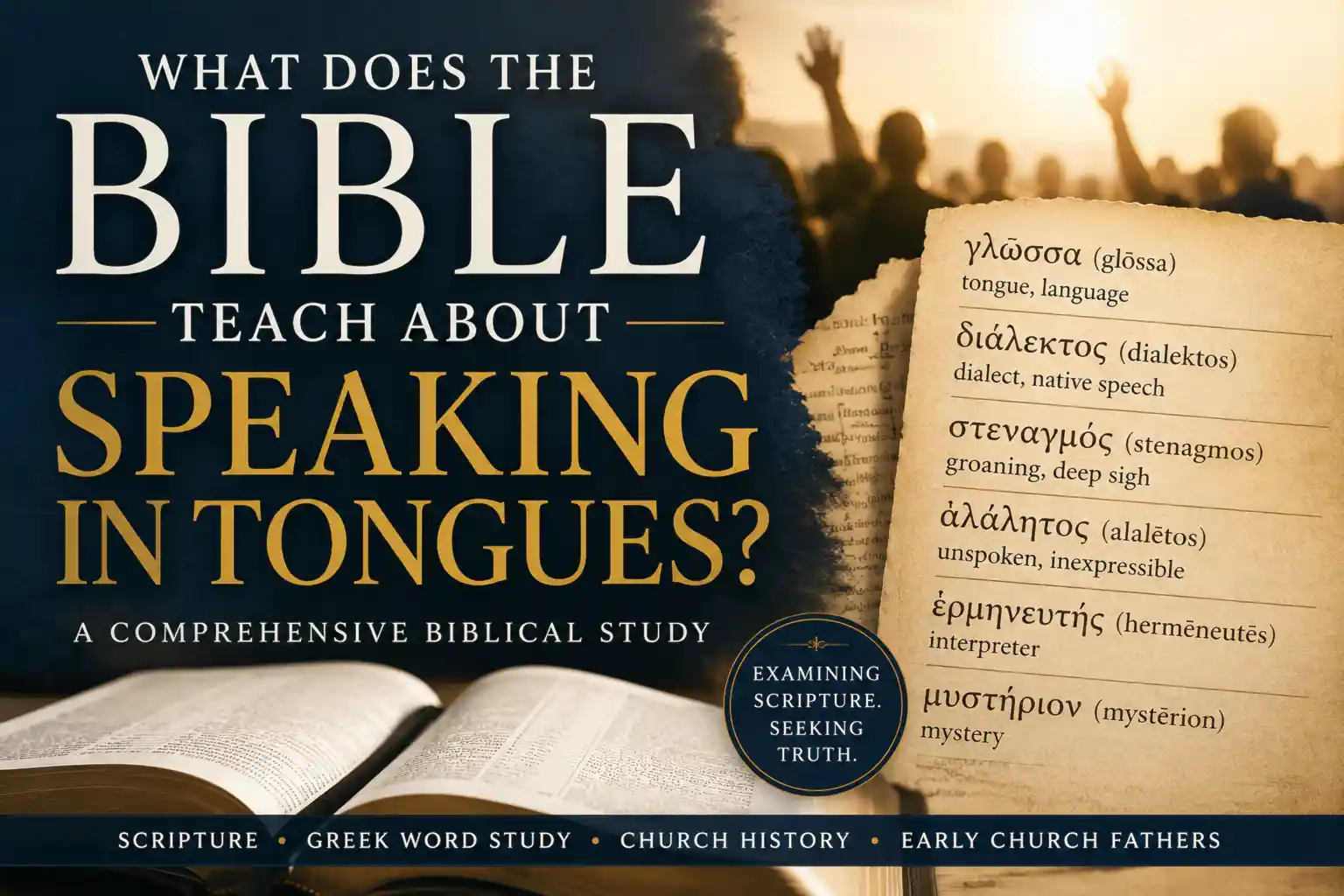
Speaking in Tongues in the Modern Church Today: What Does the Bible and Church History Teach?
Introduction
Few topics in modern Christianity generate as much discussion, disagreement, and confusion as speaking in tongues.
Some churches teach that every Christian should speak in tongues. Others teach it is the evidence of receiving the Holy Spirit. Some describe it as a private heavenly prayer language, while others believe the biblical gift referred to real human languages given for a specific purpose.
Many sincere Christians simply want to know what the Bible actually teaches.
When I first began studying this subject, I quickly discovered that much of what is commonly taught today does not always match the historical context of Scripture or the understanding of the early church. Rather than relying on personal experiences or church traditions, I wanted to examine the Bible carefully and ask some important questions.
- What were tongues in the book of Acts?
- Why did Paul spend three chapters discussing spiritual gifts in 1 Corinthians?
- What was happening in the church at Corinth?
- Why did Paul require interpretation?
- What did Christians believe about tongues before the modern Pentecostal movement?
- Is the modern practice the same gift described in Scripture?
Part of the “False Teachings” Series – Living for the Christ
Every generation of Christians is called to compare what they hear with God’s Word. This False Teaching Series is designed to help believers lovingly examine popular teachings in light of Scripture and follow the example of the Bereans, who searched the Scriptures daily to see whether these things were true (Acts 17:11).
Continue the series:
👉 What Is Legalism?
👉 What Is the Prosperity Gospel?
👉 The Truth About Mary: What the Bible Really Says vs Roman Catholic Teaching
This article is not written to attack sincere believers. Many Christians who practice speaking in tongues genuinely love Jesus and desire to follow Him faithfully.
Instead, my goal is to examine the Scriptures in their historical context, compare them with the testimony of early church history, and encourage every believer to test all things by God’s Word.
Ultimately, our authority must always be Scripture.
What You’ll Learn in This Study
According to the Bible, speaking in tongues consistently refers to real human languages miraculously given by the Holy Spirit. At Pentecost, people from many nations heard the apostles speaking in their own native languages. In Corinth, Paul required that tongues be interpreted so the church could understand and be edified.
For nearly 1,800 years, Christians overwhelmingly understood tongues this way. The modern concept of an unintelligible private prayer language developed much later with the rise of the Pentecostal movement in the early twentieth century.
This article examines the biblical, historical, and cultural evidence behind these different views.
Why This Topic Matters Today
This discussion is not simply about one spiritual gift.
It affects how we understand:
- the work of the Holy Spirit
- public worship
- biblical interpretation
- church history
- spiritual discernment
Many believers have been told that if they do not speak in tongues, they have not fully experienced the Holy Spirit.
Others have been taught that speaking in tongues is the primary evidence of Spirit baptism.
Still others have been encouraged to practice making sounds until they eventually begin speaking in tongues.
Because these teachings affect how Christians understand both salvation and the work of the Holy Spirit, they deserve careful biblical examination.
Scripture repeatedly calls believers to test every teaching.
“Prove all things; hold fast that which is good.” – 1 Thessalonians 5:21
Like the Bereans in Acts 17:11, we should examine the Scriptures daily to determine whether what we have been taught is true.
Why Is There So Much Confusion About Speaking in Tongues Today?
One reason this subject is so confusing is because many Christians assume the modern understanding of speaking in tongues has always existed throughout church history.
It has not.
For nearly eighteen centuries after the New Testament was written, Christian writers consistently described the biblical gift of tongues as real human languages miraculously given by the Holy Spirit.
The modern idea of tongues as an unintelligible heavenly prayer language did not become widespread until the rise of the Pentecostal movement in the early 1900s.
Interestingly, even the earliest Pentecostal leaders did not originally believe tongues were a private prayer language.
They believed God had restored the miracle of Acts 2, enabling believers to speak real foreign languages without studying them so they could preach the gospel throughout the world.
When those early missionaries traveled overseas expecting to communicate supernaturally in languages such as Chinese, Hindi, and other native languages, they discovered that local people could not understand what they were saying. This missionary crisis eventually led many Pentecostal leaders to redefine the gift as a private heavenly prayer language rather than miraculous human languages.
Later in this article, we will examine that historical transition in much greater detail.
First, however, we need to begin where every biblical study should begin:
What does the Bible actually define as speaking in tongues?
What Is Speaking in Tongues?
Before we can understand the modern debate surrounding speaking in tongues, we first need to understand how the Bible itself uses the word.
📖 Greek Word Study
γλῶσσα (glōssa)
Meaning:
- Tongue
- Language
Key Point: Depending on the context, glōssa refers either to the physical tongue or to a spoken human language. It is the primary word used when discussing the gift of tongues throughout the New Testament.
διάλεκτος (dialektos)
Meaning:
- Language
- Dialect
- Native speech
Key Point: Luke uses dialektos in Acts 2 to describe the miracle at Pentecost. Each listener heard the apostles speaking in their own native language, leaving no doubt that real, recognizable human languages were being spoken.
These two Greek words work together to define the biblical gift of tongues.
Rather than describing mysterious or unintelligible speech, they consistently point to understandable human languages within their biblical context.
The clearest definition of speaking in tongues is found in Acts 2.
Instead of beginning with later theological debates or modern church practices, we should begin where Scripture first explains the gift itself.
When we do, Acts becomes the foundation for understanding every later passage that discusses tongues.
What Happened at Pentecost?
The first occurrence of speaking in tongues took place on the Day of Pentecost shortly after Jesus ascended into heaven.
Acts 2 records that the disciples were gathered together when the Holy Spirit came upon them.
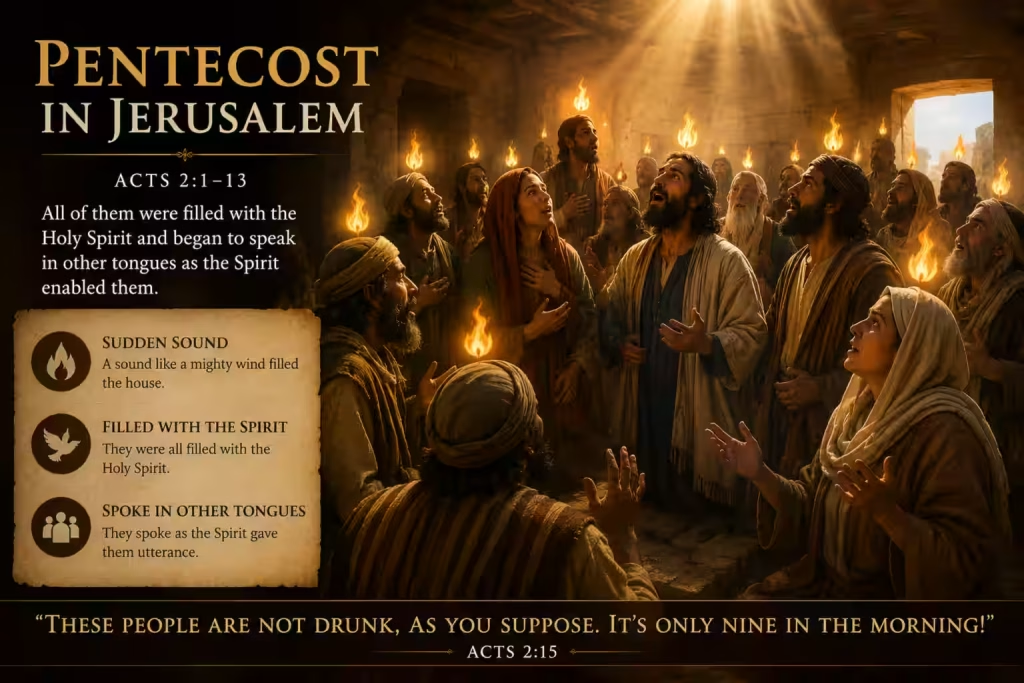
Luke writes:
“And they were all filled with the Holy Ghost, and began to speak with other tongues, as the Spirit gave them utterance.” – Acts 2:4
At first glance, someone might simply read the phrase “other tongues” and wonder what those tongues were.
Fortunately, Luke immediately answers the question.
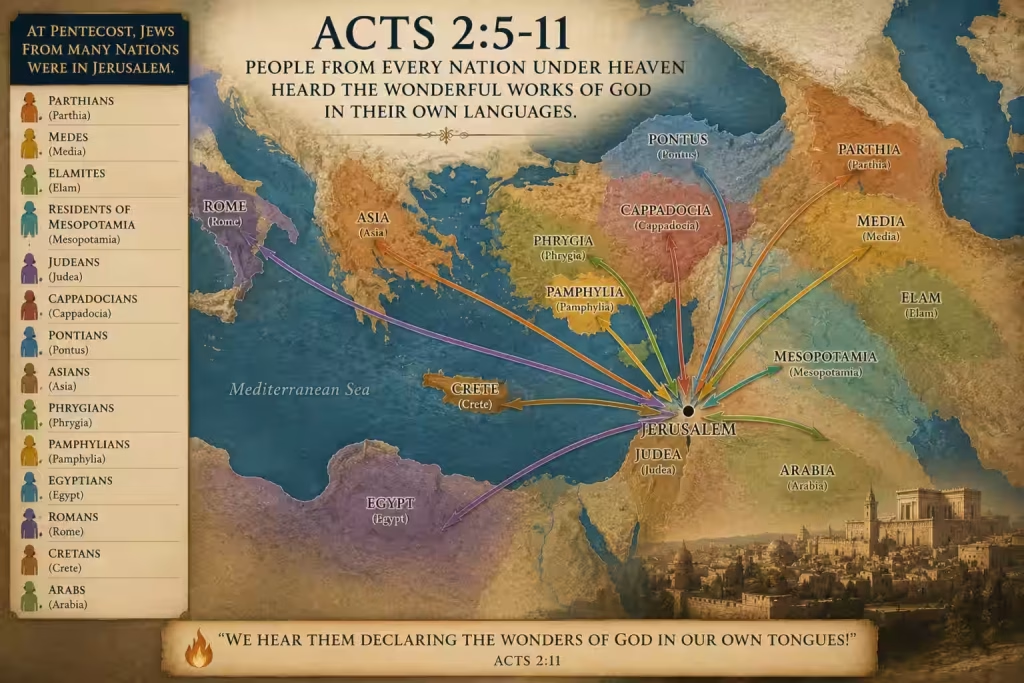
Jerusalem was filled with Jewish pilgrims who had traveled from many different nations to celebrate Pentecost.
These visitors spoke many different native languages.
When they heard the disciples speaking, they were amazed because each person heard the message in his own language.
Acts 2:6 says:
“Every man heard them speak in his own language.”
Luke uses the Greek word dialektos, meaning one’s native language or dialect.
A few verses later, the crowd asks:
“How hear we every man in our own tongue, wherein we were born?” – Acts 2:8
Luke then lists more than a dozen different regions represented in Jerusalem.
These people were not hearing meaningless sounds.
They were hearing recognizable human languages they themselves spoke from birth.
The miracle was not that the languages were mysterious.
The miracle was that uneducated Galileans were suddenly speaking languages they had never studied.
Tongues at Pentecost Were a Sign to the Nations
The miracle of Pentecost accomplished several purposes.
First, it demonstrated that the Holy Spirit had come just as Jesus promised.
Second, it allowed people from many different nations to hear the mighty works of God in their own languages.
Third, it signaled that the gospel would no longer remain limited to Israel but would now go to every nation of the world.
This understanding fits perfectly with Jesus’ Great Commission to take the gospel to all nations.
Rather than creating confusion, tongues at Pentecost removed language barriers so people from many cultures could hear and understand the message of Christ.
That emphasis on understanding becomes one of the major themes throughout the New Testament and lays the foundation for everything Paul later teaches in 1 Corinthians 14.
The Jewish Background: Why Understanding Was Central to Worship
Why the Jewish Background Matters
To properly understand Paul’s instructions about speaking in tongues, we first need to understand how Jewish worship worked during the first century.
One mistake many people make when reading the New Testament is forgetting that Christianity did not begin in a vacuum.
The earliest Christians were Jewish believers.
The apostles were Jews.
Jesus taught in Jewish synagogues.
The first churches inherited much of their structure and worship from the synagogue.
This historical background becomes incredibly important when we reach 1 Corinthians 14 because many of Paul’s instructions closely resemble practices that had existed in Jewish worship for centuries.
Understanding this background helps explain why Paul placed such a strong emphasis on interpretation, orderly worship, and ensuring that everyone present could understand what was being said.
Why the Jewish People Needed a Translator
By the first century, the Jewish people faced a significant language problem.
Although the Old Testament Scriptures were written in Biblical Hebrew, Hebrew was no longer the everyday language of most Jewish people.
Several major historical events contributed to this change.
The Babylonian Exile
In 586 BC, the Kingdom of Judah was conquered by Babylon, and many Jews were taken into exile.
During this period, Aramaic gradually replaced Hebrew as the common spoken language.
Although Hebrew continued to be preserved as the sacred language of Scripture, everyday conversations increasingly took place in Aramaic.
When the Jewish people later returned to their homeland, many could still read or hear Hebrew, but it was no longer the language they used in daily life.
Greek Influence Throughout the Roman Empire
Several centuries later, the conquests of Alexander the Great spread Greek culture and language throughout the ancient world.
By the time of Jesus and the apostles, Greek had become the common international language across much of the Roman Empire.
Many Jews living outside Judea—often called the Diaspora—spoke Greek as their primary language.
As a result, by the first century many Jewish worshipers spoke either Aramaic or Greek, while the Scriptures continued to be publicly read in Biblical Hebrew.
Without translation, much of the congregation would struggle to fully understand what they were hearing.
The Pattern Began in the Old Testament
The idea of explaining God’s Word so people could understand it did not begin in the synagogue.
Its roots can be traced back to the days of Nehemiah.
After the Jewish people returned from exile, Ezra publicly read the Book of the Law.
Nehemiah records:
“They read from the Book of the Law of God, making it clear and giving the meaning so that the people understood what was being read.” – Nehemiah 8:8 (NIV)
This verse establishes an important biblical principle.
Reading Scripture was not enough.
God’s people needed to understand it.
From this point forward, explanation and interpretation became central to Jewish worship.
This same principle would eventually shape synagogue services during the time of Jesus and the apostles.
The Office of the Meturgeman
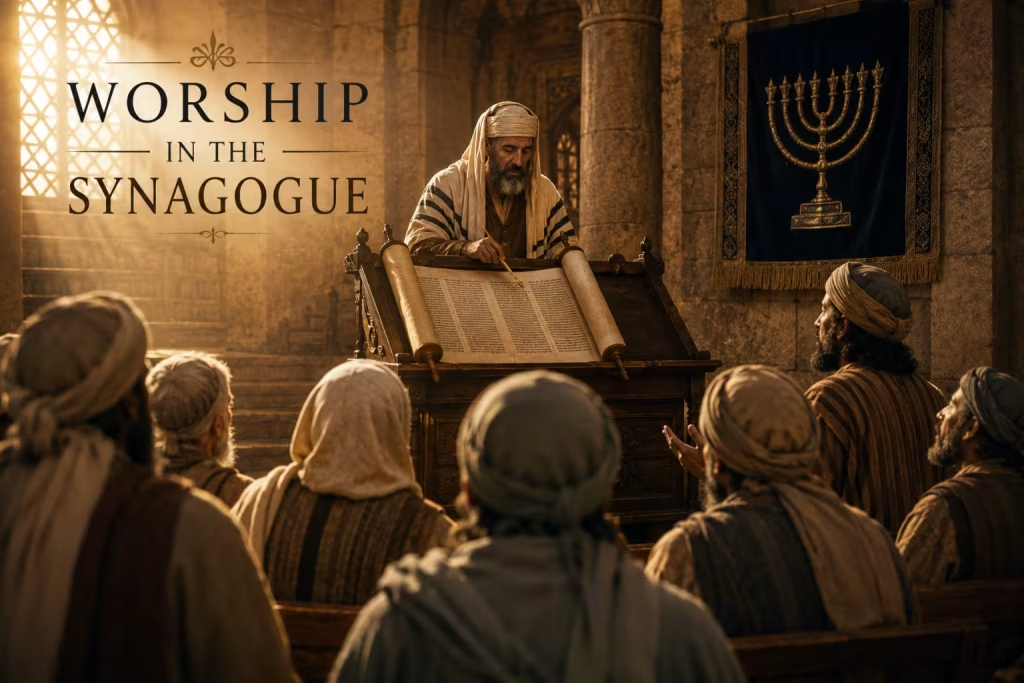
To solve the language barrier, synagogues developed the role of the Meturgeman (sometimes spelled Turgeman).
The Meturgeman served as the official oral translator during synagogue worship.
As the Hebrew Scriptures were read aloud, the Meturgeman translated them into the common language of the congregation, usually Aramaic or Greek.
His purpose was simple:
To ensure that everyone understood God’s Word.
Rather than allowing Scripture to become meaningless sounds, the Meturgeman helped bridge the language gap so the entire congregation could learn, worship, and grow together.
This role became such an important part of synagogue worship that detailed rules governed exactly how the translation was to take place.
How the Translation Process Worked
The synagogue service followed a carefully structured pattern.
The Scripture reader would read a portion of the Hebrew text.
Then he would pause.
The Meturgeman would immediately translate what had just been read into the language understood by the congregation.
For readings from the Torah, this typically happened one verse at a time.
For readings from the Prophets, the reader might read up to three verses before the translator spoke.
The process looked something like this:
Hebrew Scripture Read → Pause → Translation Given → Continue Reading
Everything happened in order.
Nothing overlapped.
The congregation always knew what portion of Scripture was being explained.
Most importantly, everyone could understand.
The Strict Rules of the Meturgeman
The office of the Meturgeman was governed by strict regulations.
These rules existed to preserve the authority of God’s Word and prevent confusion.
The Translation Was Oral
The Meturgeman was not permitted to read from a written translation.
Instead, he translated from memory and long-established oral tradition.
This helped distinguish the inspired Hebrew Scriptures from the translator’s explanatory work.
The congregation understood that the Hebrew text remained the inspired Word of God.
The translation served only to communicate its meaning.
The Translator Could Not Overpower the Reader
The translator was not allowed to speak louder than the person reading the Hebrew Scriptures.
This preserved the authority and prominence of God’s Word.
The translation served the text rather than replacing it.
Everything Happened in Order
The reader and translator never spoke at the same time.
One person spoke.
The other waited.
Then the translator spoke.
This orderly pattern prevented confusion and ensured the congregation could follow what was being communicated.
What Were Targums?
As the Meturgeman translated the Hebrew Scriptures, he often used what became known as Targums.
A Targum was more than a strict word-for-word translation.
It frequently included brief explanations, clarifications, and historical context that helped listeners understand difficult passages.
For example, if an Old Testament passage contained an expression that might confuse the audience, the translator could briefly explain its meaning while remaining faithful to the original message.
The goal was not to change Scripture.
The goal was to make Scripture understandable.
This illustrates another important principle that runs throughout both the Old and New Testaments:
God’s Word was intended to be understood by His people.
Why Understanding Matters to God
One theme appears repeatedly throughout Scripture.
God desires His people to understand His Word.
In Nehemiah, the Law was read and explained so the people could understand.
In the synagogue, the Meturgeman translated Hebrew into the common language of the people.
At Pentecost, people from many nations heard the gospel in their own native languages.
Later, when Paul addressed the church in Corinth, his concern was not simply whether people were speaking.
His concern was whether anyone understood what was being said.
Again and again, the biblical pattern is remarkably consistent.
God moves His message from the unknown into the understood.
Not confusion.
But clarity.
Not secrecy.
But revelation.
Not unintelligible speech.
But communication that builds up God’s people.
This theme becomes the key to understanding Paul’s instructions about speaking in tongues in 1 Corinthians 14.
Corinth: Why the Church Had a Tongues Problem
Corinth Was Unlike Any Other City
Before we can properly understand Paul’s instructions in 1 Corinthians, we need to understand the city where this church existed.
Corinth was not a quiet Jewish town like Nazareth or Capernaum.
It was one of the busiest and most influential cities in the Roman Empire.
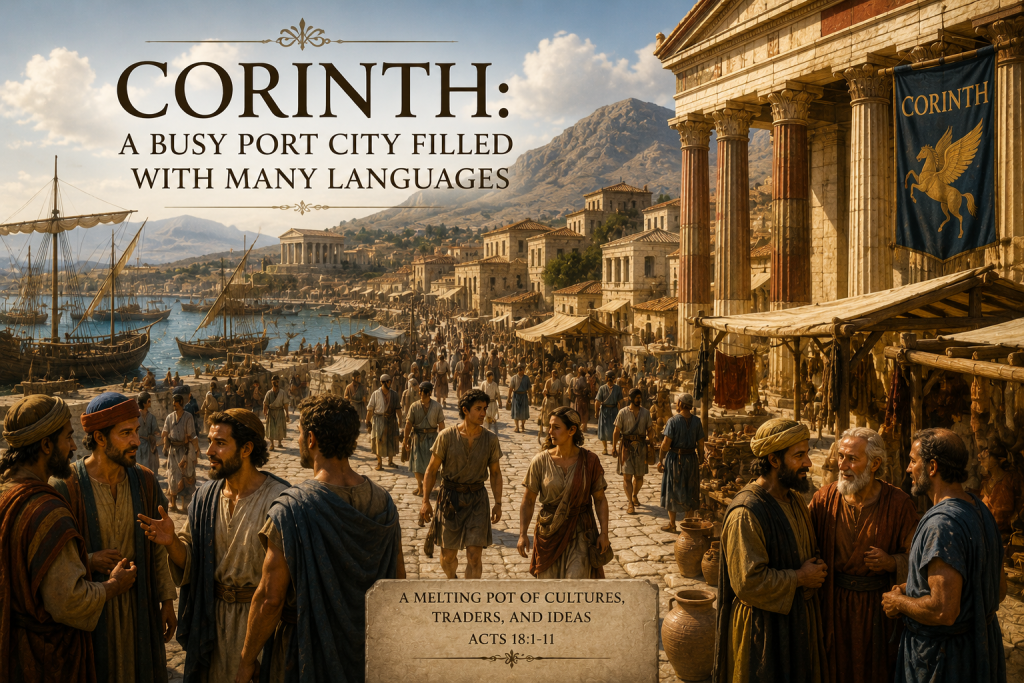
Located on a narrow strip of land connecting northern and southern Greece, Corinth became a major commercial center with two active harbors. Ships traveling east and west frequently stopped there, bringing merchants, sailors, government officials, travelers, and immigrants from all over the known world.
The city was incredibly wealthy, culturally diverse, and religiously pluralistic.
People living in Corinth spoke many different languages and came from many different backgrounds.
Some were Jews.
Others were Greeks.
Some were Romans.
Others came from Egypt, Syria, Asia Minor, and many other regions of the Roman Empire.
When Paul planted the church in Corinth, these believers brought all of their different cultures, languages, customs, and religious backgrounds with them.
That background becomes incredibly important when we begin studying spiritual gifts.
A Church Made Up of New Converts
Many of the believers in Corinth had only recently come to faith in Jesus Christ.
Before becoming Christians, most Gentile believers had spent their lives worshipping pagan gods and participating in pagan religious ceremonies.
Although they had trusted Christ for salvation, they were still learning what it meant to leave behind their old way of thinking.
This explains why Paul spends so much of 1 Corinthians correcting problems within the church.
Throughout the letter, he addresses division, pride, sexual immorality, lawsuits between believers, abuses of the Lord’s Supper, misunderstandings about spiritual gifts, and disorderly worship.
The Corinthian church loved Jesus, but they still carried much of their old culture into their new faith.
Corinth’s Pagan Religious Culture
One of the most overlooked parts of understanding 1 Corinthians is recognizing how deeply pagan religion influenced everyday life in Corinth.
The city was filled with temples dedicated to various Greek and Roman gods.
Among the best known were the worship of Dionysus, the god of wine and ecstasy, and nearby Delphi, where the famous Oracle of Apollo attracted visitors from across the ancient world.

Many pagan religions sought spiritual experiences through emotional excitement, altered states of consciousness, loud music, repetitive chanting, and ecstatic speech.
The more dramatic the experience, the more people believed they were being influenced by their god.
This background is significant because many converts brought these assumptions with them into the Christian church.
Paul’s concern was not only correcting bad behavior but helping believers understand that the Holy Spirit does not operate like the pagan gods they once served.
The Cult of Dionysus and Religious Ecstasy
One of the closest historical parallels to the confusion in Corinth was the worship of Dionysus.
Followers of Dionysus often gathered for emotional religious ceremonies involving music, dancing, drinking, and ecstatic experiences.
Their goal was to enter what the Greeks called mania, a state of divine frenzy in which they believed the god temporarily possessed them.
As worshippers entered this emotional state, they often cried out loudly, made unintelligible sounds, and believed these utterances represented communication from the divine.
Loss of self-control was viewed as evidence that the god had taken control.
This mindset stands in sharp contrast to the New Testament’s description of the Holy Spirit.
Throughout Scripture, the Holy Spirit produces self-control, understanding, and order rather than confusion.
The Oracle of Delphi
Another important influence was the nearby Oracle of Delphi.
People traveled from across the Roman world to seek guidance from the priestess known as the Pythia.
Ancient writers describe how she would enter an altered state before delivering her messages.
Her utterances were often difficult to understand.
Special priests then interpreted or translated what they believed she had spoken.
Whether every ancient description is completely accurate or not, the important point is that many Corinthians were familiar with religious systems that valued mysterious, ecstatic speech.
When some of these individuals became Christians, it is understandable that they initially viewed spiritual experiences through the lens of their former religious practices.
Paul’s task was to redirect them toward biblical worship centered on truth, understanding, and edification.
Paul Reminds Them of Their Pagan Past
Notice how Paul begins his discussion of spiritual gifts.
He writes:
“You know that when you were pagans, somehow or other you were influenced and led astray to mute idols.” – 1 Corinthians 12:2 (NIV)
I don’t believe Paul mentions their pagan past by accident.
Before correcting their misunderstanding of spiritual gifts, he reminds them where they came from.
Their former worship had been centered around idols that could not speak.
Their religious experiences depended on emotional displays, mystery, and human imagination.
The true God is completely different.
He reveals Himself through His Word.
He speaks truth.
He desires understanding.
Everything Paul says over the next three chapters should be read in light of this reminder.
Why Were Multiple People Speaking at the Same Time?
One question many Christians ask is why Paul had to tell believers to speak one at a time.
If the Holy Spirit is a God of order, why were several people apparently speaking in tongues simultaneously?
When we examine the historical context, three likely reasons emerge.
1. A Multilingual Church
Corinth was one of the most international cities in the Roman Empire.
The church likely included believers whose native languages differed greatly.
If God enabled someone to speak in another human language, there would naturally be occasions when most people present could not understand what was being said.
Without interpretation, the message benefited only the speaker.
This is one reason Paul repeatedly emphasizes interpretation.
His concern was never simply that someone spoke another language.
His concern was whether the church understood it.
2. Pagan Worship Habits
Many Gentile believers had spent years participating in religions where loud emotional experiences were viewed as evidence of divine activity.
It would have been easy to assume that the Holy Spirit worked the same way.
Instead of orderly worship, some believers apparently began speaking over one another, believing that greater excitement meant greater spirituality.
Paul corrects this misunderstanding by reminding them that God is not the author of confusion.
3. Spiritual Pride and Competition
As I studied 1 Corinthians, one thing became increasingly clear to me.
The biggest problem in Corinth was pride.
Paul repeatedly confronts believers who were competing for status within the church.
Earlier in the letter, some claimed to follow Paul while others claimed Apollos or Peter.
Some believers were taking fellow Christians to court.
Others were humiliating poorer members during the Lord’s Supper.
By the time Paul reaches chapters 12 through 14, it appears that spiritual gifts had become another source of competition.
Some believers seemed to view speaking in tongues as the most impressive gift.
Rather than using their gifts to build up others, they were using them to draw attention to themselves.
Paul repeatedly redirects their focus away from self and back toward love, humility, and the edification of the church.
Why Didn’t Paul Simply Forbid Speaking in Tongues?
This raises another important question.
If the Corinthians were abusing the gift of tongues so badly, why didn’t Paul simply tell them to stop?
Because the problem was not the gift itself.
The problem was how they were using it.
Throughout 1 Corinthians 14, Paul never condemns the genuine work of the Holy Spirit.
Instead, he establishes clear boundaries.
If tongues are spoken publicly, they must be interpreted.
Only two or at most three people should speak.
They must speak one at a time.
If there is no interpreter, they must remain silent.
Paul’s goal was never to eliminate spiritual gifts.
His goal was to ensure that every gift fulfilled its intended purpose: building up the church.
Order Reflects the Character of God
Paul eventually summarizes the entire discussion with one of the most well-known verses in the chapter:
“For God is not a God of disorder but of peace…” – 1 Corinthians 14:33 (NIV)
Later he concludes:
“But everything should be done in a fitting and orderly way.” – 1 Corinthians 14:40 (NIV)
These verses beautifully summarize the heart of Paul’s argument.
From Nehemiah…
to the synagogue…
to Pentecost…
to the church at Corinth…
God consistently values worship that communicates truth clearly and builds up His people.
Understanding—not confusion—has always been central to biblical worship.
Understanding 1 Corinthians 14
Few chapters in the New Testament have generated more discussion than 1 Corinthians 14. Some read it as a defense of modern speaking in tongues, while others see it as Paul’s correction of disorderly worship in the Corinthian church.
Rather than building our conclusions on isolated verses, let’s carefully walk through Paul’s argument one section at a time, paying close attention to the historical context, the Greek language, and the flow of the chapter itself.
By allowing Scripture to interpret Scripture, we can better understand what Paul intended his original readers to hear
Walking Through 1 Corinthians 14 Verse by Verse
Why 1 Corinthians 14 Cannot Be Read in Isolation
One of the biggest mistakes people make when studying speaking in tongues is reading 1 Corinthians 14 by itself.
Paul did not write chapter 14 as a standalone teaching on spiritual gifts. He was writing to a specific church with specific problems.
Before we opened this chapter, we already discovered several important truths.
First, the very first occurrence of speaking in tongues in the Bible takes place in Acts 2. There, the gift is clearly defined as real human languages that were understood by people from many different nations.
Second, we examined how first-century synagogue worship operated. Because most Jewish people no longer spoke Biblical Hebrew in everyday life, synagogues appointed an official interpreter known as the Meturgeman. His responsibility was to translate the Hebrew Scriptures into the common language so everyone present could understand God’s Word.
Finally, we looked at the city of Corinth itself. It was a wealthy international port filled with people from different cultures, different languages, and different religious backgrounds. Many believers had only recently come out of pagan mystery religions that valued ecstatic experiences, emotional frenzy, and displays of spirituality.
When we keep all of that in mind, Paul’s instructions in 1 Corinthians 14 suddenly become much easier to understand.
He is not redefining the gift of tongues.
He is correcting the way one local church was using—or rather, misusing—the gift.
Throughout the chapter, one theme rises above every other:
Everything done in the church should strengthen the church through clear, understandable communication.
Pursue Love While Desiring Spiritual Gifts
Paul begins by writing:
“Follow the way of love and eagerly desire gifts of the Spirit, especially prophecy.” – 1 Corinthians 14:1 (NIV)
Notice what Paul does not say.
He does not tell believers to stop desiring spiritual gifts.
Neither does he forbid speaking in tongues.
Instead, he establishes priorities.
Love must always come first.
Then spiritual gifts.
Even among the gifts, Paul encourages believers to desire prophecy because prophecy immediately builds up everyone present through understandable instruction.
This becomes Paul’s central concern throughout the chapter.
The question is never:
“Is this gift impressive?”
The question is:
“Does this build up the church?”
That distinction is extremely important because it becomes the measuring stick Paul uses for every gift discussed in this chapter.
What Does “Speaking to God” Mean?
One of the most frequently quoted verses in the modern discussion about tongues is 1 Corinthians 14:2.
Paul writes:
“For anyone who speaks in a tongue does not speak to people but to God. Indeed, no one understands them; they utter mysteries by the Spirit.” – 1 Corinthians 14:2 (NIV)
Many Christians read this verse and conclude that Paul is describing a private heavenly prayer language.
However, when we place this verse back into its first-century setting, another explanation naturally emerges.
Remember what we learned about the synagogue.
Imagine a Jewish synagogue where someone stands up and begins reading the Scriptures aloud in Hebrew.
Now imagine there is no Meturgeman present.
The congregation speaks Aramaic.
No one understands Hebrew anymore.
Who is the only One who fully understands every word being spoken?
God.
The speaker is functionally speaking only to God because no one else in the room understands what is being said.
The problem is not that the language is mystical.
The problem is that the audience cannot understand it.
The exact same principle applies to Corinth.
If someone stands and speaks in a language unknown to everyone else present, the congregation receives no benefit because they cannot understand what is being communicated.
Paul is describing the reality of communication without interpretation.
He is not presenting it as the ideal form of public worship.
This understanding also explains why Paul spends the rest of the chapter insisting that tongues be interpreted.
If speaking only to God were the goal of public worship, Paul’s repeated commands about interpretation would make little sense.
Instead, his concern is that speech intended for the church should actually benefit the church.
“No One Understands Them”
Paul continues:
“Indeed, no one understands them…”
This phrase is often overlooked, yet it is central to Paul’s argument.
Notice that Paul treats the lack of understanding as a problem.
Throughout this chapter, he repeatedly argues that speech which cannot be understood does not edify the church.
This perfectly matches everything we learned about synagogue worship.
The entire purpose of the Meturgeman was to ensure that everyone present understood what was being read.
Paul’s concern is exactly the same.
God’s people gather together to learn, encourage one another, and worship together.
If no one understands what is being spoken, the church cannot be strengthened.
That is why understanding—not merely speaking—is the repeated emphasis throughout this chapter.
What Does “Uttering Mysteries” Mean?
Paul then says:
“…they utter mysteries by the Spirit.”
Many readers immediately assume the word mysteries refers to hidden heavenly secrets.
However, it is important to remember who Paul is writing to.
The city of Corinth was surrounded by pagan mystery religions.
These religions promised secret knowledge available only to those who had been initiated into their ceremonies.
Their worship often included ecstatic experiences that outsiders could neither understand nor explain.
By contrast, Jewish worship emphasized something very different.
God’s truth was to be proclaimed clearly.
The Scriptures were read.
They were translated.
They were explained.
The goal was always understanding.
When Paul uses the word mysteries, he may very well be using language familiar to the Corinthians to expose the emptiness of speech that leaves everyone else in the dark.
Whether someone was speaking an actual foreign language that nobody understood or whether the Corinthians had begun imitating the ecstatic practices surrounding them, the result was exactly the same.
The congregation remained unable to understand.
Throughout the remainder of the chapter, Paul works to correct that problem by repeatedly emphasizing interpretation and intelligibility.
The Purpose of Prophecy
Paul immediately contrasts tongues with prophecy.
He writes:
“But the one who prophesies speaks to people for their strengthening, encouraging and comfort.” – 1 Corinthians 14:3 (NIV)
Notice the difference.
Paul is not saying prophecy is more miraculous.
He is saying prophecy accomplishes something that uninterpreted tongues do not.
People understand it.
They are strengthened.
They are encouraged.
They are comforted.
Paul’s concern has never been creating spectacular spiritual experiences.
His concern has always been building up God’s people.
Which Gift Builds Up the Church?
Paul continues:
“Anyone who speaks in a tongue edifies themselves, but the one who prophesies edifies the church.” – 1 Corinthians 14:4 (NIV)
This verse has often been used to support private devotional tongues.
However, the context suggests Paul is continuing to compare two situations within the gathered church.
If no one else understands what the speaker is saying, only the speaker benefits.
The church does not.
By contrast, prophecy immediately strengthens everyone because everyone understands it.
Paul is not encouraging selfish worship.
Quite the opposite.
Throughout the chapter, he repeatedly teaches that spiritual gifts should be exercised for the benefit of others rather than for personal display.
That is why he consistently directs believers toward gifts that strengthen the entire body of Christ.
Does Paul Teach That Speaking in Tongues Is Meant to Edify Yourself? (1 Corinthians 14:4)
One of the most frequently quoted verses in support of a private prayer language is 1 Corinthians 14:4:
“Anyone who speaks in a tongue edifies themselves, but the one who prophesies edifies the church.” (NIV)
At first glance, some conclude that Paul is encouraging believers to seek a private prayer language for personal spiritual growth.
However, when we read the verse in its context, Paul’s point is actually the opposite.
Throughout 1 Corinthians 12-14, Paul consistently emphasizes that spiritual gifts are given for the benefit of others, not merely for personal edification.
Earlier he wrote:
“Now to each one the manifestation of the Spirit is given for the common good.” (1 Corinthians 12:7)
Later he concludes:
“Everything must be done so that the church may be built up.” (1 Corinthians 14:26)
Those two statements form the framework for understanding chapter 14.
Paul is not encouraging self-edification. He is contrasting two different outcomes.
If someone speaks in a language that no one else understands, only the speaker benefits because no one else can learn from it.
But if someone prophesies in a language the congregation understands, the entire church is strengthened.
Paul’s concern is not that self-edification is the goal.
His concern is that it falls short of God’s greater purpose.
That is why, throughout the chapter, Paul repeatedly urges believers to pursue whatever builds up the church.
Notice how quickly he moves from verse 4 to verse 5:
“The one who prophesies is greater than the one who speaks in tongues, unless someone interprets, so that the church may be edified.”
The emphasis immediately shifts back to the church, not the individual.
This theme continues throughout the chapter:
- Interpretation is required (vv. 5, 13, 27-28).
- The mind should understand what is spoken (vv. 14-19).
- Everything should strengthen the church (v. 26).
- Worship should be orderly and understandable (vv. 33, 40).
Rather than promoting private spiritual experiences, Paul consistently points believers toward gifts that encourage, instruct, and build up the entire body of Christ.
This fits perfectly with Paul’s teaching in chapter 12. The Holy Spirit distributes different gifts throughout the body of Christ so that believers depend on one another. No spiritual gift was intended to become a badge of personal spirituality or a means of private spiritual advancement. Instead, every gift was given so that the whole church might grow together in Christ.
Why Paul Preferred Prophecy
Paul then says something very important:
“I would like every one of you to speak in tongues, but I would rather have you prophesy. The one who prophesies is greater than the one who speaks in tongues, unless someone interprets, so that the church may be edified.” – 1 Corinthians 14:5 (NIV)
Notice the reason Paul gives.
He does not say prophecy is greater because tongues are false.
Nor does he say tongues have no value.
Instead, he explains exactly why prophecy is preferable in the gathered church.
“…unless someone interprets, so that the church may be edified.”
Once again, interpretation is the key.
If tongues are interpreted, the church receives understanding.
If they are not interpreted, the church receives no instruction.
Paul consistently returns to one question:
Does this build up the church?
Everything else in the chapter flows from that principle.
Speaking Into the Air
Paul develops his argument further:
“Unless you speak intelligible words with your tongue, how will anyone know what you are saying? You will just be speaking into the air.” – 1 Corinthians 14:9 (NIV)
This verse beautifully summarizes Paul’s concern.
Words are meant to communicate.
Language exists so people can understand one another.
If no one understands what is spoken, communication has failed.
Paul is not criticizing language.
He is criticizing speech that cannot accomplish its intended purpose.
Once again, understanding is central.
Every Language Has Meaning
Paul continues:
“Undoubtedly there are all sorts of languages in the world, yet none of them is without meaning.” – 1 Corinthians 14:10 (NIV)
I believe this is one of the strongest verses in the entire chapter.
Paul acknowledges that there are many languages in the world.
But notice what he immediately adds.
None of them is without meaning.
Every genuine language communicates.
Every language has structure.
Every language carries meaning to those who understand it.
He then explains:
“If then I do not grasp the meaning of what someone is saying, I am a foreigner to the speaker, and the speaker is a foreigner to me.” – 1 Corinthians 14:11 (NIV)
Paul’s illustration is striking.
He does not compare tongues to mystical heavenly sounds.
He compares them to two people who speak different human languages.
Each person becomes a foreigner to the other because they cannot understand one another’s language.
This illustration fits perfectly with Acts 2, where people from many nations heard the apostles speaking in their own native languages.
Paul’s example is grounded entirely in normal human language and communication.
Pray That You May Interpret
Paul therefore reaches a practical conclusion:
“For this reason the one who speaks in a tongue should pray that they may interpret what they say.” – 1 Corinthians 14:13 (NIV)
Again, interpretation is the solution.
Paul does not tell the speaker simply to continue speaking regardless of whether anyone understands.
He tells them to pray for the ability to interpret.
Why?
Because interpretation transforms speech that benefits only the speaker into speech that benefits the entire church.
That has been Paul’s goal from the beginning of the chapter.
Every spiritual gift should strengthen the body of Christ.
What About Praying in a Tongue?
Paul continues:
“For if I pray in a tongue, my spirit prays, but my mind is unfruitful.” – 1 Corinthians 14:14 (NIV)
This verse is often cited as evidence that Paul is describing a private prayer language. However, once again, the surrounding context is essential.
Throughout the entire chapter, Paul is discussing speech that cannot be understood by those listening. His concern has consistently been the lack of understanding.
If someone prays in a language they themselves do not understand, their spirit may indeed be engaged in prayer, but their mind receives no benefit because they cannot comprehend what is being said.
Notice Paul’s response.
He does not conclude that believers should seek more experiences where the mind is bypassed.
Instead, he immediately says:
“So what shall I do? I will pray with my spirit, but I will also pray with my understanding; I will sing with my spirit, but I will also sing with my understanding.” – 1 Corinthians 14:15 (NIV)
Paul’s solution is not to abandon understanding.
His solution is to include it.
Throughout Scripture, loving God involves both the heart and the mind (Matthew 22:37).
Biblical worship is never presented as something that bypasses understanding. Instead, the Holy Spirit works through truth, bringing illumination, conviction, and understanding.
Worship Should Involve Understanding
Paul continues by asking another practical question:
“Otherwise when you are praising God in the Spirit, how can someone else, who is now put in the position of an inquirer, say ‘Amen’ to your thanksgiving, since they do not know what you are saying?” – 1 Corinthians 14:16 (NIV)
In the early church, saying “Amen” was an expression of agreement with what had been prayed or taught.
But how can someone agree with a prayer they cannot understand?
Paul’s point is beautifully simple.
Corporate worship is something believers participate in together.
If the congregation cannot understand the prayer, they cannot join in agreement.
Again, Paul’s concern is not whether someone is sincere.
His concern is whether the church is being built up.
Others Are Not Edified
Paul continues:
“You are giving thanks well enough, but no one else is edified.” – 1 Corinthians 14:17 (NIV)
This verse summarizes everything Paul has argued so far.
Notice what Paul does not criticize.
He does not say the individual lacks sincerity.
He does not accuse them of bad motives.
Instead, he simply points out that no one else benefits.
The repeated theme of the chapter is impossible to miss.
Understanding produces edification.
Without understanding, the church cannot be strengthened.
“I Thank God That I Speak in Tongues More Than All of You”
Paul then makes one of the most frequently quoted statements in the discussion about tongues.
He writes:
“I thank God that I speak in tongues more than all of you.” – 1 Corinthians 14:18 (NIV)
Many people point to this verse and argue that Paul must have spent extensive time speaking in a private heavenly prayer language.
The reasoning usually goes something like this:
“If Paul says he hardly uses tongues in church, yet he says he speaks in tongues more than everyone else, then he must have been speaking in tongues privately.”
At first glance, that might seem like a reasonable conclusion.
However, the text never actually says that.
Paul never mentions a private prayer language in this verse.
That idea has to be read into the passage rather than drawn from it.
When we consider Paul’s life and ministry, another explanation fits both the biblical and historical evidence far more naturally.
Paul’s Missionary Ministry Took Him Across the Roman Empire
Unlike most members of the Corinthian church, Paul was not confined to ministering in one local congregation.
God called him to be the apostle to the Gentiles.
Throughout the book of Acts, Paul traveled thousands of miles preaching the gospel throughout the Roman Empire.
His journeys took him through places such as:
- Cyprus
- Pisidian Antioch
- Iconium
- Lystra
- Derbe
- Philippi
- Thessalonica
- Berea
- Athens
- Corinth
- Ephesus
- Caesarea
- Malta
- and eventually Rome.
Everywhere Paul went, he encountered people from different cultures, backgrounds, and languages.
He regularly preached to Jews living throughout the Diaspora as well as Gentiles from many different nations.
Unlike the average believer in Corinth, Paul’s ministry constantly crossed language barriers.
If the biblical gift of tongues consisted of miraculously speaking real human languages—as first defined in Acts 2—it makes perfect sense that Paul could honestly say:
“I thank God that I speak in tongues more than all of you.”
His apostolic ministry would naturally have required that gift far more often than believers whose ministry was primarily within one local church.
This understanding fits perfectly with the original purpose of tongues at Pentecost.
God enabled His servants to communicate His mighty works across language barriers so that people from every nation could hear and understand the gospel.
Paul’s Entire Ministry Supports This Understanding
As I studied Paul’s ministry throughout the book of Acts, something became increasingly clear to me.
Acts records Paul’s life in remarkable detail.
We read his sermons.
His missionary journeys.
His debates in synagogues.
His conversations with governors and kings.
His teaching in homes.
His evangelism among Jews and Gentiles.
Again and again, Luke shows Paul communicating the gospel clearly and understandably.
Yet nowhere does Acts describe Paul spending time speaking in an unintelligible private prayer language.
If this had been one of the defining characteristics of Paul’s devotional life, it is striking that neither Acts nor Paul’s letters ever describe it in that way.
Instead, Paul’s ministry consistently emphasizes preaching, teaching, reasoning from the Scriptures, persuading unbelievers, and communicating truth in ways people could understand.
That pattern perfectly reflects the biblical purpose of tongues established in Acts 2.
A More Natural Reading
After comparing Acts 2, Paul’s missionary journeys, and the immediate context of 1 Corinthians 14, I find the most natural reading of verse 18 to be that Paul is referring to his missionary ministry rather than describing a private devotional practice.
Because Paul traveled extensively throughout the Roman world and regularly encountered people from many different language groups, it makes perfect sense that God would have used the genuine gift of tongues more frequently through Paul than through many members of the Corinthian church.
Rather than introducing a completely different kind of tongues than the one first defined at Pentecost, Paul’s statement fits naturally within the broader biblical picture of tongues as miraculous human languages given by the Holy Spirit for communicating the gospel across language barriers.
But in the Church…
Paul immediately follows with one of the most important verses in the entire chapter.
“But in the church I would rather speak five intelligible words to instruct others than ten thousand words in a tongue.” – 1 Corinthians 14:19 (NIV)
Notice how Paul contrasts verse 18 with verse 19.
Outside the local church, Paul’s missionary ministry regularly brought him into contact with people from different nations and languages.
Inside the gathered church, however, his priority completely changed.
Public worship was not about displaying miraculous gifts.
It was about building up fellow believers.
Paul says he would rather speak five intelligible words than ten thousand words that no one could understand.
That is an astonishing comparison.
The issue is not the number of words.
The issue is whether those words accomplish their intended purpose.
Five Words That Teach Are Better Than Ten Thousand That Do Not
There is another interesting detail in this verse.
The Greek word translated “to instruct” is κατηχήσω (katēchēsō), from the verb κατηχέω (katēcheō).
📖 Greek Word Study: κατηχέω (katēcheō)
Meaning:
- To instruct
- To teach orally
- To give careful instruction
- To thoroughly teach
English Connection:
The English word catechize comes from this Greek word. It carries the idea of systematic instruction in the truths of God’s Word.
Why It Matters:
In 1 Corinthians 14:19, Paul says he would rather speak five understandable words that instruct others than ten thousand words in a tongue. His priority is not speaking for the sake of speaking – it is teaching God’s truth in a way people can understand.
Paul’s goal is not simply speaking.
His goal is teaching.
He would rather speak five understandable words that teach God’s truth than thousands of words that leave the congregation confused.
Once again, Paul’s emphasis is exactly the same as the emphasis we have seen throughout this entire study:
God desires His people to understand His Word.
From Nehemiah…
to the synagogue…
to Pentecost…
to Corinth…
the consistent biblical pattern is remarkably clear.
God’s truth is meant to be understood.

Tongues as a Sign and Paul’s Rules for Orderly Worship
Tongues Were Given as a Sign
After emphasizing that everything done in the church should be understandable, Paul shifts the discussion to the purpose of tongues.
He writes:
“Brothers and sisters, stop thinking like children. In regard to evil be infants, but in your thinking be adults.” – 1 Corinthians 14:20 (NIV)
Paul begins by calling the Corinthians to spiritual maturity.
Much of the confusion surrounding spiritual gifts in Corinth was fueled by pride, competition, and a desire for dramatic spiritual experiences.
Instead of seeking gifts that made themselves appear spiritual, Paul urges them to think maturely and focus on what truly benefits the church.
He then quotes from the Old Testament.
Paul’s Quotation from Isaiah
Paul writes:
“In the Law it is written: ‘With other tongues and through the lips of foreigners I will speak to this people, but even then they will not listen to me,’ says the Lord.” – 1 Corinthians 14:21 (NIV)
Paul is quoting Isaiah 28:11-12.
Understanding the original context is extremely important.
During Isaiah’s day, God’s people continually rejected His warnings.
Because they refused to listen, God declared that He would speak to them through foreign invaders whose language they could not understand.
The foreign language itself became a sign of God’s judgment upon unbelieving Israel.
Paul now applies that same principle to speaking in tongues.
Tongues Are a Sign for Unbelievers
Paul immediately explains:
“Tongues, then, are a sign, not for believers but for unbelievers; prophecy, however, is not for unbelievers but for believers.” – 1 Corinthians 14:22 (NIV)
This verse has generated much discussion.
However, when viewed alongside Isaiah and Acts 2, it fits together remarkably well.
At Pentecost, Jews from many nations heard God’s mighty works proclaimed in their own native languages.
The miracle served as a sign that God was beginning to gather people from every nation through the gospel.
Likewise, Isaiah’s prophecy involved foreign languages serving as a sign to those who refused to believe.
In both passages, the emphasis is not on private spiritual experience.
The emphasis is on God’s message reaching people through real, understandable human languages.
Why Paul Preferred Prophecy in the Church
Paul then presents two illustrations.
First, he describes what happens if everyone speaks in tongues.
“So if the whole church comes together and everyone speaks in tongues, and inquirers or unbelievers come in, will they not say that you are out of your mind?” – 1 Corinthians 14:23 (NIV)
This verse is incredibly practical.
Imagine walking into a church service where multiple people are speaking simultaneously in languages you cannot understand.
What impression would you have?
Paul says the visitor would conclude that the congregation was out of its mind.
This observation alone tells us something very important.
The purpose of public worship is not to impress people with spectacular spiritual experiences.
The purpose is to communicate God’s truth.
Anything that creates confusion ultimately distracts from the gospel.
The Power of Understandable Speech
Paul now gives the opposite example.
“But if an unbeliever or an inquirer comes in while everyone is prophesying, they are convicted of sin and are brought under judgment by all, as the secrets of their hearts are laid bare. So they will fall down and worship God, exclaiming, ‘God is really among you!'” – 1 Corinthians 14:24-25 (NIV)
Notice the contrast.
When God’s truth is understood, it convicts hearts.
People respond to the gospel.
Lives are changed.
This perfectly illustrates Paul’s point throughout the chapter.
Clear communication is how God ordinarily works to bring conviction and faith.
Paul’s Rules for Speaking in Tongues
Having explained the purpose of tongues, Paul now gives practical instructions for their use within the church.
These instructions are remarkably similar to the orderly pattern of synagogue worship we examined earlier.
Paul writes:
“If anyone speaks in a tongue, two – or at the most three – should speak, one at a time, and someone must interpret.” – 1 Corinthians 14:27 (NIV)
Notice the structure.
Only two or three people.
One at a time.
Someone must interpret.
These are not suggestions.
They are clear instructions designed to preserve order and ensure that the church is strengthened.
This immediately reminded me of the synagogue services we discussed earlier.
There, one person read the Hebrew Scriptures.
Then the Meturgeman translated.
Everything happened in order.
No one spoke over another.
Everyone understood.
Paul appears to apply the same principle to the Christian assembly.
If There Is No Interpreter
Paul continues:
“If there is no interpreter, the speaker should keep quiet in the church and speak to himself and to God.” – 1 Corinthians 14:28 (NIV)
This is one of the clearest commands in the entire chapter.
If no interpreter is present, the individual is not to address the congregation.
Why?
Because without interpretation, no one benefits.
This verse also reinforces what we discussed earlier regarding verse 2.
Some have suggested that “speaking to himself and to God” establishes a private prayer language.
However, notice the context.
Paul is not introducing a new category of tongues.
He is giving instructions for public worship.
His point is simple:
If your speech cannot be understood by the congregation, do not address the congregation.
Remain silent.
This is entirely consistent with the chapter’s repeated emphasis on intelligibility and edification.
God Gives Self-Control
One of the accusations sometimes made is that the Holy Spirit simply takes over a person, making them unable to control when they speak.
Paul teaches the exact opposite.
Throughout this chapter, he repeatedly instructs believers when to speak, when to remain silent, and when to wait their turn.
He even says regarding prophecy:
“The spirits of prophets are subject to the control of prophets.” – 1 Corinthians 14:32 (NIV)
This is an important principle.
The Holy Spirit does not override a believer’s self-control.
Instead, believers remain responsible for exercising their gifts in a way that honors God and serves others.
This perfectly agrees with another fruit of the Spirit listed elsewhere in Scripture:
self-control (Galatians 5:22-23).
God Is Not a God of Disorder
Paul summarizes the entire discussion with one of the most well-known statements in the chapter.
“For God is not a God of disorder but of peace – as in all the congregations of the Lord’s people.” – 1 Corinthians 14:33 (NIV)
This verse reaches beyond Corinth.
Paul says this principle applies in all the churches.
Order is not unique to Corinth.
It reflects God’s own character.
When worship becomes chaotic, confusing, or centered on individuals rather than Christ, it no longer reflects the God revealed in Scripture.
Everything Should Be Done Decently and in Order
Paul closes the chapter by saying:
“Therefore, my brothers and sisters, be eager to prophesy, and do not forbid speaking in tongues. But everything should be done in a fitting and orderly way.” – 1 Corinthians 14:39-40 (NIV)
I appreciate the balance Paul demonstrates here.
He does not forbid speaking in tongues.
Neither does he encourage disorder.
Instead, he gives biblical boundaries.
If tongues are genuine, they must be exercised according to God’s instructions.
They should never produce confusion.
They should never draw attention to the individual.
They should always serve the purpose of strengthening Christ’s church.
Looking Back at the Entire Chapter
After studying 1 Corinthians 14 carefully, one theme stands above every other.
Paul continually returns to the importance of understanding.
He repeatedly asks whether the church is being built up.
He consistently values speech that communicates God’s truth clearly.
Whether discussing prophecy, tongues, prayer, singing, or teaching, Paul’s concern never changes.
God’s people should understand what is being said.
When we step back and look at the broader biblical picture, this same pattern appears everywhere.
- In Nehemiah 8, the Law was read and explained so the people could understand.
- In the synagogue, the Meturgeman translated Hebrew into the common language.
- At Pentecost, people from many nations heard the gospel in their own native languages.
- In Corinth, Paul repeatedly insisted that speech be interpreted so the church could be edified.
The consistent biblical pattern is one of clarity, understanding, and mutual edification.
God has always desired His people to know His truth, understand His Word, and build one another up through clear communication.
Understanding Hyperbole in 1 Corinthians 13
Before moving on to church history and the modern Pentecostal movement, we need to address one of the most common passages used to support the idea of a heavenly prayer language.
Many people point to one phrase in 1 Corinthians 13:1:
“If I speak in the tongues of men or of angels, but do not have love, I am only a resounding gong or a clanging cymbal.” – 1 Corinthians 13:1 (NIV)
At first glance, someone might conclude that Paul is teaching Christians can speak an angelic language.
However, whenever we study a single verse, it is important to read it within its immediate context.
When we do that, something very interesting begins to emerge.
Why Did Paul Place Chapter 13 Between Chapters 12 and 14?
One of the biggest mistakes people make is treating 1 Corinthians 13 as though it were an isolated chapter about love.
It certainly teaches about love, but Paul placed it exactly where he did for a reason.
Notice the flow of Paul’s argument.
Chapter 12
Paul teaches about spiritual gifts.
Chapter 13
Paul explains that love is greater than every spiritual gift.
Chapter 14
Paul returns to spiritual gifts and explains how they should function within the church.
These three chapters are not separate discussions.
They form one continuous argument.
The Corinthian believers had become fascinated with the more visible and dramatic spiritual gifts.
Instead of serving one another humbly, many were using their gifts as a source of pride and spiritual competition.
Paul interrupts that discussion to make one powerful point:
The greatest evidence of spiritual maturity is not possessing spectacular gifts.
It is love.
What Is Hyperbole?
To understand chapter 13 correctly, we first need to understand a literary device called hyperbole.
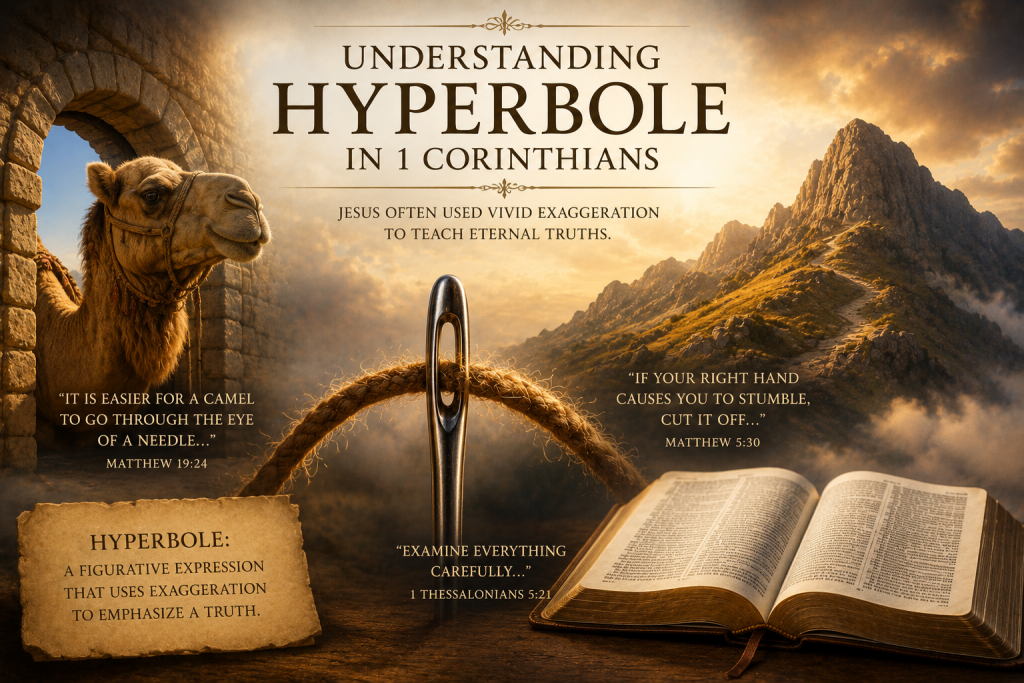
Hyperbole is the intentional use of exaggeration to emphasize a truth.
It is not deception.
It is a common teaching technique found throughout Scripture.
Jesus frequently used hyperbole.
For example, He said:
“If your right eye causes you to stumble, gouge it out and throw it away.” – Matthew 5:29 (NIV)
Jesus was not commanding people to literally remove their eyes.
He was using dramatic language to emphasize the seriousness of sin.
Another example is found in Matthew 19.
Jesus said:
“It is easier for a camel to go through the eye of a needle than for someone who is rich to enter the kingdom of God.” – Matthew 19:24 (NIV)
Again, Jesus was using an exaggerated illustration to make an important spiritual point.
Paul now uses the same teaching method in 1 Corinthians 13.
“If I Speak in the Tongues of Men or of Angels”
Paul begins:
“If I speak in the tongues of men or of angels, but do not have love, I am only a resounding gong or a clanging cymbal.” – 1 Corinthians 13:1 (NIV)
Notice the very first word.
If.
Paul does not say:
“I speak in the tongues of angels.”
Instead, he introduces a hypothetical situation.
Then he immediately continues building a series of increasingly dramatic examples.
This is exactly how hyperbole works.
Paul is not defining spiritual gifts.
He is magnifying the absolute necessity of love.
He is essentially saying:
“Suppose I possessed the greatest communication abilities imaginable—even if I could speak every human language and even the language of angels—but I had no love. It would all be worthless.”
His focus is not on proving the existence of an angelic language.
His focus is on demonstrating the supremacy of love.
Notice the Pattern Paul Uses
The strongest evidence that Paul is using hyperbole is what follows.
He writes:
“If I have the gift of prophecy and can fathom all mysteries and all knowledge…” – 1 Corinthians 13:2 (NIV)
Then:
“…and if I have a faith that can move mountains…”
Then:
“If I give all I possess to the poor…”
Then:
“…and give over my body to hardship that I may boast…” (Some manuscripts read “to be burned.”) – 1 Corinthians 13:3 (NIV)
Notice what Paul is doing.
Every example becomes more dramatic than the one before it.
He is constructing a series of extreme, hypothetical situations.
The emphasis is not on whether these things literally occur.
The emphasis is that even the greatest imaginable spiritual experiences are worthless without love.
“All Mysteries”
Paul says:
“If I have the gift of prophecy and can fathom all mysteries…”
Should we understand this literally?
Of course not.
No human being understands all mysteries.
Only God possesses complete knowledge.
Paul is intentionally using exaggerated language.
He is saying:
“Even if I possessed the greatest spiritual understanding imaginable…”
Without love…
“I am nothing.”
“All Knowledge”
Paul continues:
“…and all knowledge…”
Again, this cannot be taken literally.
No believer possesses all knowledge.
Scripture repeatedly teaches that God’s knowledge alone is infinite.
Paul is describing an impossible extreme to emphasize his point.
“Faith That Can Move Mountains”
Paul continues:
“…and if I have a faith that can move mountains…”
Jesus Himself used this same expression.
Moving mountains was a well-known figure of speech representing extraordinary faith.
Paul is not claiming that believers routinely relocate literal mountains.
He is saying:
“Even if my faith were greater than anyone could imagine…”
Without love…
“I am nothing.”
“If I Give All I Possess”
Paul then moves from spiritual gifts to personal sacrifice.
“If I give all I possess to the poor…”
He continues:
“…and give over my body to hardship…”
Paul is describing the greatest sacrifices imaginable.
Even radical generosity and personal suffering become spiritually empty if they are motivated by pride instead of love.
Again, the emphasis is not on the action itself.
It is on the absence of love.
Why This Matters for the Discussion About Tongues
This is why I believe it is dangerous to isolate one phrase from this chapter and build an entire doctrine upon it.
Many people focus exclusively on the words:
“tongues of angels.”
But they ignore the rest of Paul’s argument.
If we interpret “tongues of angels” literally, consistency requires us to interpret the other statements literally as well.
Would we also conclude that believers can literally possess:
- all knowledge?
- all mysteries?
- unlimited mountain-moving faith?
Of course not.
The entire paragraph functions as one extended example of hyperbole.
Paul is piling one impossible scenario upon another to make one unforgettable point:
Without love…
Even the most spectacular spiritual experiences are meaningless.
The “Resounding Gong” and “Clanging Cymbal”
Paul concludes verse 1 by saying:
“…I am only a resounding gong or a clanging cymbal.”
To modern readers, this may simply sound poetic.
However, first-century Corinthians likely heard something much more specific.
As we discussed in the previous section, Corinth was surrounded by pagan mystery religions.
Many of those religious ceremonies used loud gongs, cymbals, and other percussion instruments to help create emotional excitement and ecstatic experiences.
When Paul compares loveless spirituality to a noisy gong or clanging cymbal, he may very well be drawing on imagery his readers immediately recognized.
Without love, spectacular displays become nothing more than empty religious noise.
That would have been a powerful rebuke to believers who were using spiritual gifts to impress one another instead of serving one another.
Paul’s Point Is Love, Not Angelic Languages
When we step back and read chapter 13 as a whole, Paul’s message becomes beautifully clear.
He is not attempting to define an angelic prayer language.
He is correcting a church that had become fascinated with dramatic spiritual gifts while neglecting the far greater virtue of love.
His argument could be summarized like this:
“Suppose I could speak every language on earth.”
“Suppose I could even speak like the angels.”
“Suppose I understood every mystery.”
“Suppose I possessed unlimited knowledge.”
“Suppose I had faith beyond imagination.”
“Suppose I gave away everything I owned.”
“Suppose I sacrificed everything.”
Without love…
It would all be worthless.
That is Paul’s point.
Love is greater than every spiritual gift because love reflects the very character of Christ.
What Did the Early Church Believe About Speaking in Tongues?
One question often asked is whether the Christians who lived closest to the apostles believed speaking in tongues was an unintelligible heavenly prayer language or the miraculous ability to speak real human languages.
The writings of the early Church Fathers are not inspired Scripture and should never be placed on the same level as the Bible. However, they provide valuable historical insight into how the generations immediately following the apostles understood these passages.
One of the most striking observations is not simply what they said, but what they never said.
None of the earliest Christian writers describe the gift of tongues as a private, ecstatic prayer language. Their consistent descriptions align with Acts 2, where the gift enabled believers to speak genuine human languages they had never learned.
Had the modern understanding of tongues been widely practiced in the apostolic church, we would expect at least some discussion of believers privately praying in unintelligible speech, practicing tongues, or teaching that every Christian should seek this experience. Instead, the historical record consistently describes miraculous human languages given by the Holy Spirit for the advancement of the gospel and the edification of the church.
Irenaeus (Around AD 180)
One of the earliest witnesses is Irenaeus, bishop of Lyons.
His testimony is especially significant because of his close connection to the apostles. Irenaeus was a disciple of Polycarp, who himself had been a disciple of the Apostle John. In other words, he stood only one generation removed from the apostles.
Writing in Against Heresies, Irenaeus describes believers exercising spiritual gifts:
“We do also hear many brethren in the Church who possess prophetic gifts, and who through the Spirit speak all kinds of languages, and bring to light for the general benefit the hidden things of men, and declare the mysteries of God.”
— Against Heresies, Book 5, Chapter 6.1
Notice what Irenaeus emphasizes.
- Believers spoke many kinds of languages.
- These gifts benefited the church as a whole.
- Tongues are mentioned alongside prophecy and other spiritual gifts.
Nothing in his description suggests a private devotional prayer language or unintelligible ecstatic speech. Instead, his testimony closely mirrors the biblical pattern found in Acts 2.
Origen (Around AD 230)
Another important early Christian scholar was Origen.
Origen understood miraculous gifts as signs God used to establish the gospel during the ministry of the apostles.
He wrote:
“The traces of that Holy Spirit who appeared in the form of a dove are still preserved among Christians… They expel evil spirits, perform many cures, and foresee certain events according to the will of the Logos.”
— Against Celsus, Book 1
Although Origen does not spend much time discussing tongues specifically, when referring to the apostolic miracles he understood the gift of languages as enabling the gospel to be proclaimed to people from many nations.
Again, the emphasis is on evangelism through real human languages rather than private ecstatic speech.
John Chrysostom (Around AD 390)
Perhaps the most detailed discussion comes from John Chrysostom, often called the “Golden-Mouthed” preacher because of his extraordinary preaching ability.
Commenting on 1 Corinthians, he explains:
“This whole place is very obscure; but the obscurity is produced by our ignorance of the facts referred to and by their cessation, being such as then used to occur but now no longer take place.”
— Homilies on First Corinthians, Homily 29
Chrysostom also describes the gift itself:
“One used to speak in the Persian language, another in the Roman, another in the Indian, another in some other tongue…”
— Homilies on First Corinthians
Elsewhere in his commentary, Chrysostom assumes throughout that tongues were genuine foreign languages requiring interpretation.
His discussion never suggests ecstatic sounds or a private prayer language. Instead, the entire context revolves around people speaking real languages that others could understand when interpreted.
Perhaps most significantly, Chrysostom openly acknowledges that by his own day these miraculous manifestations had become uncommon, making some passages difficult for later Christians to understand from personal experience.
Augustine of Hippo (Around AD 400)
Perhaps the clearest historical testimony comes from Augustine.
Reflecting on Pentecost, he wrote:
“In the earliest times, the Holy Spirit fell upon them that believed: and they spoke with tongues which they had not learned, as the Spirit gave them utterance. These were signs adapted to the time. For there behooved to be that betokening of the Holy Spirit in all tongues, to show that the Gospel of God was to run through all tongues over the whole earth.”
— Homilies on the First Epistle of John, Homily 6
Augustine also explains:
“These signs were appropriate for that time. It was necessary that there should be this sign of the Holy Spirit in all tongues because the Gospel of God was to run through all tongues over the whole earth.”
Notice Augustine’s consistent emphasis.
He understood tongues as:
- Languages the speakers had never learned.
- A miraculous sign given by God.
- A gift connected with spreading the gospel.
- A sign especially suited to the church’s earliest missionary expansion.
Like the other early writers, Augustine never describes an unintelligible private prayer language.
Theodore of Mopsuestia (Around AD 400)
Another respected biblical commentator, Theodore of Mopsuestia, also understood tongues as genuine human languages.
He wrote:
“The apostles spoke in the languages of all nations.”
Again, the emphasis is on miraculous human languages rather than ecstatic speech.
Theodoret of Cyrus (Around AD 450)
Likewise, Theodoret of Cyrus commented:
“The believers who had received the gift spoke in various languages.”
Once again, the focus remains on real languages spoken through the power of the Holy Spirit.
A Remarkably Consistent Historical Witness
Although the Church Fathers were not inspired writers and occasionally differed on various theological issues, their testimony regarding tongues is remarkably consistent.
Across the first four centuries of church history, they repeatedly describe the biblical gift of tongues as:
- The miraculous ability to speak genuine human languages.
- A sign accompanying the spread of the gospel.
- A gift intended for the benefit and edification of others.
- Closely associated with the apostolic ministry.
Equally significant is what they never describe.
Nowhere do these early writers speak of:
- A private prayer language.
- Ecstatic or unintelligible speech used in personal devotion.
- Learning or practicing how to speak in tongues.
- Every Christian being expected to speak in tongues.
- Speaking in tongues as the evidence of receiving the baptism of the Holy Spirit.
Their consistent testimony aligns naturally with the biblical pattern established in Acts 2 and reinforced throughout the New Testament. While the Church Fathers are not our authority—Scripture alone holds that place—their writings provide valuable historical confirmation that the earliest generations of Christians understood the gift of tongues as miraculous human languages rather than the modern concept of a private heavenly prayer language.
Did the Early Church Believe the Gift Ceased?
As Christianity spread throughout the Roman Empire, many Church Fathers began observing that miraculous tongues were no longer commonly occurring.
This did not lead them to question the truthfulness of Scripture.
Instead, they understood the gift as having fulfilled a unique purpose during the church’s earliest years.
Augustine, for example, believed tongues served as a sign that the gospel would go to every nation.
Once Christianity had spread widely and Scripture was being translated into local languages, he believed that particular sign was no longer necessary in the same way.
Likewise, Chrysostom remarked that the gift had largely disappeared by his own lifetime.
These observations eventually gave rise to what later became known as cessationism—the belief that certain miraculous sign gifts were primarily associated with the apostolic foundation of the church.
However, it is important to understand that not every Christian agrees with this conclusion.
Today, sincere Bible-believing Christians hold different views regarding whether miraculous gifts continue.
Some believe the gifts continue but should always operate according to the biblical instructions found in 1 Corinthians 14.
Others believe the miraculous sign gifts fulfilled their purpose during the apostolic age.
Regardless of where someone lands on that question, one historical fact remains remarkably consistent:
For nearly eighteen centuries, the overwhelming understanding of the gift itself was that it referred to real human languages—not an unintelligible heavenly prayer language.
What Changed?
If Christians understood tongues this way for nearly eighteen hundred years, an obvious question follows.
Why do so many churches today teach something different?
The answer takes us to the beginning of the twentieth century.
Ironically, the earliest leaders of the modern Pentecostal movement originally believed exactly what the early Church Fathers believed—that speaking in tongues meant miraculously speaking real foreign languages.
Only after a series of missionary failures did that understanding begin to change.
That historical shift dramatically altered how millions of Christians would eventually understand the gift of tongues.
We’ll examine that history next.
The History of Modern Pentecostalism: How the Definition of Tongues Changed
Up to this point, we have examined what the Bible says about speaking in tongues and how the earliest Christians understood the gift.
For nearly eighteen centuries, the historical understanding remained remarkably consistent.
The gift of tongues referred to real human languages miraculously given by the Holy Spirit for communicating God’s message across language barriers.
But if that was the historic understanding of the church, an important question naturally follows:
When did the idea of a private heavenly prayer language begin?
The answer takes us to the beginning of the twentieth century.
Surprisingly, the founders of the modern Pentecostal movement did not originally believe what many Pentecostal churches teach today.
They believed exactly what we have already seen in Acts 2.
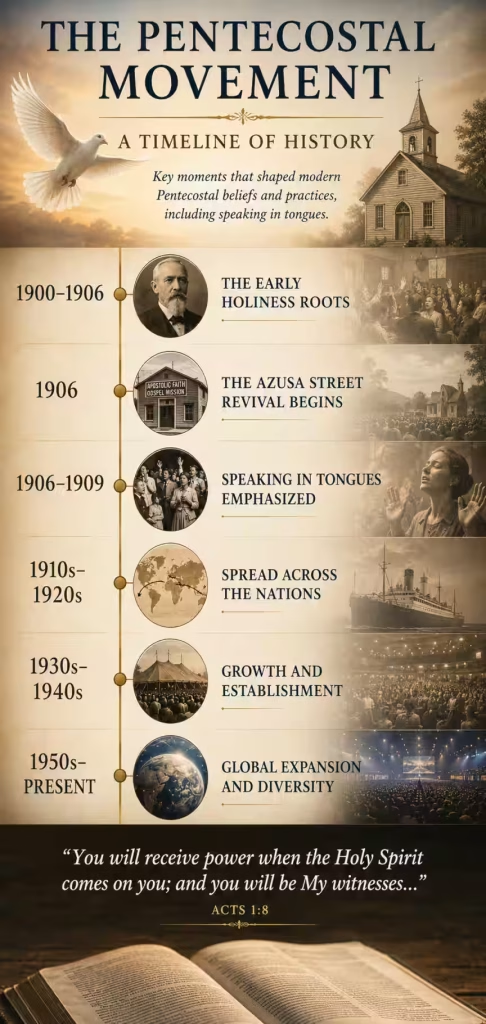
The Beginning of the Modern Pentecostal Movement
The modern Pentecostal movement is generally traced to Bethel Bible College in Topeka, Kansas, on January 1, 1901.
The school was led by Charles Fox Parham, who had been studying the book of Acts with his students.
Parham became convinced that speaking in tongues was the biblical evidence of the baptism of the Holy Spirit.
One of his students, Agnes Ozman, asked Parham to pray for her to receive the Holy Spirit.
After prayer, Ozman reportedly began speaking in what those present believed was a foreign language.
This event is often considered the beginning of modern Pentecostalism.
However, something many people do not realize is this:
Neither Parham nor his students believed Ozman was speaking a heavenly prayer language.
They believed she was speaking an actual human language.
Some even claimed she was speaking Chinese.
Others believed she had written Chinese characters.
Parham concluded that God had restored the miraculous gift seen at Pentecost.
He became convinced missionaries would no longer need years of language study because the Holy Spirit would enable them to preach immediately in whatever language was needed.
This teaching became known as the Missionary Tongues Doctrine.
The Azusa Street Revival
In 1906, one of Parham’s students, William J. Seymour, led what became known as the Azusa Street Revival in Los Angeles, California.
The revival attracted thousands of visitors from around the world.
Reports spread rapidly that ordinary men and women were suddenly speaking foreign languages they had never learned.
Early Pentecostal newspapers published testimonies claiming believers were speaking Chinese, Japanese, Hindi, Arabic, African dialects, and many other languages.
The expectation was simple.
The church believed God had restored the exact gift described in Acts 2.
Missionaries eagerly prepared to take the gospel around the world without attending language school.
The Missionary Vision
Many early Pentecostal missionaries boarded ships with tremendous excitement.
They believed the Holy Spirit had already equipped them with the languages necessary to preach Christ.
Some left without raising extensive financial support.
Others bypassed traditional missionary preparation altogether.
They expected to arrive in foreign countries and immediately begin proclaiming the gospel.
Their confidence rested entirely on the belief that God had restored the gift of miraculous human languages.
The Missionary Crisis
Unfortunately, events did not unfold as expected.
As missionaries arrived in places such as China, Japan, India, and Africa, they quickly discovered a devastating reality.
The local people could not understand what they were saying.
The sounds they believed were foreign languages were not recognized by native speakers.
One of the best-known examples involved Alfred Garr and his wife Lillian.
After participating in the Azusa Street Revival, they traveled to Hong Kong believing God had given them the ability to speak Chinese.
When they attempted to communicate, no one understood them.
Eventually, Garr was forced to do exactly what the original doctrine claimed would be unnecessary.
He hired a human translator so he could preach the gospel.
Similar reports emerged from numerous missionaries.
Many found themselves unable to communicate with the people they had traveled so far to reach.
Some returned home deeply discouraged.
Others abandoned missionary work altogether.
The S.C. Todd Investigation
One particularly significant investigation was conducted by S. C. Todd, director of the Bible Missionary Society.
Todd examined reports from Pentecostal missionaries serving in Japan, China, India, and other mission fields.
His findings were sobering.
In every documented case he investigated, native speakers were unable to recognize the supposed foreign languages.
The missionaries sincerely believed they had received miraculous languages.
The people they were trying to reach heard only unintelligible speech.
This created a major theological crisis for the young Pentecostal movement.
A Major Shift in Theology
As these missionary failures became increasingly difficult to ignore, Pentecostal leaders faced an important question.
If the gift of tongues was not functioning like Acts 2, how should it be understood?
Gradually, the movement began redefining the gift.
Instead of describing tongues primarily as miraculous human languages for missionary evangelism, many leaders began teaching that tongues were a personal prayer language intended for private devotion and worship.
This represented a significant shift from the movement’s earliest teaching.
The original expectation had been:
“God enables believers to speak real foreign languages.”
The newer understanding became:
“God gives believers a heavenly prayer language that human beings are not expected to understand.”
Over time, this newer interpretation became the dominant teaching within much of the Pentecostal and Charismatic movements.
The Word “Glossolalia”
Around this same period, another change occurred.
The term glossolalia became increasingly popular in academic and theological discussions.
📖 Greek Term Study: Glossolalia
Word Origin:
γλῶσσα (glōssa)
- Tongue
- Language
λαλέω (laleō)
- To speak
- To talk
- To utter words
Literal Meaning:
“Speaking in tongues” or “speaking in languages.”
Historical Note:
Although both Greek words appear in the New Testament, the technical theological term glossolalia is not a term used by the apostles or the early Church Fathers to describe the biblical gift of tongues.
Its modern theological usage developed much later, particularly in the late nineteenth and early twentieth centuries, as scholars and later Pentecostal writers sought to distinguish ecstatic, unintelligible speech from xenolalia – the miraculous ability to speak genuine human languages that had never been learned.
That distinction is important because the biblical descriptions in Acts consistently point toward recognizable human languages understood by listeners.
An Important Observation
I think this historical transition raises an important question for every Christian.
If the founders of the modern Pentecostal movement originally believed tongues were real human languages…
And if that belief had to be redefined after repeated missionary failures…
Then we should ask ourselves:
Which definition more closely matches the biblical evidence?
The one that was originally based on Acts 2?
Or the one that developed afterward to explain why those expectations were not fulfilled?
Ultimately, our authority is not church tradition, personal experience, or denominational history.
Our authority is Scripture.
Every doctrine – including our understanding of speaking in tongues – should be measured against God’s Word.
Does Every Christian Speak in Tongues?
One of the most common teachings in some Pentecostal and Charismatic churches is that every Christian should speak in tongues.
Some go even further by teaching that speaking in tongues is the initial physical evidence that someone has received the baptism of the Holy Spirit.
Others encourage believers to continue seeking tongues until they eventually receive the gift.
But does Scripture actually teach this?
The best place to answer that question is not by looking at modern experiences or denominational traditions.
It is by looking carefully at what Paul himself wrote.
The Holy Spirit Gives Different Gifts
In 1 Corinthians 12, Paul compares the church to a human body.
Just as a body has many different parts working together, the church has many different believers with different gifts.
Paul writes:
“Now to each one the manifestation of the Spirit is given for the common good.” – 1 Corinthians 12:7 (NIV)
Notice two important truths.
First, every believer receives something from the Holy Spirit.
Second, those gifts are given for the common good, not for personal status or superiority.
Paul then lists a variety of spiritual gifts:
- wisdom
- knowledge
- faith
- healing
- miraculous powers
- prophecy
- distinguishing between spirits
- speaking in different kinds of tongues
- interpretation of tongues
Then he makes a very important statement.
“All these are the work of one and the same Spirit, and he distributes them to each one, just as he determines.” – 1 Corinthians 12:11 (NIV)
Notice who decides which gift each believer receives.
Not the believer.
Not a pastor.
Not a denomination.
The Holy Spirit Himself.
The gifts are distributed according to His will, not ours.
Paul Asks a Series of Questions
Near the end of the chapter, Paul asks a series of rhetorical questions.
“Are all apostles? Are all prophets? Are all teachers? Do all work miracles? Do all have gifts of healing? Do all speak in tongues? Do all interpret?” – 1 Corinthians 12:29-30 (NIV)
These questions are extremely significant.
In Greek, Paul uses a grammatical construction that expects a negative answer.
Each question anticipates the response:
No.
No, not everyone is an apostle.
No, not everyone is a prophet.
No, not everyone performs miracles.
No, not everyone has gifts of healing.
And just as clearly…
No, not everyone speaks in tongues.
Paul could hardly have stated it more plainly.
If God intended every believer to speak in tongues, this would have been the perfect opportunity for Paul to say so.
Instead, he says exactly the opposite.
The Body Needs Different Gifts
Paul’s entire illustration depends on diversity.
Earlier in the chapter he writes:
“If the whole body were an eye, where would the sense of hearing be?” – 1 Corinthians 12:17 (NIV)
Imagine if every believer possessed exactly the same gift.
The church would be incomplete.
Just as a healthy body requires many different parts working together, Christ’s church requires believers with many different gifts serving one another.
Some teach.
Some encourage.
Some show mercy.
Some lead.
Some evangelize.
Some serve quietly behind the scenes.
God intentionally designed the church this way.
Spiritual maturity is never measured by possessing one particular gift.
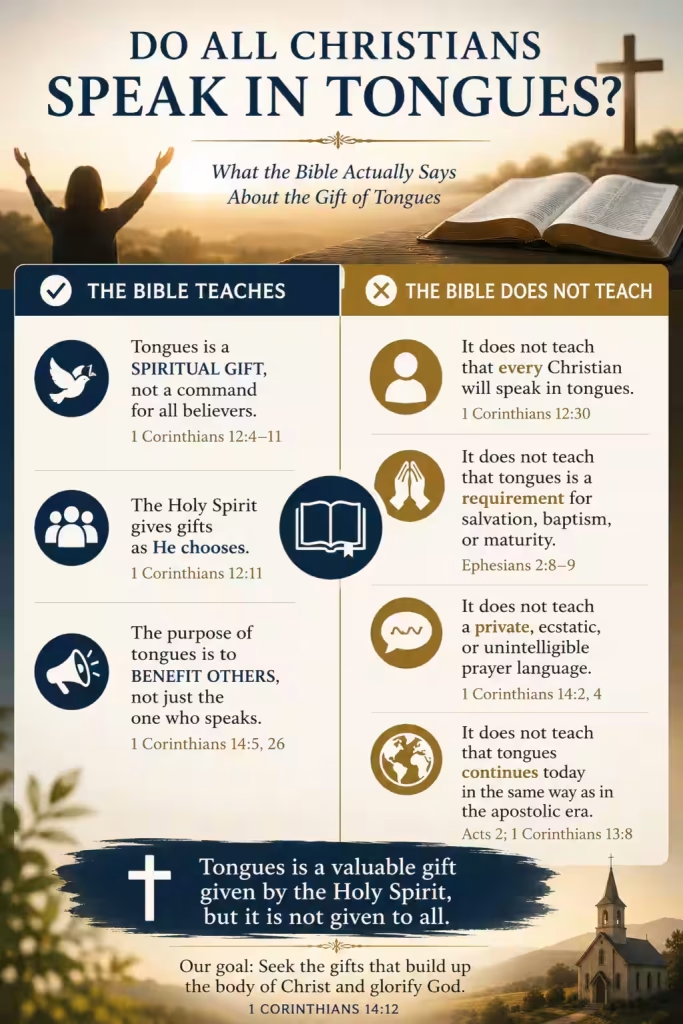
Is Speaking in Tongues the Evidence of Spirit Baptism?
Some churches teach that speaking in tongues is the initial physical evidence that a believer has been baptized in the Holy Spirit.
While sincere Christians hold different views on Spirit baptism, I personally struggle to reconcile this teaching with Paul’s own words.
If not every believer speaks in tongues—as Paul explicitly says in 1 Corinthians 12—then speaking in tongues cannot logically be the universal evidence of receiving the Holy Spirit.
Otherwise, Paul would be contradicting himself within the same letter.
Instead, Paul consistently teaches that every believer receives the Holy Spirit at conversion.
For example, he writes:
“And if anyone does not have the Spirit of Christ, they do not belong to Christ.” – Romans 8:9 (NIV)
Every Christian belongs to Christ because every Christian has received the Holy Spirit.
The New Testament never divides believers into two categories—those who truly have the Spirit because they speak in tongues and those who merely have salvation but lack the Spirit’s fullness.
Rather, all believers are united by one Spirit.
Paul also writes:
“For we were all baptized by one Spirit so as to form one body…” – 1 Corinthians 12:13 (NIV)
Notice the word all.
Every believer has been baptized into Christ’s body through the Holy Spirit.
Paul says nothing here about tongues serving as the required evidence.
What About the Book of Acts?
Some people point to several events in Acts where believers spoke in tongues after receiving the Holy Spirit.
These events are real and important.
However, Acts is describing unique moments in redemptive history as the gospel spread from Jerusalem to Judea, Samaria, and eventually to the Gentile world.
These events marked major milestones in God’s unfolding plan of salvation.
Acts records what happened.
The epistles explain what believers should expect as the normal pattern for the church.
When we turn to Paul’s teaching in 1 Corinthians 12, he explicitly says that not every believer receives the same gift.
Scripture must be interpreted as a whole.
Historical events recorded in Acts should never overturn clear doctrinal teaching given later in the New Testament.
A Healthy Church Displays Many Gifts
Something else has stood out to me as I have studied this subject.
If every member of a congregation possesses the exact same spiritual gift, it seems to conflict with Paul’s entire illustration of the body of Christ.
Paul repeatedly emphasizes diversity.
The Holy Spirit distributes different gifts to different believers so the entire church functions together.
One person teaches.
Another encourages.
Another serves.
Another shows mercy.
Another leads.
Another gives generously.
Another exercises discernment.
Another may receive the gift of tongues.
Together, these gifts strengthen the body.
The picture Paul paints is one of beautiful diversity, not uniformity.
An Observation Worth Considering
As I have observed some churches over the years, I have noticed something that has caused me to stop and think.
In some congregations, nearly everyone eventually speaks in tongues.
Often it begins with one person.
Then a spouse begins speaking in tongues.
Soon afterward, other family members or close friends begin speaking in tongues as well.
I am not questioning anyone’s sincerity.
Many people genuinely desire to honor God and experience everything He has for them.
However, this pattern raises an important question in my mind.
If the Holy Spirit distributes gifts individually according to His own will, why would nearly an entire congregation receive the exact same gift while other biblical gifts receive comparatively little attention?
That does not seem to reflect the picture Paul gives in 1 Corinthians 12.
Instead, Paul describes a church where many different gifts work together to strengthen the whole body of Christ.
I believe this is something every believer should prayerfully consider in light of Scripture.
Romans 8:26: Do “Wordless Groans” Refer to Speaking in Tongues?
Another passage frequently used to support the idea of a private prayer language is Romans 8:26.
Paul writes:
“In the same way, the Spirit helps us in our weakness. We do not know what we ought to pray for, but the Spirit himself intercedes for us through wordless groans.” – Romans 8:26 (NIV)
Some believe these “wordless groans” refer to praying in tongues.
However, when we carefully examine the context, the Greek language, and Paul’s overall argument, a very different picture emerges.
Rather than describing believers speaking in tongues, Paul is describing the Holy Spirit’s ministry of intercession on behalf of every Christian during times of suffering and weakness.
The Context of Romans 8
Before examining individual words, notice the broader context.
Romans 8 is not discussing spiritual gifts.
Paul is writing about suffering, future glory, and the hope believers have in Christ.
Beginning in verse 22, Paul describes a remarkable progression.
First, creation groans.
“We know that the whole creation has been groaning as in the pains of childbirth right up to the present time.” – Romans 8:22 (NIV)
Next, believers groan.
“Not only so, but we ourselves… groan inwardly as we wait eagerly for our adoption to sonship, the redemption of our bodies.” – Romans 8:23 (NIV)
Finally, the Holy Spirit groans.
“…the Spirit himself intercedes for us through wordless groans.” – Romans 8:26 (NIV)
Notice the progression.
Creation groans.
Believers groan.
The Spirit intercedes.
Paul is describing the pain of living in a fallen world, not explaining how spiritual gifts operate within the church.

The Greek Word for “Groans”
Paul uses the Greek noun:
στεναγμός (stenagmos)
📖 Greek Word Study: στεναγμός (stenagmos)
Used in: Romans 8:26
Meaning
The Greek noun στεναγμός (stenagmos) refers to:
- A groaning
- A deep sigh
- Inward anguish
- An expression of intense burden or suffering
Biblical Picture
Rather than describing spoken words, stenagmos paints the picture of someone carrying such a heavy burden that ordinary language is no longer sufficient to express it.
It describes the deep sigh or inward groaning that accompanies grief, suffering, weakness, or longing for deliverance.
Why This Matters
Nothing in the word στεναγμός (stenagmos) suggests speaking, vocalized language, or the gift of tongues.
Instead, it emphasizes profound inward sorrow and longing that cannot adequately be expressed through ordinary human speech.
The same theme runs throughout Romans 8.
- Creation groans under the curse of sin (Romans 8:22).
- Believers groan inwardly as they eagerly await the redemption of their bodies (Romans 8:23).
- The Holy Spirit intercedes with groans when our own words are insufficient (Romans 8:26).
The entire passage centers on suffering, hope, and God’s faithful help during our weakness—not on spiritual gifts or public worship.
The Greek Word for “Wordless”
This is perhaps the most important word in the passage.
Paul says the Spirit intercedes through:
ἀλαλήτοις (alalētois)
This comes from the adjective:
ἀλάλητος (alalētos)
📖 Greek Word Study: ἀλάλητος (alalētos)
Used in: Romans 8:26
Word Breakdown
ἀ- (a-)
Meaning:
- Without
- Not
- Lacking
This prefix negates whatever follows.
↓
λαλέω (laleō)
Meaning:
- To speak
- To utter words
- To vocalize speech
↓
Literal Meaning
When combined, ἀλάλητος (alalētos) literally means:
- Unspoken
- Not uttered
- Incapable of being spoken
- Inexpressible
- Too deep for words
How English Translations Render It
- NIV: “wordless groans”
- ESV: “groanings too deep for words”
- NASB: “groanings too deep for words”
Why This Matters
Paul intentionally chooses a word that describes something not spoken.
By definition, alalētos refers to something that is beyond human speech.
That wording is extremely significant.
Speaking in tongues, by contrast, involves audible speech. A person opens their mouth, uses their vocal cords, and produces spoken words or sounds.
Romans 8:26 describes the opposite.
Rather than describing spoken language, Paul uses a Greek word that literally means “not spoken.” The Spirit’s intercession takes place beyond the believer’s ability to express it with human words.
For this reason, many Bible scholars conclude that Romans 8:26 is describing the Holy Spirit’s silent intercession on behalf of believers during times of deep weakness and suffering, rather than the vocal gift of speaking in tongues discussed in 1 Corinthians 12-14.
Key Observation
Paul intentionally combines two important Greek words in Romans 8:26:
- στεναγμός (stenagmos) – deep inward groaning or anguish.
- ἀλάλητος (alalētos) – unspoken, inexpressible, incapable of being uttered.
Together, these words describe the Holy Spirit’s silent intercession on behalf of believers who are suffering and do not know how to pray.
This is a very different context from 1 Corinthians 12-14, where Paul discusses audible spiritual gifts exercised within the gathered church.
Who Is Doing the Groaning?
This is another detail that is often overlooked.
Notice carefully who performs the action.
Paul does not write:
“The believer groans.”
Nor does he write:
“The believer speaks mysterious sounds.”
Instead, he says:
“…the Spirit himself intercedes for us…”
The subject of the sentence is the Holy Spirit.
The Spirit—not the believer—is performing the intercession.
This is not a description of Christians vocalizing prayers.
It is a description of the Holy Spirit praying on behalf of Christians.
That distinction is extremely important.
The Spirit Intercedes for Every Believer
Notice something else.
Paul repeatedly uses universal language.
He writes:
“The Spirit helps us in our weakness.”
The Greek word translated “our” is:
ἡμῶν (hēmōn)
meaning:
our
all of us
belonging to us collectively
Paul does not divide Christians into separate categories.
He does not say:
“The Spirit helps those who speak in tongues.”
He simply says:
our weakness.
Likewise, he writes:
“…intercedes for us.”
The Greek word is:
ὑπὲρ ἡμῶν (hyper hēmōn)
meaning:
on behalf of us
for us
Again, Paul includes every believer.
The promise belongs to the entire church.
A Serious Theological Question
This raises an important question.
If Romans 8:26 is actually describing speaking in tongues, what would that imply?
It would seem to mean that only Christians who speak in tongues experience this ministry of the Holy Spirit.
But that creates a serious problem.
Paul says this promise belongs to all believers.
If someone teaches that Romans 8:26 refers exclusively to speaking in tongues, they unintentionally create two categories of Christians:
- those who experience the Spirit’s intercession
- those who do not.
That conclusion contradicts the rest of Paul’s teaching.
Two Common Attempts to Resolve the Problem
Many Pentecostal scholars recognize this difficulty and generally respond in one of two ways.
View One: Two Levels of Intercession
Some suggest the Holy Spirit intercedes in two different ways.
First, He intercedes silently for every believer.
Second, for those who speak in tongues, that intercession is also expressed outwardly through vocalized tongues.
While I appreciate the desire to preserve both passages, this explanation is not found in Romans 8 itself.
Paul never distinguishes between two different kinds of intercession.
He simply describes one universal ministry of the Holy Spirit toward every Christian.
View Two: Everyone Should Eventually Speak in Tongues
Others argue that every believer should ultimately receive the gift of tongues.
However, this creates another problem.
Earlier we saw Paul asking:
“Do all speak in tongues?” – 1 Corinthians 12:30 (NIV)
The Greek construction expects the answer:
No.
Paul explicitly teaches that not every believer receives the same gift.
Therefore, it would be inconsistent to argue that Romans 8 requires every Christian to speak in tongues in order to experience the Spirit’s fullest intercession.
What Comfort Is Paul Actually Giving?
When we read Romans 8 in context, Paul’s message becomes incredibly comforting.
Sometimes life hurts so deeply that we simply do not know how to pray.
We feel overwhelmed.
Broken.
Confused.
Words fail us.
In those moments, we are not abandoned.
The Holy Spirit Himself intercedes perfectly before the Father on our behalf.
This is not dependent upon a particular spiritual gift.
It is one of the wonderful promises given to every believer in Christ.
That truth has brought comfort to Christians for centuries.
Romans 8 and 1 Corinthians 14 Describe Two Completely Different Subjects
When we compare the two passages side by side, the differences become obvious.
| Romans 8 | 1 Corinthians 14 |
|---|---|
| Discusses suffering | Discusses corporate worship |
| Holy Spirit intercedes | Believers speak |
| Silent, inexpressible groans | Audible speech |
| Every believer | Only some receive the gift |
| Comfort during weakness | Orderly use of spiritual gifts |
These chapters address completely different situations.
Reading Romans 8 through the lens of 1 Corinthians 14 forces two unrelated passages together.
Instead, each passage makes perfect sense within its own context.
What This Means for Every Christian
One of the things I love most about Romans 8 is that this promise belongs equally to every believer.
Whether you have been a Christian for fifty years or five days…
Whether you possess many spiritual gifts or only a few…
Whether you have ever spoken in tongues or not…
The Holy Spirit intercedes for you.
When words fail…
He never does.
That is one of the greatest comforts found anywhere in Scripture.
What Is the Greatest Evidence of the Holy Spirit?
After spending so much time discussing speaking in tongues, I think it is important to step back and ask a much bigger question.
What does the Bible actually say is the greatest evidence that someone has the Holy Spirit?
Many churches answer that question by pointing to a particular spiritual gift.
Some point to speaking in tongues.
Others point to prophecy, miracles, or other supernatural experiences.
But when I read the New Testament, I see something very different.
Again and again, the apostles point us away from making spiritual gifts the primary evidence of the Holy Spirit and toward something far greater:
A life that is becoming more like Jesus Christ.
The Holy Spirit was not given simply to produce extraordinary experiences.
He was given to transform believers into the image of Christ.
That transformation is the greatest evidence of His work.
The Fruit of the Spirit
One of the clearest descriptions of a Spirit-filled believer is found in Galatians 5:22-23.
Paul begins by saying:
“But the fruit of the Spirit is love…” (Galatians 5:22-23, NIV)
He then lists the fruit that naturally grows in the life of someone walking with the Holy Spirit:
- Love
- Joy
- Peace
- Patience
- Kindness
- Goodness
- Faithfulness
- Gentleness
- Self-control
Notice something very important.
Paul does not list speaking in tongues.
He does not list miracles.
He does not list prophecy.
Instead, he describes Christlike character.
The fruit of the Spirit is not about what we can do.
It is about who we are becoming.
As we surrender our lives to Christ, the Holy Spirit changes our hearts, our attitudes, our speech, and our actions.
People should increasingly see Jesus reflected in us.
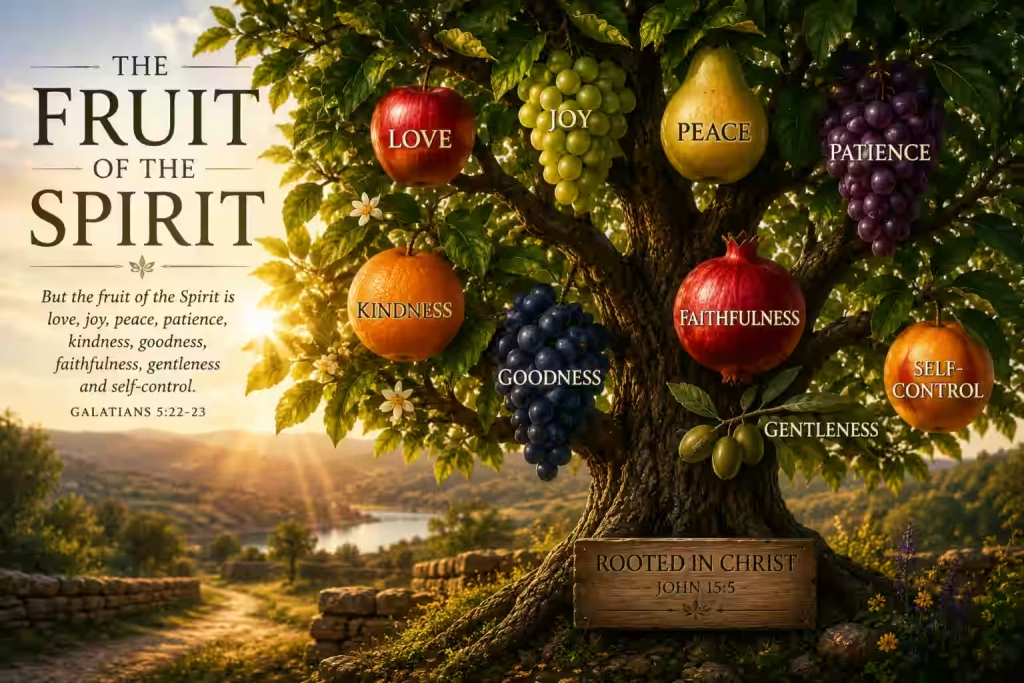
The Greatest Gift Is Love
This fits perfectly with everything Paul has already taught in 1 Corinthians.
Remember why Paul interrupted his discussion about spiritual gifts with the famous “love chapter.”
The Corinthians had become fascinated with spectacular gifts.
Paul redirected their attention to something greater.
He concluded chapter 12 by saying:
“…And yet I will show you the most excellent way.” (1 Corinthians 12:31, NIV)
That “most excellent way” was not another spiritual gift.
It was love.
Then, after discussing love throughout chapter 13, Paul returned to spiritual gifts in chapter 14.
The placement of these chapters is no accident.
Paul wanted the Corinthians—and us—to understand that gifts are temporary, but love reflects the very character of God.
Someone may possess remarkable gifts and still be spiritually immature.
But a believer who consistently demonstrates Christlike love reveals the transforming work of the Holy Spirit.
Jesus Said We Are Known by Our Fruit
Jesus Himself taught this principle.
Speaking about false prophets, He said:
“…By their fruit you will recognize them.” (Matthew 7:16, NIV)
Notice what Jesus did not say.
He did not say we would recognize genuine believers by dramatic experiences or miraculous gifts.
He said we recognize them by their fruit.
Fruit takes time to grow.
It is visible.
It affects every area of life.
A tree is known by what it consistently produces.
Likewise, a follower of Christ is recognized by a life that increasingly reflects His character.
The Holy Spirit Glorifies Christ
Jesus also explained one of the primary ministries of the Holy Spirit.
Speaking about the coming Helper, He said:
“…He will glorify me…” (John 16:14, NIV)
That short statement is incredibly important.
The Holy Spirit does not seek to draw attention to Himself.
His ministry is to glorify Jesus Christ.
Whenever the Holy Spirit is genuinely at work, people should leave thinking more about Christ—not more about spectacular experiences.
He points people to the Savior.
He convicts of sin.
He opens our understanding of Scripture.
He transforms our hearts.
He produces holiness.
He magnifies Jesus.
That has always been His mission.
A Spirit-Filled Life Looks Like Jesus
Sometimes people ask,
“What does a Spirit-filled Christian look like?”
The New Testament answers that question repeatedly.
A Spirit-filled believer loves others.
Forgives others.
Shows humility.
Pursues holiness.
Walks in obedience.
Displays patience.
Exercises self-control.
Serves others.
Speaks truth with grace.
Grows in Christlikeness.
These are not flashy qualities.
They rarely attract headlines.
But they are exactly what the Holy Spirit is producing in every believer.
Gifts Can Be Counterfeited. Character Cannot.
One observation that has become increasingly important to me is this:
Spiritual experiences can be misunderstood.
Emotions can be powerful.
People can imitate what they see around them.
Even outward displays of spirituality can sometimes be counterfeited.
Jesus warned that some people would one day say,
“Lord, Lord, did we not prophesy in your name…” (Matthew 7:22, NIV)
Yet Jesus responded that He never truly knew them.
That passage reminds us that miraculous claims alone are not proof of genuine spirituality.
The true test is whether a person’s life has been transformed by Christ.
That is much harder to fake.
A humble, loving, obedient life consistently reflects the work of the Holy Spirit.
Spiritual Gifts Are Meant to Serve Others
Another important truth is that spiritual gifts were never intended to become badges of spiritual superiority.
Paul repeatedly teaches that gifts are given for the benefit of the entire church.
Whether someone teaches, serves, encourages, gives generously, leads, shows mercy, or exercises another gift, every gift exists to build up the body of Christ.
When spiritual gifts become a source of pride, division, or competition, they are no longer being used as God intended.
The Holy Spirit never gives gifts to exalt individuals.
He gives them to glorify Christ and strengthen His church.
Can Speaking in Tongues Be Learned?
As I researched this topic, I came across numerous testimonies from people describing how they first began speaking in tongues.
One thing I noticed repeatedly was that several individuals explained they were encouraged to begin making sounds or repeating syllables until tongues eventually came.
Some described sitting for hours simply vocalizing sounds.
Others said they were instructed to start with random letters or syllables, speaking them repeatedly until the Holy Spirit supposedly took over.
I even heard two people share their personal testimonies, explaining that they began by speaking sounds from “A to Z” for hours until they eventually believed they were speaking in tongues.
I did not question their sincerity, because I believe they genuinely desired to experience everything God had for them.
However, as I listened, I found myself asking an important question:
Is that the pattern we find anywhere in Scripture?
When we examine the biblical accounts of speaking in tongues, we never see believers being coached to practice sounds.
At Pentecost, no one was taught how to speak in tongues.
No one practiced syllables.
No one gradually developed the gift over hours or days.
The Holy Spirit simply enabled believers to speak languages they had never learned.
Likewise, throughout the book of Acts, whenever the gift appears, it is presented as an immediate work of God—not as a skill developed through repetition, coaching, or practice.
That difference is worth considering carefully.
Comparing Tongues with the Other Spiritual Gifts
As I continued studying, another question came to mind.
When we look at the other spiritual gifts described in the New Testament, do we ever see believers practicing them until they eventually develop the gift?
For example, when the apostles healed the sick, Scripture never says they first spent weeks or months practicing healing until they became proficient.
When prophets received a message from God, they were not instructed to rehearse speaking prophetically until the gift finally appeared.
When God gave wisdom, discernment, miraculous faith, or the interpretation of tongues, those gifts are consistently presented as works of the Holy Spirit—not abilities developed through human repetition or training.
Paul explains this clearly in 1 Corinthians 12:
“…one and the same Spirit works all these things, distributing to each one individually just as He wills.” (1 Corinthians 12:11, NASB)
The Holy Spirit is the One who gives spiritual gifts.
He chooses which gifts to give.
He empowers those gifts.
He enables believers to use them according to His will.
That naturally raises an important question.
If every other spiritual gift is presented as a sovereign work of the Holy Spirit, why would speaking in tongues be the one gift that people must learn through repeated practice?
Nowhere in Scripture do we find the apostles telling believers:
- Practice healing until you receive the gift.
- Practice prophesying until prophetic words begin to come.
- Practice words of knowledge until they eventually flow.
- Practice miracles until God begins working through you.
- Practice speaking in tongues by repeating sounds or syllables.
Instead, whenever God gave a spiritual gift, He gave the ability itself.
The power came from the Holy Spirit—not from human repetition.
For that reason, I believe we should be cautious whenever a practice depends primarily on human instruction rather than the clear pattern we find in Scripture.
If a gift must be learned through coaching, imitation, or repeated practice, it is worth asking whether we are witnessing the sovereign work of the Holy Spirit—or something that has been acquired through human effort.
I am not suggesting that those who have been taught these methods are intentionally trying to deceive anyone. Many sincere believers simply trusted the instruction they were given by people they respected.
However, sincerity alone does not determine whether a practice is biblical.
As with every doctrine and every spiritual experience, we should lovingly and prayerfully compare what we have been taught with the clear teaching and example of God’s Word.
Frequently Asked Questions About Speaking in Tongues
What About Mark 16:17?
One of the verses frequently cited in discussions about speaking in tongues is Mark 16:17.
Jesus said:
“…they will speak in new tongues.” (Mark 16:17, NIV)
At first glance, some conclude that this verse teaches every Christian should speak in tongues.
However, there are several important points to consider.
The Longer Ending of Mark
Many modern Bible translations include a footnote explaining that Mark 16:9-20 is absent from some of the earliest and most reliable Greek manuscripts.
This does not automatically mean the passage is false, but it does mean Christians should exercise caution when building major doctrines solely upon these verses.
Most biblical scholars acknowledge that there are textual questions surrounding the longer ending of Mark.
Even If the Passage Is Authentic
Even if we accept Mark 16:9-20 as authentic Scripture, the verse still does not redefine what tongues are.
The Book of Acts provides the first historical fulfillment of Jesus’ promise.
When the Holy Spirit came at Pentecost, the disciples spoke real human languages that the surrounding crowd immediately recognized.
Acts interprets Mark.
It does not introduce a different kind of tongues.
Nothing in Mark 16 suggests a private prayer language or unintelligible speech.
Instead, the fulfillment recorded in Acts points to miraculous human languages given by the Holy Spirit.
Can God Still Enable Someone to Speak an Unlearned Human Language Today?
Absolutely.
God is sovereign.
Nothing in this article is intended to place limits on what God is capable of doing.
If God chose to miraculously enable someone to speak a language they had never learned in order to proclaim the gospel, He certainly could.
God has not changed.
He remains all-powerful.
However, there is an important distinction between what God can do and what we should expect as normal Christian doctrine.
Our beliefs should not be built upon isolated testimonies or personal experiences.
They should be built upon Scripture.
The purpose of this article is not to argue about God’s power.
It is to understand what the Bible actually teaches about the biblical gift of tongues.
Is Speaking in Tongues Required for Salvation?
No.
The Bible consistently teaches that salvation comes through faith in Jesus Christ—not through possessing any particular spiritual gift.
Paul writes:
“For it is by grace you have been saved, through faith…” (Ephesians 2:8-9, NIV)
Likewise, Romans teaches that salvation comes through believing in Christ and confessing Him as Lord.
Nowhere does Scripture say that speaking in tongues is a requirement for salvation.
One of the clearest examples is the thief on the cross.
He placed his faith in Jesus shortly before his death.
Jesus assured him that he would be with Him in paradise.
There is no mention of speaking in tongues or receiving any miraculous gift.
Our hope rests entirely in Christ’s finished work on the cross.
Is Speaking in Tongues the Evidence of Receiving the Holy Spirit?
Some churches teach that speaking in tongues is the initial physical evidence of Spirit baptism.
However, when we examine Paul’s teaching, we find a different emphasis.
In 1 Corinthians 12, Paul explains that the Holy Spirit distributes different gifts to different believers according to His will.
Later in the same chapter, Paul asks:
“Do all speak in tongues?” (1 Corinthians 12:30, NIV)
The expected answer is clearly no.
If not every believer speaks in tongues, then tongues cannot be the universal evidence of receiving the Holy Spirit.
Instead, Scripture teaches that every believer receives the Holy Spirit at salvation.
Paul writes:
“…if anyone does not have the Spirit of Christ, they do not belong to Christ.” (Romans 8:9, NIV)
The Holy Spirit indwells every true believer—not just those who possess one particular spiritual gift.
Can Christians Disagree About Speaking in Tongues and Still Be Brothers and Sisters in Christ?
Absolutely.
Throughout church history, faithful Christians have disagreed about many secondary doctrines.
While I have become convinced that the biblical evidence points to tongues being real human languages rather than a private prayer language, I also recognize that many sincere believers who love Jesus hold a different view.
This article is not written to question anyone’s salvation or love for Christ.
It is written because I believe every doctrine should be carefully examined in light of Scripture.
Our unity is ultimately found in Jesus Christ—not in complete agreement on every secondary issue.
At the same time, genuine unity does not require us to avoid difficult conversations.
True love rejoices with the truth (1 Corinthians 13:6).
We honor one another best when we study God’s Word together with humility, allowing Scripture—not tradition or experience—to shape our beliefs.
Why Does This Matter?
Some may wonder why this discussion is even important.
After all, if someone sincerely loves Jesus, does it really matter how they understand speaking in tongues?
I believe it does matter, not because speaking in tongues is the center of the Christian faith, but because how we interpret Scripture matters.
Our understanding of this subject affects how we view the work of the Holy Spirit, how we understand spiritual gifts, how churches conduct worship, and how believers evaluate spiritual experiences.
Most importantly, it teaches us an important principle that applies far beyond this one topic:
Our experiences should always be interpreted through Scripture, never the other way around.
When we allow the Bible to define our doctrine, we build our faith on a foundation that does not change with culture, movements, or personal experiences.
That is why careful Bible study is so important.
📖 Read Me Next
If this study encouraged you, continue exploring God’s Word with these related Bible studies:
- Romans Bible Study – Explore the book of Romans verse by verse, including Romans 8 and its teaching on the Holy Spirit’s work in the life of every believer.
- John Chapter 1 Bible Study – Jesus, the eternal Word made flesh.
- John Chapter 3 Bible Study – What it truly means to be born again.
- John Chapter 4 Bible Study – Worshiping God in spirit and truth.
- John Chapter 6 Bible Study – Jesus, the Bread of Life.
- John Chapter 8 Bible Study – The truth will set you free.
My Thoughts
When I first began studying speaking in tongues, I wasn’t trying to prove anyone wrong.
In fact, my goal wasn’t to defend a particular denomination or theological position at all.
I simply wanted to know one thing:
What does the Bible actually teach?
As I dug deeper into Scripture, I quickly realized that many of the assumptions I had heard over the years weren’t actually coming from the biblical text itself. They often came from modern traditions, personal experiences, or teachings that I had simply accepted without ever examining them carefully.
That realization challenged me.
Instead of asking, “What have I always been told?” I began asking, “What does God’s Word actually say?”
That question changed the direction of my study.
The more I studied Acts, 1 Corinthians, Romans, church history, the writings of the early Church Fathers, and the historical background of the first-century synagogue, the more convinced I became that the biblical gift of tongues refers to real human languages miraculously given by the Holy Spirit for the purpose of communicating God’s message.
That doesn’t mean every question has an easy answer.
It doesn’t mean sincere Christians can’t disagree.
And it certainly doesn’t mean I know everything.
But it does mean I believe Scripture must remain our final authority.

I Don’t Identify with Labels
One thing I’d like to mention before I close is that I don’t personally identify with labels like “cessationist” or “continuationist.”
In today’s church, it often seems like discussions about spiritual gifts quickly become debates between opposing camps. Before long, people begin asking, “Are you a cessationist?” or “Are you a continuationist?” as though our understanding of Scripture must fit neatly into one of those categories.
Personally, I don’t find those labels helpful.
When I first began studying this subject, I honestly didn’t even know what those terms meant. I wasn’t trying to defend a theological system or align myself with a particular movement. I simply opened my Bible with one question in mind:
“What does God’s Word actually teach?”
That is still my goal today.
If Scripture agrees with something someone who identifies as a cessationist teaches, then I want to believe what Scripture says.
If Scripture agrees with something someone who identifies as a continuationist teaches, then I want to believe what Scripture says.
My loyalty is not to a label.
My loyalty is to Jesus Christ and His Word.
I believe every Christian should be willing to let Scripture shape their beliefs rather than trying to fit Scripture into a theological system.
For me, that has meant being willing to change my mind whenever God’s Word clearly teaches something different than what I previously believed.
That should be true for all of us.
As followers of Christ, our identity is not found in theological labels but in Jesus Christ. We should all be students of God’s Word, allowing Scripture – not traditions, denominations, or personal experiences – to shape what we believe.
My Desire Is Not to Win an Argument
One thing that has been on my heart throughout writing this article is that I do not want it to become another argument between Christians.
I know many believers who attend Pentecostal or Charismatic churches genuinely love Jesus.
Many faithfully serve the Lord.
Many have a sincere desire to follow Him.
I am not writing this article to attack them.
Nor am I questioning anyone’s salvation or love for Christ simply because we disagree about this subject.
Instead, my prayer is that every one of us – including myself – would be willing to lay our traditions, experiences, and personal opinions at the feet of Scripture.
If God’s Word corrects us, then we should gladly allow ourselves to be corrected.
That should be true for every doctrine we hold.
We Must Be Bereans
One group of believers has always stood out to me when I read the book of Acts.
The Bereans.
Luke tells us that they eagerly received Paul’s teaching, yet they didn’t simply accept it because an apostle said it.
Instead, they searched the Scriptures every day to see whether what Paul was teaching was true.
That has become one of my greatest desires as a Christian.
I don’t want to believe something simply because a pastor teaches it.
Or because a denomination believes it.
Or because someone I admire says it.
I want to know what God has revealed in His Word.
If that means changing my mind, then I want to have the humility to do so.
The Holy Spirit Always Points Us to Christ
One truth kept resurfacing throughout this entire study.
The Holy Spirit’s primary ministry is not to draw attention to Himself.
It is to glorify Jesus Christ.
Whenever the Holy Spirit is genuinely at work, our eyes should be drawn to Christ.
We should love Him more.
Trust Him more.
Obey Him more.
Study His Word more.
Become more like Him.
If our focus becomes centered on pursuing spiritual experiences rather than pursuing Christ Himself, I believe our priorities have become misplaced.
The greatest miracle the Holy Spirit performs is not enabling someone to speak another language.
The greatest miracle is taking a lost sinner and transforming them into the likeness of Jesus Christ.
That work continues every single day in the life of every believer.
What I Hope You Take Away From This Study
If you’ve read this entire article, first of all, thank you.
I know this has been a long study.
But my hope is not that you walk away simply agreeing with me.
My hope is that you walk away wanting to study God’s Word even more deeply for yourself.
Open your Bible.
Read Acts again.
Read 1 Corinthians 12 through 14 as one continuous discussion.
Study Romans 8 in its context.
Look at the writings of the early Church Fathers.
Ask difficult questions.
Pray for wisdom.
Then allow Scripture—not tradition, not experiences, and not even this article—to shape your conclusions.
If this study encourages even one believer to search the Scriptures more carefully, to test everything against God’s Word, and to keep Christ at the center of their faith, then I will be thankful.
Keep the Main Thing the Main Thing
Speaking in tongues is an important subject.
But it is not the gospel.
Jesus Christ is.
His death.
His resurrection.
His grace.
His mercy.
His invitation for sinners to repent and believe.
Those are the truths that save us.
Those are the truths that unite believers across every nation, language, and culture.
At the end of the day, my greatest desire is not that people remember my conclusions about speaking in tongues.
My greatest desire is that they leave this study with a deeper love for Jesus Christ, a greater confidence in the authority of Scripture, and a renewed commitment to faithfully follow Him wherever His Word leads.
If this article accomplishes that, then I believe it has served its purpose.
Reflection Questions
As you finish this study, I encourage you not to simply accept my conclusions—or anyone else’s.
Instead, spend time in prayer and search the Scriptures for yourself.
Here are a few questions to help guide your personal study and reflection.
1. What does the Bible consistently define as “tongues”?
When you read Acts 2, Acts 10, Acts 19, and 1 Corinthians 12-14 together, what picture emerges?
Do the biblical examples consistently point to real human languages, or do they describe something different?
2. Am I interpreting Scripture through my experiences, or interpreting my experiences through Scripture?
This is one of the most important questions any Christian can ask.
Have my beliefs about speaking in tongues been shaped primarily by:
- God’s Word?
- Church tradition?
- Personal experiences?
- The teachings of others?
Am I willing to let Scripture correct me if my understanding is wrong?
3. Does my understanding of 1 Corinthians fit the entire context?
Have I read chapters 12, 13, and 14 together as one continuous discussion?
Or have I built my understanding from only a few isolated verses?
Have I considered why Paul repeatedly emphasizes:
- order,
- understanding,
- interpretation,
- and the edification of the church?
4. Does my understanding agree with the rest of Scripture?
Does my interpretation fit:
- Acts 2?
- Romans 8?
- 1 Corinthians 12?
- 1 Corinthians 13?
- 1 Corinthians 14?
- The teaching of Jesus?
- The overall purpose of spiritual gifts?
Scripture interprets Scripture.
A doctrine should fit the whole counsel of God—not just one verse.
5. What does the New Testament identify as the greatest evidence of the Holy Spirit?
When I examine my own life, am I more concerned with pursuing spiritual experiences…
or becoming more like Christ?
Am I growing in:
- love,
- joy,
- peace,
- patience,
- kindness,
- goodness,
- faithfulness,
- gentleness,
- and self-control?
These are the qualities Scripture consistently points to as evidence of the Holy Spirit’s transforming work.
6. Am I willing to change my beliefs if God’s Word teaches something different?
This may be the hardest question of all.
Every Christian—including me—must be willing to lay aside traditions, assumptions, and personal experiences if they do not align with Scripture.
Following Christ means allowing His Word to shape our beliefs, even when doing so is uncomfortable.
7. Is Jesus Christ the center of my faith?
The purpose of every spiritual gift is ultimately to glorify Christ.
As I study this topic, is my attention being drawn toward experiences…
or toward Jesus Himself?
The Holy Spirit’s ministry has always been to glorify Christ and conform believers into His image.
May that remain the greatest desire of our hearts.
Closing Prayer
Heavenly Father,
Thank You for giving us Your Word as our perfect and trustworthy guide. Thank You that we do not have to rely on human opinions, traditions, or experiences alone, but can open the Scriptures and learn from what You have revealed.
Lord, give us humble hearts that are willing to follow Your truth wherever it leads. Help us to approach Your Word with honesty, wisdom, and discernment, always seeking to rightly divide the Scriptures.
Protect us from pride, from deception, and from placing our confidence in experiences rather than in You. Teach us to test everything carefully and to hold fast to what is true.
Father, help us never to lose sight of what matters most. May our focus always remain on Jesus Christ—His life, His death, His resurrection, and the salvation He has freely given through grace.
May Your Holy Spirit continue His work within us, producing the fruit that reflects the character of Christ. Help us to grow in love, joy, peace, patience, kindness, goodness, faithfulness, gentleness, and self-control, so that our lives bring glory to You.
Lord, I also pray for unity among believers. Even when we disagree on secondary matters, help us to treat one another with humility, grace, and love while remaining firmly committed to the truth of Your Word.
May we be like the Bereans, searching the Scriptures daily to see whether these things are so, always willing to be taught and corrected by Your truth.
Above all, deepen our love for Jesus. Draw us closer to Him each day, and help us faithfully follow Him until the day we see Him face to face.
In Jesus’ name,
Amen.
Resources
Early Church & Synagogue Background
- The Mishnah (Megillah, Chapter 4)
- English Explanation of Mishnah Megillah 4:4 (Meturgeman)
- The Targums: A Textbook for the Study of the Traditional Aramaic Translations of the Hebrew Bible – Paul V. M. Flesher & Bruce Chilton
- The Ancient Synagogue: The First Thousand Years – Lee I. Levine
- Commentary on the New Testament from the Talmud and Hebraica – John Lightfoot
Greek Language Resources
- A Greek-English Lexicon of the New Testament and Other Early Christian Literature (BDAG)
- The Complete Word Study Dictionary: New Testament – Spiros Zodhiates
- Mounce’s Complete Expository Dictionary of Old and New Testament Words – William D. Mounce
Church History
- Against Heresies – Irenaeus
- Homilies on First Corinthians – John Chrysostom
- Homilies on Romans – John Chrysostom
- Homilies on First John – Augustine of Hippo
- Against Celsus – Origen
History of Modern Pentecostalism
These are among the best-documented historical resources:
- The Apostolic Faith (1906–1908 issues)
- The Holiness-Pentecostal Tradition – Vinson Synan
- Dictionary of Pentecostal and Charismatic Movements
- The Pentecostal Missionary Movement – Gary B. McGee
- Goff, James R. Jr. Fields White Unto Harvest: Charles F. Parham and the Missionary Origins of Pentecostalism.