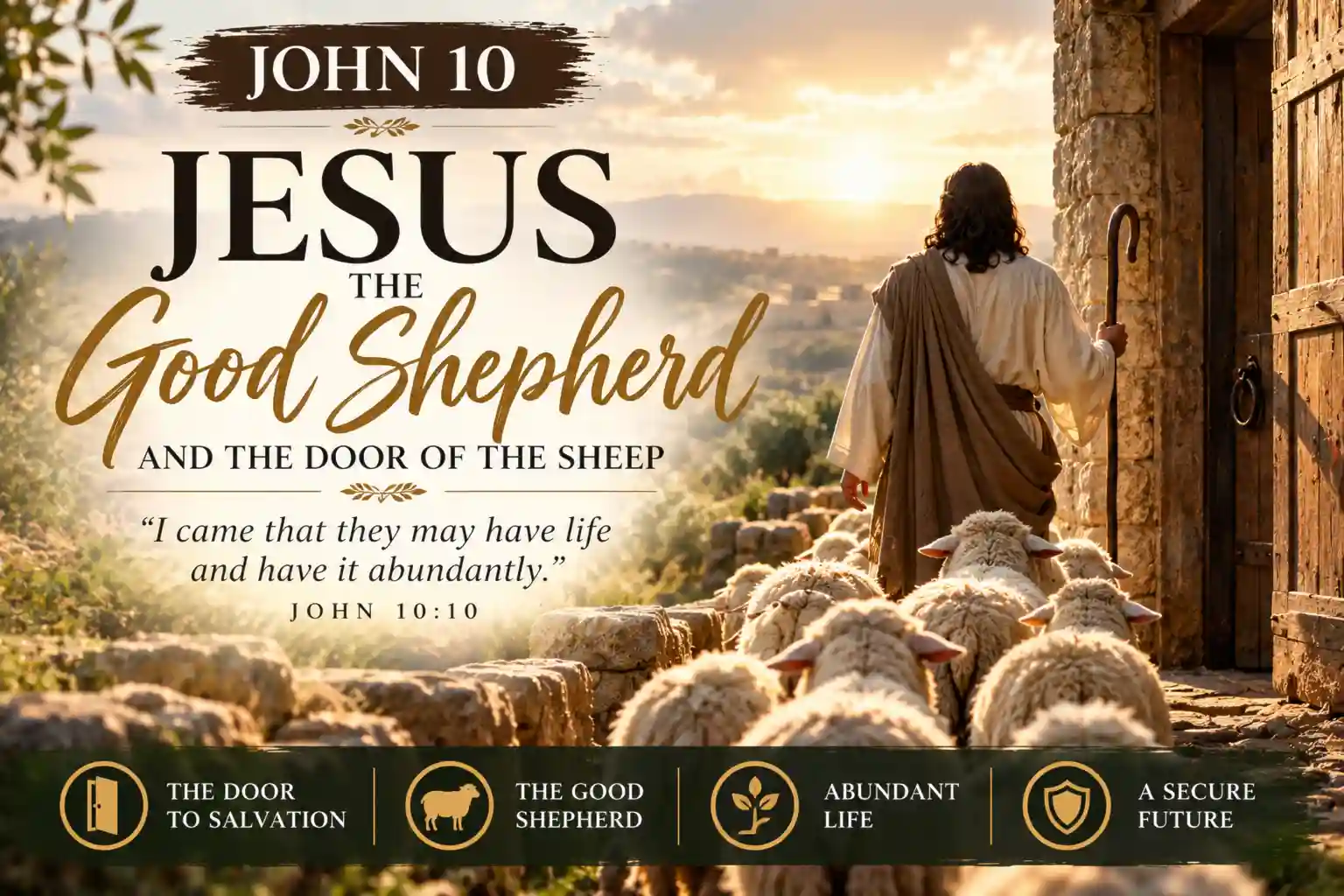
John 10 Bible Study – Jesus the Good Shepherd and the Door of the Sheep
Welcome back to our Gospel of John Bible Study here on Living for the Christ.
John Chapter 10 gives us one of the most comforting pictures of Jesus in all of Scripture. He describes Himself as the Door of the sheep and the Good Shepherd who lays down His life for the sheep.
But John 10 is about much more than the peaceful image of a shepherd caring for a flock.
Jesus contrasts Himself with false and uncaring shepherds. He explains that His sheep hear His voice, that He knows them personally, that He came to give abundant life, and that He willingly lays down His life for them.
Later, He gives His sheep an extraordinary promise:
“I give them eternal life, and they will never perish, and no one will snatch them out of My hand.” – John 10:28
And when Jesus declares:
“I and the Father are one.” – John 10:30
His opponents recognize that He is making an extraordinary claim about His relationship with God.
John 10 shows us that salvation is not about strong sheep finding their own way to God. It is about the Good Shepherd knowing, rescuing, leading, and keeping His sheep.
Key Themes in John 10
- Jesus is the Door of the sheep
- Jesus is the Good Shepherd
- Jesus knows His sheep personally
- His sheep hear and follow His voice
- Jesus willingly lays down His life
- Jesus came to give abundant life
- Jesus gathers one flock under one Shepherd
- Christ protects His sheep
- Jesus has a unique unity with the Father
- Jesus’ works testify to His identity
- False shepherds exploit, while Jesus sacrifices Himself
Why John 10 Matters Today
We live surrounded by voices competing for our attention.
Culture tells us what to believe. Social media tells us what matters. Other people tell us who we should become. Our fears, emotions, and desires can also influence the direction we take.
John 10 reminds us that there is one voice above every other voice that deserves our trust: the voice of Jesus Christ.
The Good Shepherd does not exploit His sheep. He cares for them.
He does not run when danger comes. He gives His life for them.
He does not merely know facts about His sheep. He knows them personally.
He does not lead them toward destruction. He leads them toward life.
The question John 10 places before us is simple but important:
Do I know the Shepherd, and am I following His voice?
Historical and Biblical Background – Shepherds and Sheep
Shepherding was familiar to Jesus’ audience.
Shepherds cared for their flocks by leading them to pasture and water and protecting them from predators and thieves. Sheep could become familiar with the shepherd who regularly cared for them.
But Jesus’ illustration also carries a much deeper Old Testament meaning.
Throughout Scripture, God is pictured as the Shepherd of His people.
Psalm 23 begins:
“The Lord is my shepherd.”
Isaiah describes God tending His flock like a shepherd.
The prophets also described Israel’s rulers and spiritual leaders as shepherds. Some of those leaders failed terribly.
Ezekiel 34 strongly condemns Israel’s shepherds because they cared for themselves rather than the flock.
Then God makes an incredible promise:
“I Myself will search for My sheep and seek them out.” – Ezekiel 34:11
Later in the chapter, God promises to place one shepherd, His servant David, over His people.
Those promises create an important background for John 10.
When Jesus says:
“I am the good shepherd,”
He is placing Himself directly within this great biblical expectation of God rescuing His flock and providing the promised Davidic Shepherd.
The Connection Between John 9 and John 10
The chapter division between John 9 and John 10 can make the stories seem more separate than they actually are.
In John 9, Jesus heals a man who had been blind from birth.
Instead of rejoicing over his healing, the religious leaders interrogate him and eventually cast him out.
Then Jesus goes and finds him.
That makes John 10 especially powerful.
The religious leaders failed to care properly for someone among God’s people.
Jesus sought him.
The false shepherds cast him out.
The Good Shepherd found him.
John 10:1-6 – The Shepherd and His Sheep
Jesus begins with an illustration about a sheepfold.
Someone who climbs into the sheepfold another way rather than entering properly acts like a thief or robber.
The true shepherd enters properly.
Jesus says:
“The sheep hear his voice, and he calls his own sheep by name and leads them out.” – John 10:3
Then:
“The sheep follow him, for they know his voice.” – John 10:4
They will not willingly follow a stranger because they do not recognize the stranger’s voice.
The people listening to Jesus do not yet understand what He means.
📌 Truths to Remember
- Jesus knows those who belong to Him.
- Christ leads His people rather than abandoning them.
- His followers increasingly learn to recognize His truth.
- Not every spiritual voice should be trusted.
- Knowing the Shepherd produces a desire to follow Him.
How Do We Recognize the Voice of Jesus?
This part of John 10 can easily be misunderstood.
“Hearing Jesus’ voice” should not lead us to treat every thought, feeling, dream, or impression as a direct message from God.
Jesus has given His people His Word.
The Holy Spirit does not lead believers into something that contradicts what God has revealed in Scripture.
The more deeply we know Scripture, the better equipped we become to distinguish truth from error.
When someone claims that a message, teaching, or idea comes from God, we should ask:
- Does it agree with Scripture?
- Does it honor Jesus Christ?
- Does it reflect God’s character?
- Does it encourage holiness and obedience?
- Does it distort the gospel?
- What kind of spiritual fruit does it produce?
The Shepherd’s voice will never contradict the Shepherd’s Word.
How to Test a Spiritual Voice or Teaching
Compare It With Scripture
Acts 17:11 praises the Bereans for examining the Scriptures to test what they were being taught.
Look at What It Says About Jesus
Teaching that diminishes Christ, contradicts His gospel, or presents another way of salvation should immediately concern us.
Examine Its Fruit
Jesus taught that false prophets can be recognized by their fruit.
Does the teaching produce humility, repentance, holiness, love, and faithfulness to Christ?
Or does it produce pride, greed, fear, manipulation, or obsession with the teacher?
Do Not Confuse Confidence With Truth
A teacher can sound certain and still be wrong.
Our final authority is not charisma, popularity, emotion, or personality.
It is God’s Word.
John 10:7-10 – Jesus Is the Door
Because the listeners do not understand His illustration, Jesus explains further:
“I am the door of the sheep.” – John 10:7
Then He says:
“I am the door. If anyone enters by Me, he will be saved.” – John 10:9
Jesus does not present Himself merely as one spiritual option among many.
He presents Himself as the entrance into salvation.
This is why Scripture teaches that Jesus is the only way to heaven.
Later, He will say:
“I am the way, and the truth, and the life.” – John 14:6
Jesus then contrasts His mission with that of the thief:
“The thief comes only to steal and kill and destroy. I came that they may have life and have it abundantly.” – John 10:10

📌 Life-Giving Truths
- Salvation is found through Jesus Christ.
- Jesus provides safety and pasture for His sheep.
- Christ came to rescue rather than destroy.
- Eternal life begins in relationship with Jesus.
- The world cannot provide the kind of life Christ gives.
What Does “Abundant Life” Mean?
John 10:10 is sometimes used to suggest that following Jesus guarantees financial prosperity, constant happiness, good health, or an easy life.
That is not what Jesus promises.
Jesus’ own disciples experienced persecution, hardship, imprisonment, rejection, and even martyrdom.
The abundant life Jesus offers is life reconciled to God.
It includes:
- Forgiveness
- Peace with God
- Eternal life
- Relationship with Christ
- The presence of the Holy Spirit
- Spiritual fruit
- Purpose
- Hope that survives suffering
A Christian may experience tremendous hardship while still possessing the abundant life Jesus gives.
You can explore this promise more deeply in What Is Eternal Life in the Bible?
John 10:11-18 – Jesus the Good Shepherd
Jesus now makes one of His most beloved declarations:
“I am the good shepherd. The good shepherd lays down his life for the sheep.” – John 10:11
A hired worker does not have the same relationship with the sheep. When danger comes, the hired hand may abandon them.
Jesus does the opposite.
He stays.
He knows His sheep.
And ultimately:
He gives His life for them.
Jesus says:
“I lay down My life for the sheep.” – John 10:15
This points directly toward the cross.
Jesus’ death will not be an accident or an unexpected defeat.
He says:
“No one takes it from Me, but I lay it down of My own accord.” – John 10:18
He also says that He has authority to lay His life down and authority to take it up again.
The cross and resurrection are already in view.
📌 What the Good Shepherd Teaches Us
- Jesus loves His people sacrificially.
- His death was voluntary.
- Christ does not abandon His sheep.
- Jesus knows those who belong to Him.
- The cross reveals the depth of His love.
- Jesus speaks of His authority over both His death and resurrection.
Jesus Knows His Sheep
Jesus says:
“I know My own and My own know Me.” – John 10:14
Biblical “knowing” can communicate far more than knowing facts about someone.
It points toward relationship.
Christianity therefore cannot be reduced to knowing information about Jesus.
Someone can know Bible stories, attend church, understand Christian vocabulary, and still miss the heart of Christianity.
Jesus knows His sheep.
And His sheep know Him.
Christian faith is rooted in a real relationship with the living Christ.
This relationship produces a life of discipleship. Read What It Means to Follow Jesus Daily for a practical look at following Christ in everyday life.
John 10:16 – “I Have Other Sheep”
Jesus says:
“I have other sheep that are not of this fold. I must bring them also.”
The most natural understanding in the wider New Testament context is that Jesus is looking beyond His immediate Jewish flock toward others, including the Gentiles, who will also hear His voice.
He says:
“There will be one flock, one shepherd.”
The gospel will cross ethnic and national boundaries.
Jew and Gentile believers will ultimately belong to the same people of God under the same Shepherd.
Paul later describes this unity beautifully in Ephesians 2:11-22.
The Bigger Picture
- God’s saving plan reaches beyond one nation.
- Jesus actively gathers His people.
- Believers share one Shepherd.
- The gospel crosses ethnic and cultural boundaries.
- Unity among God’s people is centered in Christ.
John 10:19-21 – Division Over Jesus
Jesus’ words once again divide those listening.
Some accuse Him of being demon-possessed or insane.
Others respond:
“These are not the words of one who is oppressed by a demon. Can a demon open the eyes of the blind?” – John 10:21
The healing of the man in John 9 is still fresh in their minds.
Jesus’ words and works force people to wrestle with His identity.
📌 Important Reminders
- People can examine the same evidence and respond differently.
- Miracles by themselves do not guarantee saving faith.
- Jesus reveals what is already present in the human heart.
- We should evaluate Christ according to truth rather than popular opinion.
🎥 Watch: John 10:1-24 Explained
In this teaching, Pastor Skip Heitzig walks through the opening portion of John 10 and explains what Jesus meant when He described Himself as the Door and the Good Shepherd.
John 10:22-30 – My Sheep Hear My Voice
The setting changes to the Feast of Dedication, known today as Hanukkah.
It is winter, and Jesus is walking in Solomon’s Colonnade.
The religious leaders surround Him and demand:
“If You are the Christ, tell us plainly.” – John 10:24
Jesus responds that His works already testify about Him.
Then He gives one of the most comforting descriptions of His sheep:
“My sheep hear My voice, and I know them, and they follow Me.” – John 10:27
He continues:
“I give them eternal life, and they will never perish, and no one will snatch them out of My hand.” – John 10:28
Jesus then speaks of the Father’s protecting hand before declaring:
“I and the Father are one.” – John 10:30
Promises for Christ’s Sheep
- Jesus knows His sheep.
- His sheep hear and follow Him.
- Jesus gives eternal life.
- No outside power can overpower Christ and steal His sheep.
- The Father also protects them.
- Jesus expresses a profound unity with the Father.
Can Anyone Snatch a Believer From Jesus’ Hand?
John 10 gives believers tremendous assurance.
Jesus specifically promises that no one can snatch His sheep from His hand or the Father’s hand.
Different Christian traditions have debated how this promise relates to questions about perseverance and whether a professing believer can later abandon the faith.
We should be careful not to force John 10 to answer every theological question by itself.
But we should also allow Jesus’ promise to give the comfort He intended.
The security of His sheep does not ultimately depend on the sheep being powerful enough to defeat every enemy.
Their Shepherd is powerful enough to protect them.
At the same time, Jesus describes His sheep as people who:
- Hear His voice
- Are known by Him
- Follow Him
Assurance and discipleship therefore belong together.
For a fuller examination of this question, read Can a Christian Lose Their Salvation? Examining Eternal Security.
You may also find Did God Choose You or Did You Choose God? helpful when studying God’s work in salvation and our responsibility to believe.
John 10:31-39 – “I and the Father Are One”
After Jesus says:
“I and the Father are one,”
His opponents pick up stones.
Jesus asks why they intend to stone Him despite the good works He has shown them.
They answer:
“You, being a man, make Yourself God.” – John 10:33
Their response shows that they heard Jesus’ statement as far more than merely saying He and God shared similar goals.
Jesus then quotes Psalm 82:
“I said, you are gods.”
This is one of the more difficult passages in John 10.
Jesus is not teaching that ordinary human beings are literally divine gods.
Psalm 82 uses the term “gods” in connection with figures who stand under God’s judgment. Exactly whom the psalm refers to has been interpreted in different ways, but Jesus’ immediate argument is clear.
If Scripture itself can use that elevated language in a lesser context, His opponents cannot simply dismiss His claim as blasphemy without considering who He is, the Father’s sending of Him, and the works He performs.
Jesus then points again to His works:
“Even though you do not believe Me, believe the works.” – John 10:38
He wants them to recognize:
“The Father is in Me and I am in the Father.”
What This Reveals
- Jesus makes extraordinary claims about His relationship with the Father.
- His opponents recognize the seriousness of those claims.
- Jesus’ works provide evidence for His identity.
- Psalm 82 does not teach that humans become gods.
- Unbelief can persist even when confronted with strong evidence.
- Jesus continually directs attention toward who He truly is.
John 10:40-42 – Many Believe in Jesus
Jesus leaves Jerusalem and travels across the Jordan to the area where John the Baptist had ministered earlier.
The people remember John’s testimony.
They say:
“John did no sign, but everything that John said about this man was true.” – John 10:41
Then John tells us:
“Many believed in Him there.” – John 10:42
This is a beautiful ending.
After rejection, debate, hostility, and attempted arrest, people elsewhere hear the truth and believe.
John the Baptist’s faithful testimony is still bearing fruit.
Encouragement for Believers
- Faithful testimony can produce fruit long after we speak.
- We do not need miraculous abilities to point people toward Jesus.
- God’s Word continues working after our role seems finished.
- Rejection does not mean the gospel has failed.
- Some will hear about Christ and believe.
False Shepherds vs. the Good Shepherd
| False Shepherds | The Good Shepherd |
|---|---|
| Use the flock for themselves | Gives Himself for the flock |
| Abandon the sheep when danger comes | Lays down His life for the sheep |
| Scatter or neglect | Gathers and leads |
| Mislead | Leads in truth |
| Seek their own benefit | Seeks the good of the sheep |
| Fail to care for the vulnerable | Knows and cares for His sheep |
| Cannot give eternal life | Gives eternal life |
This contrast should cause us to examine every spiritual leader carefully.
A faithful Christian shepherd should increasingly reflect the character of the Chief Shepherd, Jesus Christ.
Ezekiel 34 and the Good Shepherd
Ezekiel 34 is one of the most important Old Testament passages for understanding John 10.
God condemns Israel’s shepherds because they:
- Fed themselves rather than the sheep
- Failed to strengthen the weak
- Did not seek the lost
- Allowed the flock to scatter
Then God declares:
“I Myself will search for My sheep.”
Later, He promises:
“I will set up over them one shepherd, My servant David.” – Ezekiel 34:23
These two promises are remarkable.
God Himself will shepherd His people.
And God’s promised Davidic Shepherd will lead them.
John 10 brings these themes together in Jesus.
He is the promised Messiah from David’s line.
And He carries out the shepherding work that the Old Testament says God Himself will perform.
He seeks.
He gathers.
He leads.
He protects.
And most astonishingly:
The Shepherd gives His own life for the sheep.
Sheep, Goats, and Belonging to Christ
Scripture uses sheep imagery in several places to describe people who belong to Christ.
John 10 emphasizes that Jesus’ sheep are:
- Known by Him
- Responsive to His voice
- Followers of the Shepherd
Matthew 25 later uses sheep and goats in a different teaching setting to distinguish between those whose lives reveal allegiance to the King and those whose lives do not.
We should not turn these metaphors into a teaching that people earn salvation by successfully behaving like sheep.
Salvation comes through Christ.
But belonging to Christ produces a changed direction of life.
The sheep follow their Shepherd, not perfectly, but genuinely.
Common Questions About John 10
Does “Abundant Life” Mean God Wants Christians to Be Wealthy?
No.
John 10:10 promises life in Christ, not guaranteed financial prosperity or freedom from suffering.
The New Testament repeatedly shows faithful Christians enduring hardship while still possessing joy, hope, peace, and eternal life.
Who Are the “Other Sheep” in John 10:16?
The verse does not explicitly use the word “Gentiles,” so we should not pretend it does.
However, within John’s Gospel and the wider New Testament story, it most naturally points toward people beyond Jesus’ immediate Jewish flock who would be gathered to Him, including Gentile believers.
The result is one flock under one Shepherd.
Does John 10 Teach Eternal Security?
John 10 clearly teaches that Jesus gives His sheep eternal life and that no outside power can snatch them from His hand.
Christians disagree about how this passage fits with other warning passages concerning perseverance and apostasy.
Whatever position someone holds on that larger theological question, Jesus’ words here should give believers real assurance in the strength and faithfulness of Christ.
Does Hearing Jesus’ Voice Mean Christians Receive New Revelations?
John 10 itself does not teach us to identify every internal impression as Christ speaking.
Believers know Jesus through His revealed Word, and the Holy Spirit leads consistently with Scripture.
Any supposed message that contradicts Scripture should be rejected.
What Does “I and the Father Are One” Mean?
The immediate context includes the Father’s and Son’s shared protection of the sheep.
But John’s Gospel presents Jesus’ relationship with the Father as much deeper than mere cooperation.
The reaction in verse 33 also shows that His opponents heard His words as an extraordinary divine claim.
Why Does Jesus Call Himself Both the Door and the Shepherd?
Jesus is using complementary pictures.
As the Door, He is the way into salvation and safety.
As the Good Shepherd, He knows, leads, protects, and gives His life for His sheep.
The images are not contradictory. Each reveals something different about Christ.
What John 10 Does NOT Mean
John 10 does not teach that:
- Abundant life means guaranteed wealth or comfort
- Christians should follow every inner feeling as Jesus’ voice
- Spiritual leaders should never be examined or questioned
- Jesus is simply one possible door among many
- Psalm 82 teaches that human beings become divine gods
- Being secure in Christ makes obedience irrelevant
Instead, John 10 directs our confidence toward Jesus Himself.
What John 10 Reveals About Jesus
Jesus is the Door to salvation.
Jesus is the Good Shepherd.
Jesus knows His people personally.
Jesus leads His sheep.
Jesus willingly gives His life for them.
Jesus has authority over His death and resurrection.
Jesus gathers people beyond His immediate Jewish flock.
Jesus gives eternal life.
Jesus protects His people.
Jesus shares a profound unity with the Father.
Jesus fulfills the Old Testament expectation of God’s Shepherd and the promised Davidic Shepherd.
📖 Memory Verse
“My sheep hear My voice, and I know them, and they follow Me.”
John 10:27
Notice the relationship described here:
Jesus knows them.
They hear Him.
They follow Him.
How Can I Know I Am Following the Good Shepherd?
John 10 gives us several things to examine.
A follower of Christ:
- Trusts Jesus for salvation
- Listens to His Word
- Desires to follow Him
- Recognizes that eternal life comes from Christ
- Learns to reject voices that contradict Him
- Depends upon the Shepherd rather than self
- Grows in obedience
This does not mean Christians follow Jesus perfectly.
Believers stumble.
We still need correction.
But the direction of Christian discipleship is increasingly toward the Shepherd who calls us.
Reflection Questions
- Which voices have the greatest influence over my life right now?
- Am I testing those voices against Scripture?
- Do I truly know Jesus, or mainly know information about Him?
- Where is Jesus asking me to follow Him more closely?
- Do I trust the Good Shepherd when I cannot see where He is leading?
- What does Jesus laying down His life reveal about His love for me?
- Am I resting in Christ’s strength or constantly depending upon my own?
- Are there any teachers or influences in my life that resemble the false shepherd rather than the Good Shepherd?
- What does “abundant life” in Christ look like in my life right now?
- How can my testimony point someone else toward Jesus?
Discipleship Challenge
Read John 10 slowly at least twice this week.
As you read, make two lists.
What Jesus Does for His Sheep
Write down every action Jesus takes.
For example:
- He knows.
- He calls.
- He leads.
- He saves.
- He gives life.
- He lays down His life.
- He protects.
- He gathers.
How the Sheep Respond
Then write down how the sheep respond:
- They hear.
- They know.
- They follow.
When you finish, ask yourself:
How should knowing what my Shepherd does for me change the way I trust and follow Him?
Finally, choose one competing voice in your life that needs to become quieter so that Scripture can have greater influence.
The Gospel in John 10
Human beings are like sheep who need a Shepherd.
Sin separates us from God, and we cannot rescue ourselves.
Jesus came as the Good Shepherd.
He willingly laid down His life for His sheep on the cross.
He rose again, just as He spoke of taking up His life again.
Jesus is the Door through whom sinners enter salvation.
Those who belong to Him receive eternal life.
The gospel is not ultimately about lost sheep becoming clever enough to find their own way home.
It is about the Good Shepherd giving His life to save His sheep.
Key Takeaways From John 10
| Truth | Verse | Encouragement |
|---|---|---|
| Jesus is the Door | John 10:9 | Salvation is found in Christ |
| Jesus gives abundant life | John 10:10 | True life is found in Him |
| Jesus is the Good Shepherd | John 10:11 | He willingly gave His life |
| Jesus knows His sheep | John 10:14 | Christ knows His people personally |
| Jesus gathers one flock | John 10:16 | God’s saving plan reaches the nations |
| Jesus gives eternal life | John 10:28 | Our hope rests in the Shepherd |
| Jesus protects His sheep | John 10:28-29 | No enemy can overpower Christ |
| Jesus and the Father are one | John 10:30 | Jesus has a unique unity with the Father |
Cross-References for John 10
The Lord as Shepherd
- Psalm 23:1-6
- Psalm 80:1
- Isaiah 40:10-11
- Ezekiel 34:11-16
False Shepherds and the Promised Shepherd
- Jeremiah 23:1-6
- Ezekiel 34:1-10
- Ezekiel 34:23-24
- Zechariah 11:15-17
Jesus Lays Down His Life
- Isaiah 53:4-6
- Mark 10:45
- Romans 5:6-8
- 1 Peter 2:24-25
One Flock and One Shepherd
- Isaiah 56:6-8
- Ephesians 2:11-22
- Ephesians 4:4-6
Security in Christ
- Romans 8:31-39
- Philippians 1:6
- 2 Timothy 1:12
- 1 Peter 1:3-5
Knowing Christ
- John 17:3
- Romans 8:29
- 2 Timothy 1:9
Testing Spiritual Teaching
- Acts 17:11
- Matthew 7:15-20
- 1 John 4:1
- 2 Timothy 3:16-17
🙏 Prayer
Lord Jesus,
Thank You for being the Good Shepherd.
Thank You for knowing Your sheep, calling them, leading them, protecting them, and giving Your life for them.
Help me recognize Your truth in a world filled with competing voices. Give me discernment to test what I hear against Your Word and courage to reject anything that leads me away from You.
When I am afraid, remind me that You are the Shepherd who sees what I cannot see.
When I wander, correct me and draw me back.
When I do not understand where You are leading, teach me to trust Your goodness.
Thank You for laying down Your life on the cross and rising again so that sinners could receive forgiveness and eternal life.
Guard me from false teaching. Keep me humble and teachable. Help me not merely know things about You but to know You more deeply and follow You faithfully.
May my life point others toward the Good Shepherd who gives abundant and eternal life.
In Jesus’ name,
Amen.
Final Encouragement
John 10 gives believers a beautiful reason to rest.
Our hope does not depend upon being exceptionally strong sheep.
Our hope rests in a faithful Shepherd.
Jesus knows His sheep.
He calls them.
He leads them.
He lays down His life for them.
He gives them eternal life.
And no enemy is powerful enough to overpower the Good Shepherd and tear His sheep from His hand.
Whatever you are facing today, remember who is leading you.
The Good Shepherd knows the way.
Read Me Next
- John 1 – The Word Became Flesh
- John 2 – Water Into Wine
- John 3 – You Must Be Born Again
- John 4 – The Woman at the Well
- John 5 – Healing at Bethesda
- John 6 – Jesus the Bread of Life
- John 7 – Jesus Offers Living Water
- John 8 – Jesus the Light of the World
- John 9 – Jesus Heals the Man Born Blind
➡️ Next: John 11 – Jesus Raises Lazarus and Declares, “I Am the Resurrection and the Life”
The Good Shepherd knows the way.
Welcome back to our Gospel of John Bible Study here on Living for the Christ.
In John 9, Jesus healed a man who had been born blind. Although the man could finally see, the religious leaders remained spiritually blind. Instead of rejoicing over the miracle, they questioned the man, rejected his testimony, and cast him out of the synagogue.
John 10 continues that confrontation. Jesus exposes the difference between false spiritual leaders and the true Shepherd of God’s people. He describes Himself as the Door of the sheep, the Good Shepherd who willingly lays down His life, and the One who gives eternal life to everyone who truly belongs to Him.
This chapter also answers several deeply personal questions:
- How can we recognize the voice of Jesus?
- What did Jesus mean when He said He came to give abundant life?
- Why did Jesus call Himself the Good Shepherd?
- Can anyone take a true believer away from Christ?
- Was Jesus truly claiming to be God?
John 10 gives us a beautiful picture of salvation, discipleship, protection, sacrifice, and the deity of Jesus Christ.
Key Themes in John 10
- Jesus is the Door through whom sinners enter salvation.
- Jesus is the Good Shepherd who laid down His life for His sheep.
- Christ’s sheep recognize His voice and follow Him.
- False shepherds use, exploit, and abandon the flock.
- Jesus gives His sheep eternal life.
- No one can snatch a true believer from the hands of the Son or the Father.
- Jesus and the Father are one.
- The works of Jesus testify that He is the promised Messiah.
John 10:1-6 – The Shepherd and His Sheep
Jesus begins with an illustration that would have been familiar to His original listeners. Sheep were often kept together in a protected enclosure during the night. A shepherd entered through the proper opening, while a thief attempted to climb in another way.
Jesus said:
“He that entereth not by the door into the sheepfold, but climbeth up some other way, the same is a thief and a robber.” – John 10:1
This warning follows the actions of the Pharisees in John 9. These religious leaders should have cared for God’s people, but they mistreated the man Jesus had healed. They questioned him repeatedly, insulted him, and expelled him from the synagogue.
They held religious authority, but they did not have a shepherd’s heart.
A true shepherd does not enter the sheepfold to steal, control, or destroy. He comes openly, and the sheep recognize him.
“The sheep hear his voice: and he calleth his own sheep by name, and leadeth them out.” – John 10:3
The shepherd knows each sheep personally. He does not merely recognize the flock as a group. He calls his own sheep by name and leads them.
This is a beautiful picture of the relationship Jesus has with those who belong to Him. We are not nameless faces in a crowd. Jesus knows His people individually. He knows our weaknesses, fears, temptations, wounds, and needs.
He does not drive His sheep forward from a distance. He goes before them.
The Difference Between Leading and Driving
Jesus leads His people through truth, love, conviction, and faithful instruction. False teachers often try to control people through intimidation, manipulation, guilt, or fear.
The voice of Jesus may correct us, but it will never contradict His written Word. His correction leads us toward repentance, holiness, truth, and spiritual life.
A voice that encourages sin, excuses rebellion, glorifies self, or contradicts Scripture is not the voice of the Good Shepherd.
If you want to understand what genuine discipleship looks like, read What It Means to Follow Jesus Daily.
How Do We Recognize the Voice of Jesus?
Jesus primarily speaks to us through Scripture. The more deeply we know God’s Word, the more readily we can recognize teachings that do not agree with it.
We recognize the Shepherd’s voice by:
- Reading and studying the Bible regularly
- Comparing every teaching with Scripture
- Asking the Holy Spirit to give us understanding
- Obeying what God has already revealed
- Rejecting messages that contradict the character or Word of God
- Remaining in fellowship with mature, Bible-believing Christians
Jesus will never lead us away from biblical truth. He will never tell us that sin does not matter, that repentance is unnecessary, or that there are many different ways to God.
Jesus is not merely one possible shepherd among many. He is the only Savior and the only way to the Father. You can explore this further in Is Jesus the Only Way to Heaven?
Reflection: Am I becoming familiar with the voice of Christ through Scripture, or am I allowing other voices to shape what I believe?
John 10:7-10 – Jesus Is the Door
Because the people did not fully understand the first illustration, Jesus explained it more directly:
“Verily, verily, I say unto you, I am the door of the sheep.” – John 10:7
Jesus does not say that He is one door among many. He identifies Himself as the Door.
“I am the door: by me if any man enter in, he shall be saved.” – John 10:9
Salvation does not come through religious effort, family background, baptism, church membership, good deeds, or sincerity alone. We are saved by God’s grace through faith in Jesus Christ.
Jesus is the entrance into reconciliation with God because He alone paid the penalty for our sins. To learn more about this gift, read The Gift of Grace: Understanding Salvation.
The Thief Comes to Steal, Kill, and Destroy
Jesus contrasts His mission with the destructive work of thieves:
“The thief cometh not, but for to steal, and to kill, and to destroy.” – John 10:10
In the immediate context, this describes false spiritual leaders who misuse God’s people. It also reflects the destructive nature of Satan’s work.
False teaching steals truth, destroys spiritual discernment, and leads people away from the life found in Christ.
Not everyone who uses Christian language represents Jesus faithfully. A teacher may mention God, quote isolated verses, and attract a large following while still presenting a message that distorts the gospel.
This is why Christians must test every message by Scripture rather than judging it by popularity, emotion, charisma, or promises of earthly success.
What Is Abundant Life?
Jesus continues:
“I am come that they might have life, and that they might have it more abundantly.” – John 10:10
Abundant life does not mean that every Christian will be wealthy, healthy, comfortable, or free from suffering. Jesus never promised His followers an easy earthly life.
The abundant life Christ gives includes:
- Forgiveness of sin
- Peace with God
- Freedom from sin’s controlling power
- A restored relationship with the Father
- The presence of the Holy Spirit
- Spiritual purpose
- Hope in suffering
- Growth in holiness
- Eternal life with Christ
Abundant life is not primarily about receiving more earthly possessions. It is about receiving Christ and being made spiritually alive in Him.
For a deeper explanation, read What Is Eternal Life in the Bible?
Practical application: Ask yourself whether your picture of a blessed life comes from Scripture or from the world. Christ may not remove every hardship, but He gives us something far greater – Himself.
John 10:11-18 – The Good Shepherd Lays Down His Life
Jesus now gives one of His most beloved declarations:
“I am the good shepherd: the good shepherd giveth his life for the sheep.” – John 10:11
A hired worker may care for sheep as long as there is no danger. When a wolf comes, however, the hired worker runs away because the sheep do not belong to him.
Jesus is different.
He does not abandon His people when danger appears. He willingly places Himself between His sheep and the judgment they deserve.
Jesus Chose to Lay Down His Life
The cross was not an accident, and Jesus was not a helpless victim of circumstances.
He said:
“No man taketh it from me, but I lay it down of myself.” – John 10:18
Jesus willingly gave His life. His crucifixion took place according to God’s redemptive plan, and His sacrifice was motivated by love and obedience to the Father.
The Good Shepherd became the sacrificial Lamb.
John introduced Jesus this way in the opening chapter of the Gospel:
“Behold the Lamb of God, which taketh away the sin of the world!” – John 1:29
You can revisit that declaration in our John 1 Bible Study: In the Beginning Was the Word.
Jesus bore the penalty for sin so that everyone who repents and trusts in Him can be forgiven. Salvation is not something we earn. It is received by grace through faith.
For more about repentance, grace, and saving faith, read The Path to Salvation: Understanding Grace, Faith, and Repentance.
Jesus Knows His Sheep
“I am the good shepherd, and know my sheep, and am known of mine.” – John 10:14
Jesus does not merely know facts about believers. He knows them relationally and personally.
This does not mean everyone who claims to know Jesus truly belongs to Him. Scripture distinguishes between knowing information about Christ and possessing genuine saving faith.
A true relationship with Jesus produces evidence over time. His sheep hear His voice, trust Him, follow Him, and continue with Him.
This does not mean Christians become sinlessly perfect. It means genuine believers are changed by God and cannot remain entirely comfortable in unrepentant rebellion.
“Other Sheep I Have”
Jesus also said:
“And other sheep I have, which are not of this fold: them also I must bring.” – John 10:16
The “other sheep” refers to Gentiles who would be brought into God’s people through faith in Christ. God’s saving plan would extend beyond Israel to people from every nation, tribe, and language.
Jewish and Gentile believers would become one flock under one Shepherd.
There are not separate ways of salvation for different groups of people. Everyone who is saved is saved through Jesus Christ.
John 10:19-21 – The People Are Divided Again
The words of Jesus caused another division among the people.
Some claimed that He had a demon and should not be heard. Others recognized that His words and miracles could not be explained that way.
They asked:
“Can a devil open the eyes of the blind?” – John 10:21
This points directly back to the healing in John 9. The miracle was undeniable, yet many religious leaders refused to accept what it revealed about Jesus.
Evidence alone does not soften a heart committed to unbelief. People can witness God’s work and still search for reasons to reject Him.
The same Jesus who brought comfort to the healed man exposed the pride of the Pharisees. Truth comforts the humble but confronts those who refuse to surrender.
🎥 Watch: John 10:1-24 Explained
In this teaching, Pastor Skip Heitzig walks through the opening portion of John 10 and explains what Jesus meant when He described Himself as the Door and the Good Shepherd.
John 10:22-30 – My Sheep Hear My Voice
The setting changes to the Feast of Dedication in Jerusalem. This celebration, now commonly associated with Hanukkah, remembered the rededication of the temple after it had been defiled.
The religious leaders surrounded Jesus and demanded:
“If thou be the Christ, tell us plainly.” – John 10:24
Jesus explained that He had already shown them who He was. His words and His works testified about Him, but they did not believe.
Their problem was not that Jesus had failed to provide sufficient evidence. Their hearts remained resistant to the truth.
Jesus said:
“Ye believe not, because ye are not of my sheep.” – John 10:26
He then described the distinguishing marks of His sheep:
“My sheep hear my voice, and I know them, and they follow me.” – John 10:27
Notice the relationship in this verse:
- Christ’s sheep hear His voice.
- Jesus knows them personally.
- They follow Him.
A profession of faith without any desire to follow Christ should cause serious self-examination. We are not saved by works, but saving faith produces a changed direction.
Jesus told Nicodemus that sinners must be born again. You can study that essential truth in John 3 Bible Study: What It Means to Be Born Again.
📌 Promises for Christ’s Sheep
John 10:27-29 contains several powerful promises:
- Jesus knows His sheep.
- His sheep hear His voice.
- His sheep follow Him.
- Jesus gives them eternal life.
- They will never perish.
- No one can snatch them from His hand.
- The Father also holds them securely.
- The Father is greater than all.
Our security does not rest on the strength of our grip on Jesus. It rests on the strength of His grip on us.
Can Anyone Snatch a Believer From Jesus’ Hand?
Jesus said:
“I give unto them eternal life; and they shall never perish, neither shall any man pluck them out of my hand.” – John 10:28
He then added:
“No man is able to pluck them out of my Father’s hand.” – John 10:29
These verses provide powerful assurance for those who truly belong to Christ. No person, false teacher, spiritual power, trial, or circumstance is stronger than Jesus. No outside force can steal one of His sheep from Him.
True believers are secure because salvation is God’s work from beginning to end.
However, eternal security should never be used as permission to live in deliberate, unrepentant sin. Jesus describes His sheep as those who hear His voice and follow Him.
Good works do not earn salvation, but genuine salvation produces spiritual fruit. When someone permanently abandons Christ and rejects the gospel, Scripture gives us reason to question whether that person was ever truly converted.
A struggling believer and a false convert are not necessarily the same. Genuine Christians may stumble, doubt, experience spiritual dryness, or fall into serious sin. But God disciplines, restores, and preserves His children. They cannot live in permanent peace while rejecting the Shepherd.
For a fuller examination of this subject, read Can a Christian Lose Their Salvation? Examining Eternal Security.
Scripture also teaches both God’s sovereign work and the responsibility of people to repent and believe. Explore that relationship in Did God Choose You or Did You Choose God?
Jesus and the Father Are One
Jesus concludes:
“I and my Father are one.” – John 10:30
This statement goes far beyond saying that Jesus and the Father merely agreed with one another. Jesus claimed unity with the Father in divine power and purpose.
The people understood the seriousness of His claim. Their immediate reaction confirms it: they picked up stones to stone Him for blasphemy.
Throughout John’s Gospel, Jesus repeatedly reveals His divine identity. He is not a created being, a lesser god, or merely a moral teacher. He is the eternal Son who shares the divine nature with the Father.
This truth connects with John’s opening declaration:
“The Word was with God, and the Word was God.” – John 1:1
John 10:31-39 – The Religious Leaders Try to Stone Jesus
When the religious leaders picked up stones, Jesus asked which of His good works had caused them to respond this way.
They answered:
“For a good work we stone thee not; but for blasphemy; and because that thou, being a man, makest thyself God.” – John 10:33
They understood that Jesus was making a divine claim. They did not attempt to correct a misunderstanding. They wanted to kill Him because they rejected His identity.
What Did Jesus Mean by “You Are Gods”?
Jesus responded by quoting Psalm 82:6:
“I said, Ye are gods.” – John 10:34
This verse is sometimes removed from its context and used to claim that human beings are divine or can become gods. That is not what Jesus was teaching.
In Psalm 82, the term was used for human judges or rulers who exercised delegated authority and were accountable to God. These rulers were not divine beings worthy of worship. In fact, the psalm rebukes them for judging unjustly and reminds them that they will die like other men.
Jesus used a lesser-to-greater argument. If Scripture could use this limited expression for human representatives who received God’s Word, it was inconsistent for the leaders to accuse the One set apart and sent by the Father of blasphemy for calling Himself the Son of God.
Jesus was not weakening His claim to deity. He was exposing their inconsistent use of Scripture while continuing to point to His divine works.
Believe the Works
Jesus told them that if He was not doing the works of His Father, they should not believe Him. But if He was doing the Father’s works, those works provided evidence that:
“The Father is in me, and I in him.” – John 10:38
His miracles were not entertainment or isolated acts of compassion. They were signs revealing His identity and confirming that He had been sent by the Father.
Yet the leaders again attempted to seize Him, and He escaped from their hands.
Their unbelief was not caused by a lack of evidence. They rejected the conclusion to which the evidence pointed.
Reflection: When Scripture confronts something I do not want to surrender, do I humbly submit to God’s truth or search for a way around it?
John 10:40-42 – Many Believe in Jesus
Jesus left Jerusalem and went back across the Jordan to the place where John the Baptist had ministered earlier.
Many people came to Him and remembered that everything John had said about Jesus was true.
“And many believed on him there.” – John 10:42
This creates a striking contrast.
In Jerusalem, religious leaders surrounded Jesus with hostility despite witnessing His works. Across the Jordan, ordinary people remembered the faithful testimony of John and believed.
John the Baptist performed no recorded miracle, but his testimony faithfully pointed people to Christ. His ministry reminds us that spiritual usefulness is not measured by fame, spectacle, or visible power.
Faithfulness to the truth can continue bearing fruit long after the words are first spoken.
We may not see the immediate results of every conversation, prayer, lesson, or act of obedience. Our responsibility is to point people toward Jesus and trust God with the outcome.
What John 10 Teaches Us About Jesus
Jesus Is the Only Door to Salvation
We cannot enter God’s kingdom through our own goodness, religious background, or personal effort. Jesus is the Door, and salvation is found in Him alone.
Jesus Is the Good Shepherd
Unlike false shepherds who exploit or abandon people, Jesus loves His sheep and gave His life for them.
Jesus Knows His People Personally
Christ does not treat believers as an anonymous crowd. He knows each of His sheep and calls them by name.
Jesus Leads Through His Word
The voice of the Shepherd will always agree with Scripture. Knowing the Bible helps protect us from false teaching and spiritual deception.
Jesus Gives Abundant and Eternal Life
The life Jesus gives is not a promise of constant comfort or material prosperity. It is reconciliation with God, spiritual life now, and eternal life with Him.
Jesus Preserves His Sheep
No outside power can remove a genuine believer from the hands of Jesus and the Father.
Jesus Is God the Son
When Jesus said, “I and my Father are one,” His listeners understood that He was claiming equality with God. His words and works consistently reveal His divine identity.
Practical Applications From John 10
Spend Time Learning the Shepherd’s Voice
Make Scripture part of your daily life. Read it carefully, study it in context, and compare everything you hear with what God has revealed.
Be Careful Whom You Follow
A popular teacher is not necessarily a faithful teacher. Look for humility, sound doctrine, biblical fruit, and a willingness to proclaim the whole counsel of God.
Rest in Christ’s Protection
If you have genuinely repented and trusted in Jesus, your salvation rests in His power rather than your ability to live without weakness or failure.
Follow Rather Than Merely Listen
The sheep of Jesus do not only recognize His voice; they follow Him. Ask God to reveal any area where you are hearing the truth but resisting obedience.
Remember What Abundant Life Really Means
Do not measure God’s goodness solely by comfort, possessions, health, or circumstances. The greatest gift God gives us is Christ Himself.
Point Others to Jesus Faithfully
Like John the Baptist, you may not always see immediate results. Continue speaking the truth and directing attention away from yourself and toward Christ.
Key Takeaways From John 10
| Truth | Passage | What It Means for Us |
|---|---|---|
| Jesus is the Door | John 10:7-9 | Salvation is found through Christ alone |
| Jesus gives abundant life | John 10:10 | Life in Christ is spiritually full and eternally secure |
| Jesus is the Good Shepherd | John 10:11 | He willingly laid down His life for His sheep |
| Jesus knows His sheep | John 10:14 | Believers are personally known and loved by Christ |
| Christ’s sheep follow Him | John 10:27 | Genuine faith produces a changed direction |
| Jesus gives eternal life | John 10:28 | Salvation is a gift that rests on Christ’s power |
| No one can snatch away His sheep | John 10:28-29 | True believers are secure in the hands of the Son and Father |
| Jesus and the Father are one | John 10:30 | Jesus openly revealed His divine identity |
| God can use faithful testimony | John 10:40-42 | Our words may bear fruit even when we do not immediately see it |
Reflection Questions
- What does the image of Jesus as the Good Shepherd teach you about His character?
- Are you learning to recognize the voice of Jesus through Scripture?
- What competing voices have been influencing your beliefs or decisions?
- Have you entered through the Door by repenting and trusting in Jesus alone?
- Have you ever confused abundant life with financial success or an easy life?
- How does knowing that Jesus willingly laid down His life affect the way you view the cross?
- Does your life show evidence that you are following the Shepherd?
- Do you struggle to believe that you are secure in Christ’s hands? Why?
- How can John 10:28-29 comfort you during seasons of fear, doubt, or spiritual weakness?
- Is there an area in which you hear what Jesus says but resist following Him?
- How can you become more discerning about false teachers?
- Who in your life needs to hear a faithful testimony about Jesus?
A Prayer Based on John 10
Lord Jesus,
Thank You for being the Good Shepherd who knows me, calls me, leads me, and laid down His life for me. Thank You for not abandoning Your sheep when danger comes.
Help me recognize Your voice through Your Word. Give me discernment to reject false teaching and courage to obey the truth, even when obedience is difficult.
Forgive me for the times I have followed the voices of fear, culture, pride, comfort, or human approval instead of following You.
Thank You for being the Door to salvation. I know that I cannot save myself through good works or religious effort. My hope rests entirely in Your finished work.
Help me understand the abundant life You give. Teach me to value forgiveness, holiness, truth, fellowship with You, and eternal hope more than temporary comfort.
When I feel afraid or uncertain, remind me that no one can snatch Your true sheep from Your hand. Help me rest in Your strength while continuing to follow You faithfully.
Use my life and testimony to point others toward You, just as John the Baptist faithfully prepared the way.
In Jesus’ name, amen.
Final Thoughts
John 10 gives us one of the clearest and most comforting pictures of Jesus in all of Scripture.
He is the Door through whom we enter salvation. He is the Good Shepherd who willingly laid down His life for His sheep. He knows His people personally, leads them through His Word, gives them eternal life, and holds them securely in His hand.
This chapter also gives us an important warning. Many voices compete for our attention, and not everyone who claims spiritual authority faithfully represents Christ. We must know Scripture well enough to distinguish the Shepherd’s voice from the voices of strangers.
The question is not merely whether we have heard facts about Jesus. The question is whether we know Him, trust Him, and follow Him.
The Good Shepherd is still calling sinners to repent, believe, and follow Him. Those who come to Him will find forgiveness, spiritual life, loving guidance, and eternal security in His hands.
Read Me Next
- John 9 Bible Study: Jesus Heals a Man Born Blind
- Can a Christian Lose Their Salvation? Examining Eternal Security
- What Is Eternal Life in the Bible?
- What It Means to Follow Jesus Daily
- The Gift of Grace: Understanding Salvation
- Is Jesus the Only Way to Heaven?
Let’s Talk
Which truth from John 10 encouraged or challenged you the most?
Does the promise that no one can snatch Christ’s sheep from His hand change the way you think about your security in Him?
Share your thoughts in the comments below.