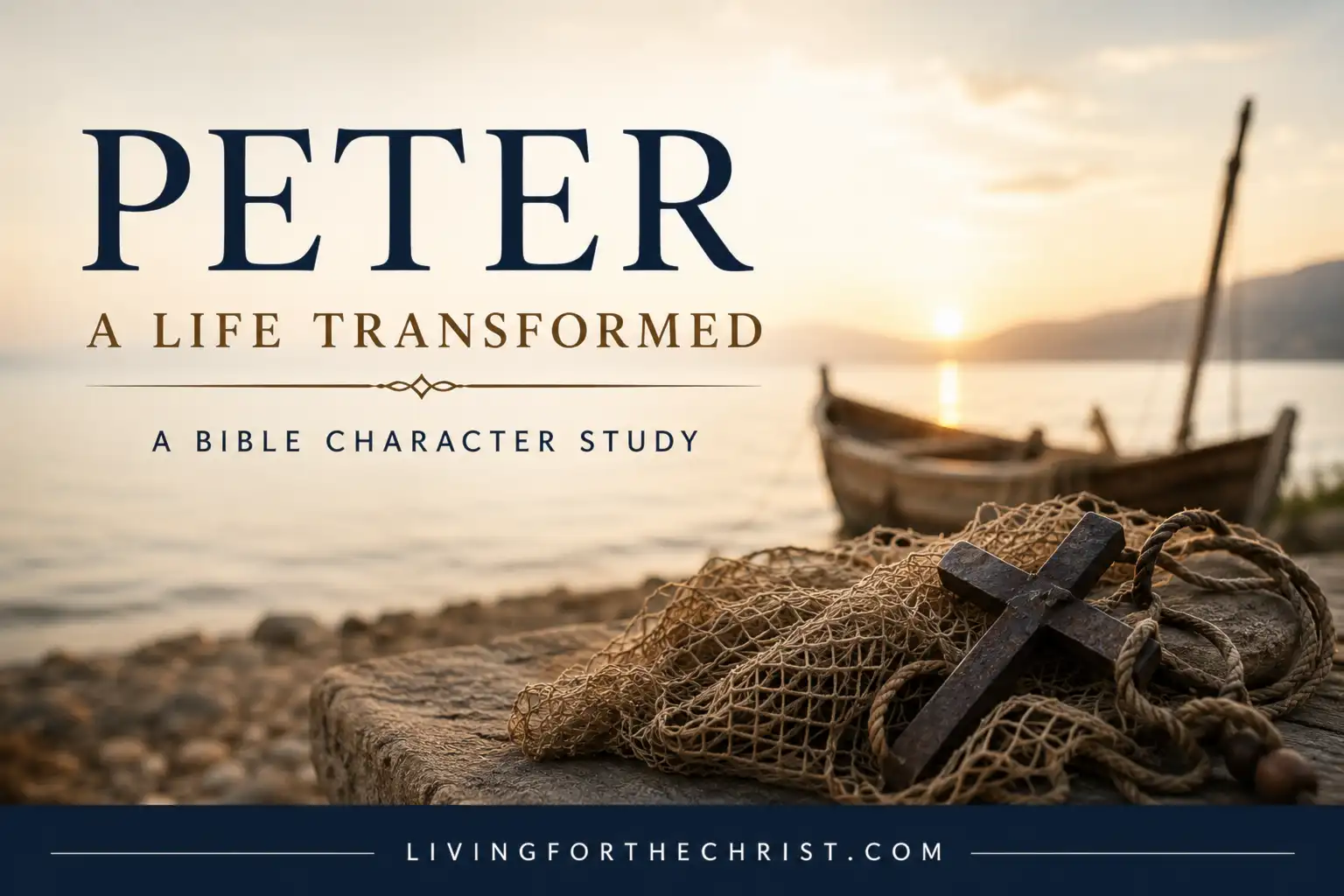
Peter Character Study: What We Can Learn from Failure, Fear, and God’s Grace
Peter’s Story at a Glance
Peter was one of Jesus’ closest disciples and one of the most well-known people in the Bible. He was bold, passionate, outspoken, and often acted before thinking. Peter loved Jesus deeply, but he also experienced moments of fear, doubt, and failure.
His story gives hope because we see someone who made mistakes, denied Jesus, struggled with fear, and yet God still used him powerfully.
If you have ever felt like you’ve failed God too many times or wonder whether God can still use you, Peter’s story offers encouragement.
Key passages:
- John 1:35-42
- Luke 5:1-11
- Matthew 14:22-33
- Matthew 16:13-18
- Luke 22:54-62
- John 21:15-19
- Acts 2:14-41
How We Studied Peter’s Life
This character study was created by examining key events throughout Peter’s life and comparing passages across the Gospels, Acts, and Peter’s own letters.
The goal is not simply to learn facts about Peter but to understand what his life teaches us about faith, repentance, spiritual growth, discipleship, and God’s grace.
Peter’s story points us beyond Peter and ultimately to Jesus Christ.
Peter’s Life Timeline
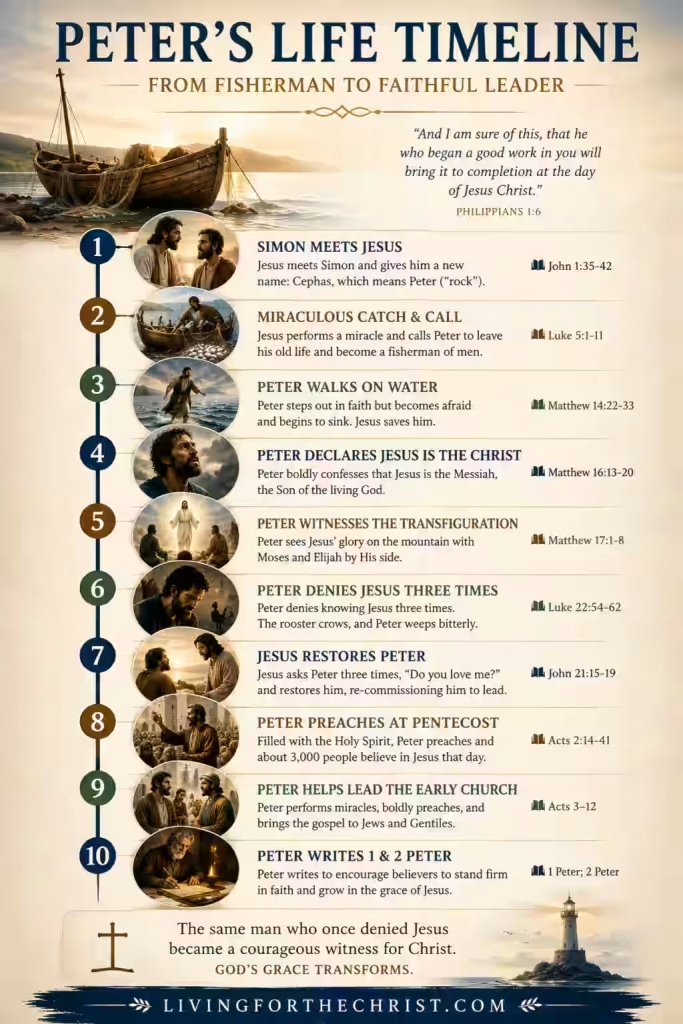
Simon meets Jesus
(John 1:35-42)
↓
Miraculous catch of fish and Jesus calls Peter
(Luke 5:1-11)
↓
Peter walks on water
(Matthew 14:22-33)
↓
Peter declares Jesus is the Christ
(Matthew 16:13-20)
↓
Peter witnesses the Transfiguration
(Matthew 17:1-8)
↓
Peter denies Jesus three times
(Luke 22:54-62)
↓
Jesus restores Peter
(John 21:15-19)
↓
Peter preaches at Pentecost
(Acts 2)
↓
Peter helps lead the early church
↓
Peter writes 1 Peter and 2 Peter
↓
Peter remains faithful to Christ until death
Who Was Peter?
Peter’s original name was Simon.
When Jesus first met him, He said:
“You are Simon the son of John. You shall be called Cephas” (which means Peter).
John 1:42 (ESV)
The name Peter means “rock.”
Peter worked as a fisherman before Jesus called him to become one of His disciples.
Some things we learn about Peter:
✔ Fisherman by trade
✔ Brother of Andrew
✔ One of Jesus’ closest disciples
✔ Witnessed many miracles
✔ Strong personality and passionate faith
✔ Became a leader in the early church
Peter often spoke first, acted quickly, and sometimes got himself into trouble.
Yet God was shaping him through every success and failure.
Peter reminds us that God often uses ordinary people to accomplish extraordinary purposes.
Interesting Facts About Peter
- Peter was married. Matthew 8:14 mentions Jesus healing Peter’s mother-in-law.
- Peter was originally called Simon before Jesus gave him the name Peter (Cephas).
- Peter was part of Jesus’ inner circle along with James and John.
- Peter witnessed the Transfiguration, where Jesus revealed His glory.
- Peter witnessed Jesus raise Jairus’ daughter from the dead.
- Peter was among the first disciples to investigate the empty tomb after Jesus’ resurrection.
- Peter wrote two books of the New Testament: 1 Peter and 2 Peter.
- Peter preached one of the most influential sermons in history on the Day of Pentecost.
- God used Peter to help open the door of the gospel to Gentiles through Cornelius in Acts 10.
These details help us understand Peter’s unique role among Jesus’ followers.
Peter’s Strengths and Weaknesses
One reason Peter is so relatable is because Scripture shows both his strengths and his weaknesses.
Strengths
- Bold faith
- Passion for Jesus
- Leadership qualities
- Willingness to step out
- Teachable heart
- Deep love for Christ
Weaknesses
- Impulsive decisions
- Fear of people
- Overconfidence
- Sometimes spoke before thinking
- Struggled to fully understand God’s plans
Encouragement: God did not discard Peter because of his weaknesses. Instead, He transformed Peter through them.
That should encourage every believer who feels inadequate or unqualified.
Jesus Calls Peter
Peter’s life changed dramatically after witnessing Jesus’ power.
Luke chapter 5 records a miraculous catch of fish after an unsuccessful night of fishing.
After seeing what Jesus had done, Peter fell before Him and said:
“Depart from me, for I am a sinful man, O Lord.”
Luke 5:8 (ESV)
Peter immediately recognized his own unworthiness.
Jesus responded:
“Do not be afraid; from now on you will be catching men.”
Luke 5:10 (ESV)
Peter left his old life behind and followed Christ.
📌 Lessons from Peter’s Calling
- Jesus calls imperfect people.
- God often uses ordinary workers and everyday people.
- Following Jesus requires leaving our old life behind.
- God sees what we can become through His grace.
Jesus did not wait for Peter to become perfect.
He called Peter and transformed him along the way.
The same is true for us today.
Peter Walks on Water
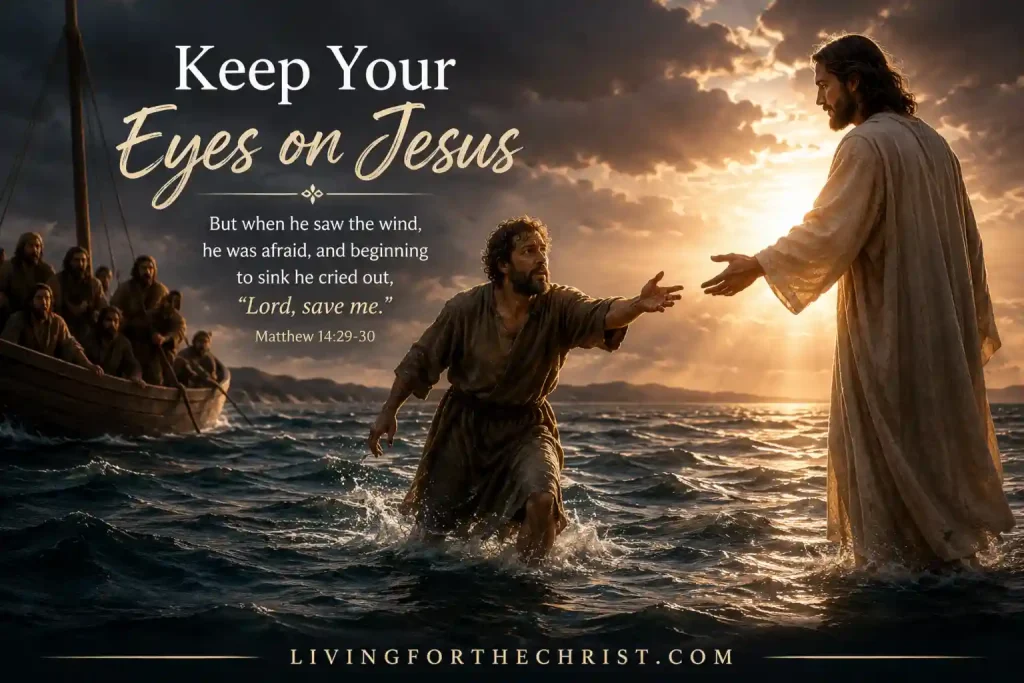
One of Peter’s most famous moments happened when Jesus walked across the Sea of Galilee.
Peter said:
“Lord, if it is you, command me to come to you on the water.”
Matthew 14:28 (ESV)
Jesus told him to come.
Peter stepped out of the boat and actually walked on water.
But then Scripture says:
“But when he saw the wind, he was afraid…”
Matthew 14:30 (ESV)
Peter became frightened and began sinking.
Immediately Jesus reached out and saved him.
📌 Lessons from Peter Walking on Water
- Faith sometimes requires stepping out of our comfort zone.
- Fear grows when we focus on circumstances instead of Christ.
- Jesus is faithful even when our faith is weak.
- God often teaches us through our failures.
Many believers can relate to Peter.
We start out trusting God, but then life’s storms distract us.
Peter’s story reminds us to keep our eyes on Jesus.
Peter Declares Jesus Is the Christ
One of Peter’s greatest moments came when Jesus asked His disciples:
“But who do you say that I am?”
Matthew 16:15 (ESV)
Peter answered:
“You are the Christ, the Son of the living God.”
Matthew 16:16 (ESV)
This declaration stands as one of the clearest statements about Jesus’ identity in the Gospels.
Peter recognized that Jesus was not merely a teacher or prophet.
He was the promised Messiah.
Yet only a few verses later Peter rebuked Jesus for speaking about His coming death.
Jesus responded:
“Get behind me, Satan!”
Matthew 16:23 (ESV)
Peter moved from remarkable spiritual insight to serious misunderstanding within a matter of moments.
📌 Lessons from Peter’s Confession
- Spiritual insight comes from God.
- We can know truth and still misunderstand God’s plans.
- Human wisdom is not always God’s wisdom.
- Following Jesus requires trusting Him even when we do not understand.
Peter’s experience reminds us that spiritual growth is often a process.
Peter Witnesses the Transfiguration
Peter was one of only three disciples invited to witness the Transfiguration.
Jesus took Peter, James, and John up a mountain where His appearance was transformed before them.
His face shone like the sun and His clothes became dazzling white.
Moses and Elijah appeared with Him.
Peter was overwhelmed and suggested building three tents for Jesus, Moses, and Elijah.
While Peter was speaking, God the Father declared:
“This is my beloved Son, with whom I am well pleased; listen to him.”
Matthew 17:5 (ESV)
📌 Lessons from the Transfiguration
- Jesus is far more than a prophet or teacher.
- Jesus is God’s beloved Son.
- Our focus should remain on Christ.
- Worship begins with seeing Jesus for who He truly is.
The Transfiguration gave Peter a glimpse of Christ’s divine glory that he would never forget.
Peter Denies Jesus
Peter once boldly claimed:
“Even though they all fall away because of you, I will never fall away.”
Matthew 26:33 (ESV)
Jesus warned Peter that he would deny Him three times before morning.
Peter insisted it would never happen.
Yet later that night, fear overcame him.
Three times Peter denied knowing Jesus.
Then the rooster crowed.
Luke records a heartbreaking detail:
“And the Lord turned and looked at Peter.”
Luke 22:61 (ESV)
Peter immediately realized what he had done.
Scripture says:
“And he went out and wept bitterly.”
Matthew 26:75 (ESV)
📌 Lessons from Peter’s Failure
- Self-confidence can lead to spiritual failure.
- Fear of people can cause us to compromise.
- Even sincere believers can fall.
- Failure does not place us beyond God’s grace.
This was one of the darkest moments in Peter’s life.
Yet it was not the end of his story.
Jesus Restores Peter
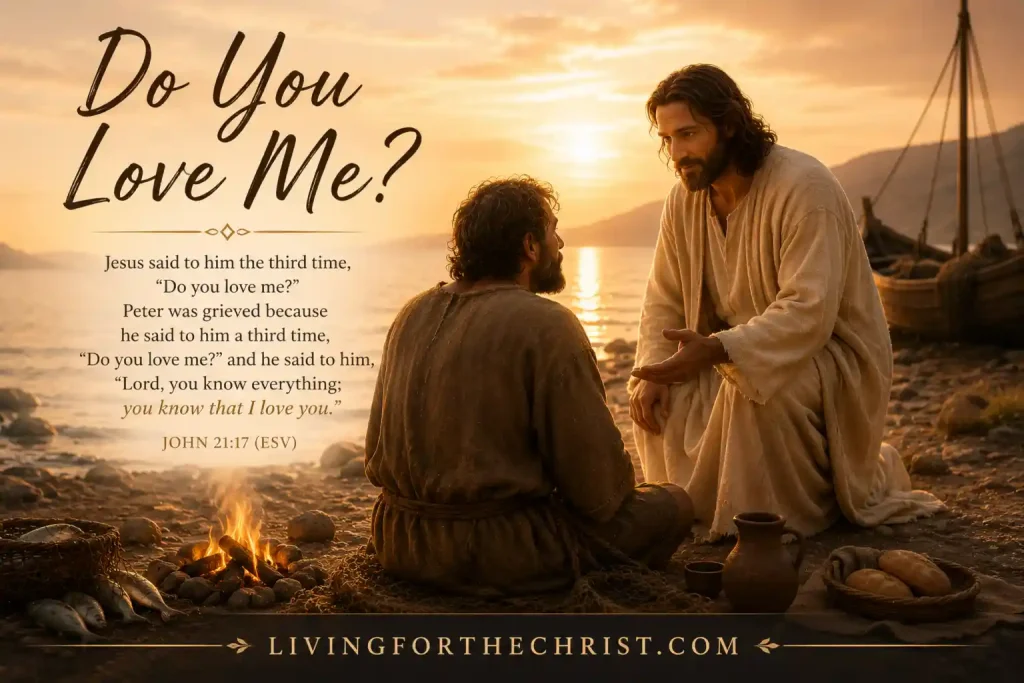
After Jesus rose from the dead, He intentionally sought out Peter.
The disciple who had denied Him was not forgotten.
In John 21, Jesus met Peter by the Sea of Galilee.
Three times Jesus asked:
“Do you love me?”
John 21:15-17 (ESV)
Three times Peter answered yes.
Many Bible scholars believe Jesus asked the question three times because Peter had denied Him three times.
Jesus was not trying to shame Peter.
He was restoring him.
After each response, Jesus gave Peter a commission:
“Feed my lambs.”
“Tend my sheep.”
“Feed my sheep.”
Peter’s ministry was not over.
God still had a purpose for his life.
📌 Lessons from Peter’s Restoration
- Jesus restores repentant sinners.
- Failure does not have to define your future.
- God’s calling is not canceled by our mistakes.
- Grace is greater than our failures.
Peter’s greatest failure became part of his testimony.
How God Changed Peter
Peter’s life shows what God can do through a surrendered heart.
| Before | After |
|---|---|
| Fearful | Bold |
| Impulsive | More Spirit-led |
| Denied Jesus | Publicly preached Jesus |
| Trusted his own strength | Learned dependence on God |
| Easily shaken | Grew into a church leader |
Peter did not become mature overnight.
God transformed him over many years.
The Christian life works the same way.
Growth is usually gradual.
God patiently shapes His people over time.
Peter After Restoration
After Jesus ascended into heaven, Peter was empowered by the Holy Spirit.
The same man who once denied Jesus now boldly proclaimed Him.
Acts chapter 2 records Peter standing before a large crowd and preaching the gospel.
About 3,000 people believed in Christ that day.
This was not because Peter had become naturally courageous.
It was because God had transformed him.
Peter still struggled at times.
Galatians chapter 2 records a situation where Paul publicly corrected Peter for acting hypocritically toward Gentile believers.
Even mature believers continue growing.
📌 Lessons from Peter’s Later Life
- Spiritual growth is a lifelong process.
- Mature believers still need correction.
- God continues sanctifying His people.
- Dependence on the Holy Spirit is essential.
Peter’s Ministry in the Early Church
Peter became one of the key leaders in the early church.
Through the power of the Holy Spirit, God used Peter in remarkable ways.
Peter’s Ministry Included:
✔ Preaching at Pentecost and seeing about 3,000 people saved (Acts 2)
✔ Healing a lame man through the power of Christ (Acts 3)
✔ Boldly preaching despite persecution (Acts 4)
✔ Helping lead the growing church (Acts 5)
✔ Bringing the gospel to Gentiles through Cornelius (Acts 10)
✔ Encouraging believers during times of difficulty
The man who once denied Jesus became a faithful witness for Christ.
📌 Lessons from Peter’s Ministry
- God can use anyone who is surrendered to Him.
- The Holy Spirit empowers believers for ministry.
- Courage comes from God, not ourselves.
- The gospel is for all people.
How Peter’s Life Ended
The Bible does not record Peter’s death.
However, early Christian writings indicate that Peter was martyred in Rome during the persecution under Emperor Nero.
Church tradition states that Peter requested to be crucified upside down because he did not consider himself worthy to die in the same manner as Jesus.
While Scripture does not confirm every detail of that tradition, history consistently records that Peter remained faithful to Christ until the end of his life.
The man who once denied Jesus eventually became willing to suffer and die for Him.
📌 Lessons from Peter’s Death
- Faithfulness matters more than comfort.
- God’s grace can completely transform a life.
- Following Christ is worth the cost.
- True faith endures.
What Did Peter Write?
God also used Peter to write two books of the New Testament.
1 Peter
Peter wrote this letter to encourage believers facing suffering and persecution.
Major themes include:
- Hope in Christ
- Enduring suffering
- Holy living
- Standing firm in faith
2 Peter
Peter wrote this letter to encourage spiritual growth and warn believers about false teachers.
Major themes include:
- Growing in godliness
- Knowing God’s truth
- Guarding against deception
- Looking forward to Christ’s return
Even today, Christians continue learning from Peter’s inspired writings.
What Peter’s Story Reveals About Jesus
Peter’s story is not ultimately about Peter.
It reveals the character of Jesus.
Jesus:
✔ Calls imperfect people
✔ Shows patience with weak believers
✔ Restores repentant sinners
✔ Continues working in us over time
✔ Gives grace where we deserve condemnation
Peter’s life magnifies the mercy and faithfulness of Christ.
Character Traits We Can Learn From Peter
Courage
Peter was willing to step out of the boat when others remained behind.
Humility
After failure, Peter repented rather than making excuses.
Teachability
Peter accepted correction from Jesus and later from Paul.
Love for Christ
Despite his failures, Peter genuinely loved Jesus.
Perseverance
Peter continued following Christ even after making mistakes.
These are qualities every believer should seek to develop.
Warnings From Peter’s Life
Peter’s story contains important warnings.
⚠ Overconfidence in our own strength
⚠ Fear of what others think
⚠ Speaking before listening
⚠ Taking our eyes off Christ
⚠ Depending on emotions instead of obedience
⚠ Assuming we are stronger spiritually than we really are
Peter’s failures remind us of our daily need for God’s grace.
Common Questions About Peter
Was Peter the First Pope?
This question has been debated for centuries and is one of the major differences between Roman Catholic and Protestant beliefs.
If you would like to explore related topics further, see our studies on Should Christians Pray to Mary and the Saints? and The Truth About Mary: What the Bible Says vs. Roman Catholic Teaching.
The Roman Catholic Church teaches that Peter was the first pope and that Jesus chose him as the foundation of church leadership based on Matthew 16:18-19. Roman Catholicism further teaches that Peter held a unique position of authority among the apostles and that his authority was passed down through an unbroken line of bishops of Rome, a doctrine known as apostolic succession. The Roman Catholic Church also teaches that the pope serves as the visible leader of the church and, under certain circumstances, can speak infallibly on matters of faith and doctrine.
Many Protestant Christians respectfully disagree with this interpretation.
While Scripture clearly shows that Peter played a crucial role in the early church and was often a spokesman among the apostles, the Bible never explicitly calls Peter a pope, nor does it teach that his authority would be passed down to future bishops of Rome.
Several passages suggest that the apostles shared authority rather than one apostle ruling over the others. For example:
- Paul publicly corrected Peter in Galatians 2:11-14.
- James appears to lead the discussion at the Jerusalem Council in Acts 15.
- Peter refers to himself simply as an apostle and fellow elder rather than claiming supreme authority (1 Peter 1:1; 5:1).
The Bible also teaches that all believers are part of a royal priesthood under Christ (1 Peter 2:5, 9). For this reason, many Protestants believe that Jesus alone is the head of the church and that no earthly office carries the authority later associated with the papacy.
Regardless of where Christians land on this question, Peter’s life clearly demonstrates his importance in the early church and his faithful service to Jesus Christ.
Did Peter Ever Stop Struggling?
No.
Galatians chapter 2 shows that Peter still had moments of weakness even after years of ministry.
This should encourage us because spiritual growth is a lifelong process.
Did Jesus Forgive Peter?
Yes.
Jesus restored Peter after his denial and continued using him for ministry.
Was Peter Married?
Yes.
Matthew 8:14 mentions Peter’s mother-in-law, which indicates he was married.
Why Did Jesus Change Simon’s Name to Peter?
Jesus gave Simon the name Peter (Cephas), which means “rock” (John 1:42).
The name reflected the role Peter would play in the early church and the transformation God would bring about in his life.
Did Peter Really Walk on Water?
Yes.
According to Matthew 14:29, Peter stepped out of the boat and walked on the water toward Jesus. Although he eventually became afraid and began to sink, this event demonstrates both Peter’s faith and his human weakness.
How Did Peter Die?
The Bible does not record Peter’s death.
However, early Christian tradition states that Peter was martyred in Rome during the persecution under Emperor Nero. Tradition also says he was crucified upside down because he did not consider himself worthy to die in the same manner as Jesus.
Why Did Peter Deny Jesus?
Peter denied Jesus out of fear.
Although he genuinely loved Christ, he became afraid when confronted and worried about the consequences of identifying himself as one of Jesus’ followers.
His denial reminds us that even sincere believers can fail when they rely on their own strength instead of God’s.
What Is the Biggest Lesson We Learn from Peter?
The biggest lesson from Peter’s life is that God’s grace is greater than our failures.
Peter denied Jesus, yet Jesus restored him and used him powerfully. His story reminds us that no failure is beyond God’s ability to forgive and redeem.
Lessons We Can Learn From Peter
1. God Uses Ordinary People
Peter was a fisherman, not a religious expert.
God often chooses ordinary people to accomplish extraordinary purposes.
2. Faith Sometimes Struggles
Peter walked on water and later sank in fear.
Believers experience similar struggles today.
3. Failure Does Not Mean God Is Finished With You
Peter failed badly.
God restored him.
4. Spiritual Growth Takes Time
Peter was not instantly mature.
God shaped him over many years.
5. Jesus Restores Those Who Repent
Peter’s story is not mainly about failure.
It is about grace.
Peter’s Greatest Life Lessons
Trust Jesus More Than Your Circumstances
Peter sank when he focused on the storm instead of Christ.
Failure Is Not the End
Peter denied Jesus but was restored.
Spiritual Growth Takes Time
God works in His people throughout their lives.
God Uses Imperfect People
Peter’s weaknesses did not disqualify him.
God’s Grace Is Greater Than Our Mistakes
The defining feature of Peter’s story is not failure.
It is restoration.
Key Verse to Remember
“And the Lord turned and looked at Peter.”
Luke 22:61 (ESV)
This verse reminds us that even in our worst moments, Jesus sees us and does not abandon us.
Another powerful verse from Peter’s story is:
“Feed my sheep.”
John 21:17 (ESV)
This verse reminds us that Jesus restores and recommissions His people.
Encouraging Verses Written by Peter
“Cast all your anxieties on him, because he cares for you.”
1 Peter 5:7 (ESV)
“Humble yourselves, therefore, under the mighty hand of God so that at the proper time he may exalt you.”
1 Peter 5:6 (ESV)
“But grow in the grace and knowledge of our Lord and Savior Jesus Christ.”
2 Peter 3:18 (ESV)
These verses reveal Peter’s spiritual maturity and his desire to encourage fellow believers.
How Peter’s Story Applies to Us Today
Ask yourself:
- Am I focusing more on my problems than on Christ?
- Am I allowing past failures to define me?
- Am I trusting my own strength instead of God’s power?
- Is God calling me to step out in faith?
- Have I forgotten how much grace God has shown me?
Peter’s life reminds us that God is patient with His children.
Growth is often messy.
But God continues His work in us.
“And I am sure of this, that he who began a good work in you will bring it to completion…”
Philippians 1:6 (ESV)
How Peter’s Story Points to the Gospel
Peter’s story mirrors the gospel itself.
Peter sinned.
Peter failed.
Peter could not save himself.
Yet Jesus pursued him, forgave him, restored him, and gave him a new purpose.
That is exactly what Jesus does for everyone who places their faith in Him.
Peter’s story is ultimately not about how faithful Peter was.
It is about how faithful Jesus is.
The gospel is not that we never fail.
The gospel is that Christ saves sinners, forgives those who repent, and continues transforming them by His grace.
Reflection Questions
- Which part of Peter’s story do you relate to most?
- Have you ever struggled with fear or failure like Peter?
- Is there an area where God may be calling you to trust Him more?
- Are there past mistakes you need to bring to God instead of carrying yourself?
- What does Peter’s restoration teach you about God’s grace?
Prayer
Heavenly Father,
Thank You for Peter’s story and for showing us that You use imperfect people. Thank You that our failures do not have the final word. Thank You for Your patience, mercy, and grace.
Help us keep our eyes on Jesus instead of our circumstances. Teach us to trust You more fully, depend on Your strength instead of our own, and remember that You are still at work in us.
Thank You for restoring those who come to You in repentance and faith.
In Jesus’ name,
Amen.
Read Me Next
Growing in Your Faith
→ What Is Repentance?
→ What It Means to Follow Jesus Daily
→ What Does It Mean to Be Born Again?
→ Romans 7 Bible Study: The Struggle Within
→ Sanctification Through the Holy Spirit
→ Walking in Faith: Trusting God in Hard Times
→ What Is Saving Faith?
→ Can a Christian Lose Salvation?
Continue Exploring Bible Character Studies
→ Joseph Character Study: Trusting God When Life Doesn’t Make Sense
Final Thoughts
Peter’s story gives hope to every believer.
He was bold one moment and fearful the next.
He trusted Jesus and later struggled with doubt.
He made promises and then failed.
Yet Jesus never gave up on him.
The same God who restored Peter still restores people today.
If you belong to Christ, your failures do not have to define you. Your past does not have to control your future. God’s grace is greater than your mistakes.
Peter’s life reminds us that Jesus does not merely forgive sinners.
He transforms them.
And that is good news for every one of us.