
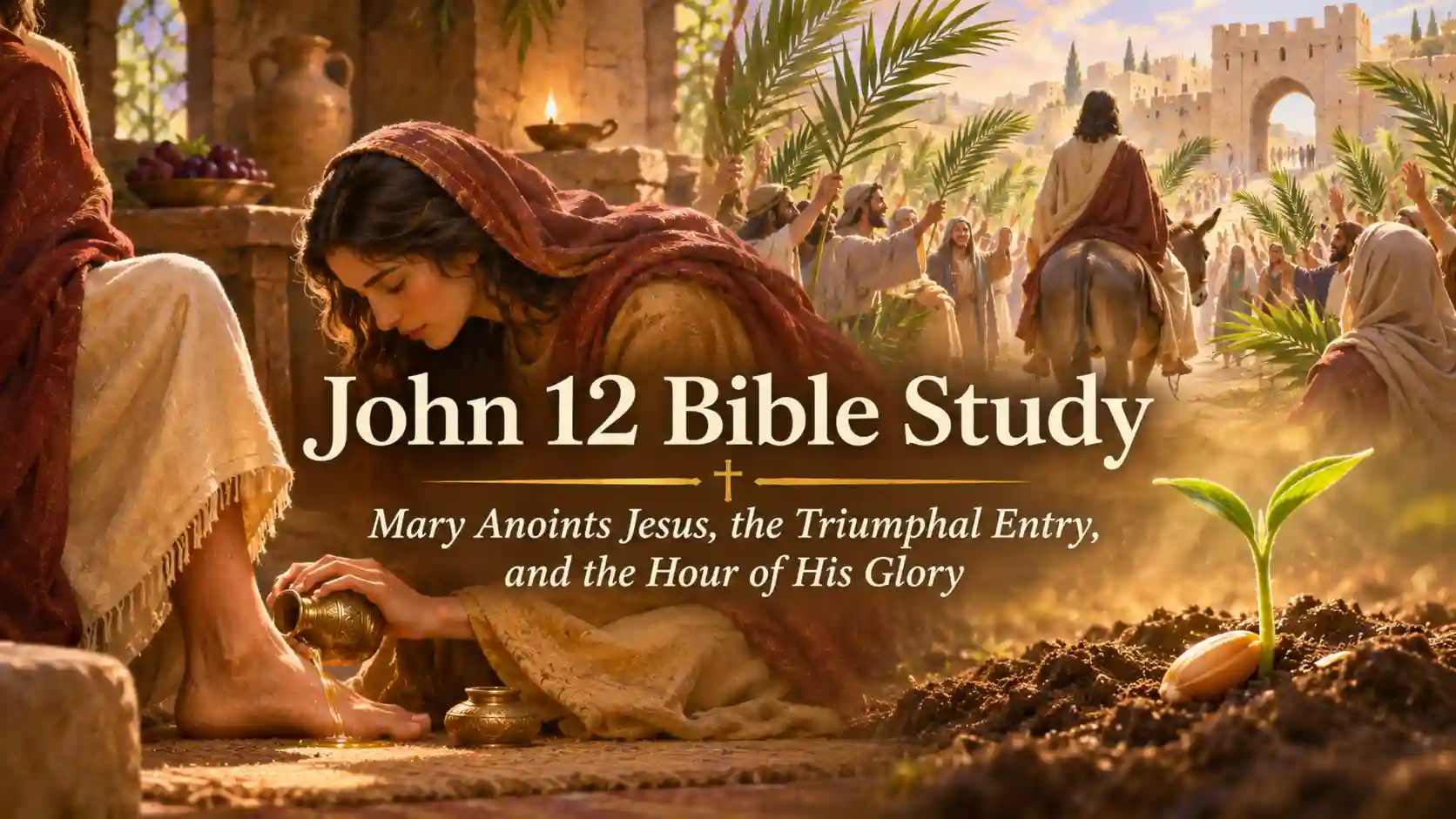
John 12 Bible Study: Mary Anoints Jesus, the Triumphal Entry, and the Hour of His Glory
Welcome back to our Gospel of John Bible Study here on Living for the Christ.
In John 11, Jesus called Lazarus out of the tomb, demonstrating His authority over death. Many believed in Him, but the religious leaders responded by plotting to kill Him.
Now John 12 brings us into the final days before the crucifixion. A grateful Mary pours expensive perfume over Jesus’ feet. Crowds welcome Him as King. Yet Jesus makes clear that His path to glory leads through suffering and death. The chapter closes with a sobering contrast: some reject Him despite the signs they have seen, while others believe but fear admitting it.
John 12 asks every reader a personal question: Will we honor Jesus as He truly is, or only as we wish Him to be?
If you are following the series, you can explore the other studies in our Gospel of John Bible Study collection.
Key Themes in John 12
- Jesus is worthy of wholehearted, costly worship.
- The cross is not an interruption of God’s plan; it is central to Jesus’ mission.
- Jesus is the promised King, yet His kingdom does not operate according to worldly expectations.
- His death will bear much fruit and draw people from beyond Israel.
- Following Jesus requires putting Him above our own comfort and reputation.
- Light should be received while it is available.
- Seeing miracles is not the same thing as believing.
- The words of Jesus reveal the Father and carry eternal significance.
Memory Verse — John 12:46
I am come a light into the world, that whosoever believeth on me should not abide in darkness.
John 12:46 (KJV)
Remember: Jesus came as the Light of the world. Everyone who believes in Him is called out of spiritual darkness and into the truth and life found in Christ.
Historical Background: The Final Passover Approaches
John 12 begins six days before Passover, when Jesus comes to Bethany, the village where Lazarus lived. Bethany was near Jerusalem. News of Lazarus’ resurrection had spread, and Jesus was approaching the city where He would be crucified.
The Passover celebrated God’s deliverance of Israel from Egypt (Exodus 12). That background matters. As Jerusalem filled with worshipers, Jesus—the Lamb of God whom John had identified earlier (John 1:29)—was approaching the hour when He would give His life.
The first part of this chapter unfolds around a meal in Bethany. The scene then shifts to Jerusalem and the public response to Jesus. Finally, John reflects on why so many refused to believe and records Jesus’ appeal to believe in the One sent by the Father.
John 12:1–3 — Mary Anoints Jesus with Costly Perfume

Six days before Passover, Jesus arrives in Bethany. A dinner is given in His honor. Martha serves, and Lazarus is among those reclining at the table with Jesus.
Consider what that scene means. Lazarus, whom Jesus had raised from the dead, is now eating with Him. The man whose funeral had brought so much grief is alive and present.
Mary responds with an extraordinary act of devotion. She takes about a pound of expensive perfume made from pure nard, anoints Jesus’ feet, and wipes them with her hair. John tells us that the fragrance fills the house.
Mary does not offer Jesus something insignificant. She gives something costly and deeply personal. Wiping His feet with her hair is an act of profound humility.
The fragrance filling the house is a beautiful detail: Mary’s worship is not hidden, and those around her cannot ignore what she has done.
What this teaches us: Genuine worship recognizes Jesus’ worth. Worship is not primarily about outward performance or impressing others. It is about honoring the Lord from a sincere heart.
We should be careful not to turn Mary’s action into a command that Christians must spend extravagantly to prove their devotion. The point is Jesus’ worthiness and Mary’s loving response to Him.
John 12:4–8 — Judas Objects, but Jesus Defends Mary
Judas Iscariot objects to Mary’s offering. He asks why the perfume was not sold and the money given to the poor. John estimates its value at three hundred denarii—roughly the wages of a laborer for many months.
At first, Judas’ objection may sound compassionate. But John explains that Judas did not say this because he cared for the poor. He was a thief who had access to the common moneybag and used to take what was put into it.
This is a warning about outward appearances. Religious-sounding words do not always reveal a faithful heart.
Jesus defends Mary and connects her action to His coming burial. In verse 7, the wording differs slightly among translations, but the central point is clear: Mary’s act is appropriate in light of Jesus’ approaching death.
When Jesus says the poor will always be with them but they will not always have Him in the same way, He is not dismissing the needs of the poor. Scripture repeatedly commands generosity and compassion (Deuteronomy 15:11; James 2:15–17). Jesus is emphasizing the uniqueness of this moment before His death.
A Heart-Checking Question
Do we sometimes criticize sincere devotion because it does not look the way we expect? And are there moments when our stated concerns sound spiritual, while our actual motives need examination?
John 12:9–11 — The Plot Against Lazarus
A large crowd gathers, not only to see Jesus but also to see Lazarus. Lazarus has become a living witness to Jesus’ power.
The chief priests then plan to kill Lazarus as well, because many Jews are going away and believing in Jesus on account of him.
Notice the tragedy: rather than reconsidering their opposition when confronted with such a remarkable sign, these leaders seek to remove the evidence.
A vital distinction: Not every religious leader responds the same way, and John does not teach that all Jewish people rejected Jesus. Jesus, His disciples, Mary, Martha, Lazarus, and many of those who believed were themselves Jewish. This passage describes the hostility of particular leaders, not a judgment on an entire people.
Lazarus’ life points others to Jesus. In a different way, every believer is called to live as a witness to what Christ has done (Matthew 5:16).
John 12:12–15 — Jesus Enters Jerusalem as King
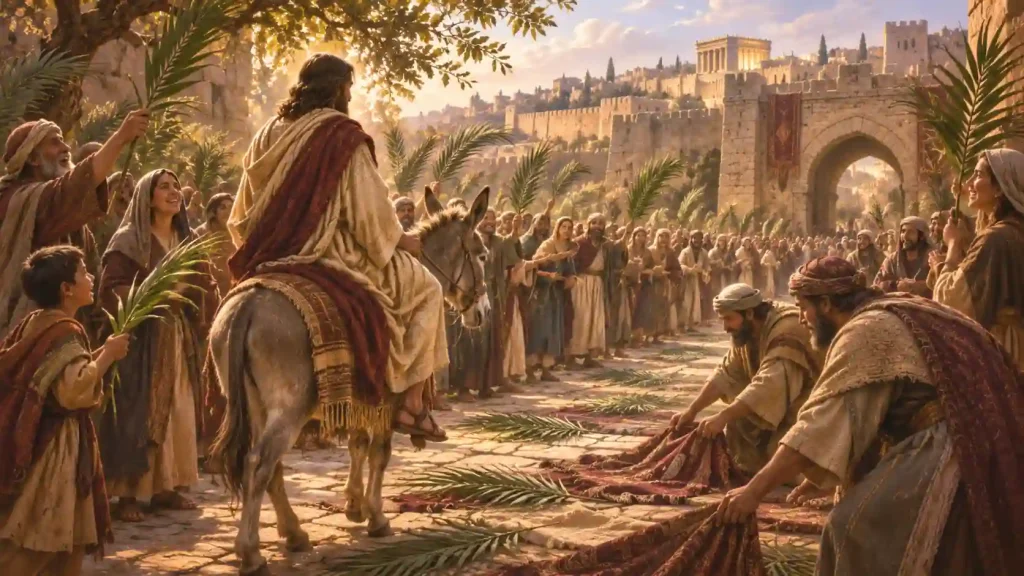
The next day, the crowd attending the feast hears that Jesus is coming to Jerusalem. They take palm branches and go out to meet Him, crying out in praise.
They proclaim “Hosanna” and bless the One coming in the Lord’s name, calling Him the King of Israel (John 12:13; see Psalm 118:25–26).
“Hosanna” comes from a plea for salvation and had become an expression of praise. The crowd is welcoming Jesus with royal expectations.
Yet Jesus enters riding on a young donkey, fulfilling the picture of Zion’s king in Zechariah 9:9. This is a deliberate, meaningful action.
Jesus is King—but not the kind of king many people expected. He does not enter as a military conqueror leading a political revolt. His mission is to save through His death and resurrection.
It is possible to celebrate Jesus enthusiastically while misunderstanding what He came to do. We must allow Scripture to shape our understanding of Him instead of reshaping Him to match our expectations.
Watch: John 12 Bible Teaching
🎬 Pastor Paul LeBoutillier walks through John 12:1–19, examining Mary’s act of devotion, the opposition to Jesus, and His triumphal entry into Jerusalem.
John 12:16–19 — The Disciples Understand Later
John says the disciples did not understand these events at first. After Jesus was glorified, they remembered that these things had been written about Him and had happened to Him.
That detail is encouraging. Even those who walked with Jesus did not immediately understand everything they witnessed.
Later, as the meaning of His death and resurrection became clear, they could see the connection between Scripture and what had happened.
Meanwhile, witnesses to Lazarus’ resurrection continue speaking about the sign, and the crowds gather partly because they have heard about it. The Pharisees lament that their efforts are failing, saying that the world has gone after Him.
The word “world” here expresses the breadth of the public response; it is not a literal claim that every person believed.
Application: Spiritual understanding often deepens as we keep returning to God’s Word. When we do not fully understand a passage, we should continue studying rather than assuming there is nothing more to learn.
John 12:20–22 — Greeks Want to See Jesus
Some Greeks who have come up to worship at the feast approach Philip with a request: they want to see Jesus. Philip tells Andrew, and together they tell Jesus.
John does not record whether these visitors met Jesus face-to-face. Instead, he turns immediately to Jesus’ explanation that His hour has come.
The Greeks’ request is significant in the flow of the Gospel. Jesus’ saving mission will reach people from every nation—not Israel alone. This is consistent with God’s promise of blessing to the nations (Genesis 12:3) and the later proclamation of the gospel to all peoples.
Their request also invites reflection: Do we want merely to know about Jesus, or do we genuinely want to know Him?
John 12:23–26 — A Grain of Wheat Must Die

Jesus announces that the hour has come for the Son of Man to be glorified.
This is striking because in John’s Gospel, Jesus’ glory is inseparable from the cross. He compares His approaching death to a grain of wheat that falls into the earth and dies. Unless it dies, it remains alone; if it dies, it bears much fruit.
The image explains how His death, far from defeating His mission, will accomplish it. Through His sacrificial death and resurrection, many will receive life.
Jesus then speaks about loving one’s life in this world and losing it, or hating one’s life in this world and keeping it for eternal life. In this context, “hating” one’s life does not mean self-harm or despising the life God has given. It describes putting loyalty to Christ above self-preservation, comfort, and worldly priorities.
Verse 26 adds that those who serve Jesus must follow Him, and the Father will honor those who serve Him.
Following Jesus is more than admiring His teachings. It involves belonging to Him, trusting Him, and walking in obedience.
We are not saved by making ourselves suffer. Salvation is God’s gift through faith in Christ (Ephesians 2:8–9). Yet the faith that receives Him changes the direction of our lives (Ephesians 2:10).
John 12:27–30 — Jesus Is Troubled, Yet Committed to the Father’s Will
Jesus says His soul is troubled as He faces the approaching hour. His coming suffering is real. He does not treat it casually or pretend it will be easy.
But He also declares that He came for this very hour and asks the Father to glorify His name.
A voice from heaven answers that the Father’s name has been glorified and will be glorified again. Some bystanders think they heard thunder; others say an angel has spoken.
Jesus explains that the voice came for their sake.
This passage reveals something important about Christ. His willingness to go to the cross was not the absence of distress; it was loving obedience in the face of genuine suffering.
When obedience to God is difficult, believers can remember that Jesus understands sorrow and anguish. He remained faithful to the Father’s purpose.
John 12:31–33 — The Ruler of This World Will Be Cast Out
Jesus declares that judgment is coming upon the world and that the ruler of this world will be cast out.
In this context, the ruler of this world refers to Satan, whose power is decisively challenged and defeated through Christ’s saving work. This does not mean that evil immediately disappears from human experience. It means the cross marks Christ’s decisive victory, whose final outcome will be fully revealed.
Jesus also says that when He is lifted up from the earth, He will draw people to Himself.
John immediately explains that Jesus said this to indicate the kind of death He would die. “Lifted up” points to the crucifixion, while also carrying John’s theme of Jesus being exalted through His obedient sacrifice.
The phrase about drawing “all” to Himself should be read in context. It points to the reach of His saving work beyond one group or nation. It does not teach that every person is automatically saved regardless of faith. John repeatedly calls readers to believe in Jesus (John 3:16–18; 12:36, 46).
John 12:34–36 — Walk While You Have the Light
The crowd struggles to reconcile Jesus’ words with their expectation that the Messiah would remain forever. They ask how the Son of Man can be lifted up.
Jesus responds by speaking about the light being among them for a little while longer. He calls them to walk while they have the light and to believe in the light so that they may become children of light.
Throughout John’s Gospel, light represents the truth and life revealed in Christ (John 1:4–9; 8:12). Darkness represents spiritual blindness and unbelief.
The warning is urgent: do not keep postponing your response to Jesus.
This does not mean that a genuinely saved person can lose eternal life by having a difficult season or struggling with doubt. Jesus has already promised that His sheep are secure in His hand (John 10:27–29). The warning is directed toward those who are hearing His truth and must respond in faith.
John 12:37–41 — Why Did Many Still Refuse to Believe?
Despite the many signs Jesus performed, many people still did not believe in Him. John connects this rejection to passages from Isaiah 53:1 and Isaiah 6:10.
The first passage asks who has believed the message. The second speaks of hardened hearts, blinded eyes, and people who do not turn to be healed.
This is a serious passage about persistent unbelief and divine judgment. It must be handled carefully.
John is not saying people lacked sufficient evidence because Jesus had failed to reveal Himself. Rather, he shows that unbelief persisted even in the face of His signs, fulfilling what Scripture had foretold.
Isaiah’s words also remind us that hearing truth repeatedly without receiving it is spiritually dangerous. Hardening is not something to treat lightly.
John adds that Isaiah spoke about Jesus because he saw His glory. The statement fits John’s larger testimony to the divine identity and glory of Christ.
John 12:42–43 — Belief, Fear, and the Praise of People
John then records that many even among the authorities believed in Jesus, but because of the Pharisees they did not confess Him openly, fearing exclusion from the synagogue.
He explains that they loved human praise more than the praise of God.
This passage is not permission to declare with certainty the eternal standing of every person mentioned. It does expose the danger of letting fear of people control our response to Christ.
It is possible to know that something is true and still be reluctant to stand by it when doing so has social consequences.
We should examine ourselves: Are we more concerned with what God thinks or with protecting our reputation?
Openly following Jesus matters. At the same time, Scripture teaches that salvation rests in Christ and is received through genuine faith—not through performing a flawless public confession or never experiencing fear.
John 12:44–46 — To Believe in Jesus Is to Believe in the One Who Sent Him

Jesus declares that believing in Him is inseparable from believing in the Father who sent Him. Seeing Jesus is seeing the One who sent Him—not because Jesus and the Father are the same Person, but because Jesus perfectly reveals the Father.
This echoes John 1:18 and prepares us for Jesus’ teaching in John 14.
Jesus also says that He came into the world as light so that those who believe in Him should not remain in darkness.
Christian faith is not merely agreement with a moral teacher. It is trust in Jesus Christ, God’s Son, who reveals the Father and gives eternal life.
John 12:47–50 — Jesus’ Words and the Promise of Eternal Life
Jesus explains that His coming was to save the world rather than to condemn it. Nevertheless, those who reject Him and do not receive His words will face judgment; His word will judge on the last day.
There is no contradiction here. His first coming brings the saving message, but rejecting that message has eternal consequences (compare John 3:17–18).
Jesus teaches that He speaks what the Father has commanded, and the Father’s commandment is eternal life. His message is therefore not a private human opinion or an independent religious philosophy. It carries the Father’s authority.
The chapter ends where all faithful Bible study must lead us: to the person and words of Jesus Christ.
What Does John 12 Teach Us About Jesus?
He is worthy of worship. Mary’s offering shows a heart that treasures Him above material value.
He is the promised King. His entrance into Jerusalem fulfills Scripture, but His kingship is not defined by worldly power.
He is the Savior who willingly goes to the cross. The grain of wheat illustrates that His death will bring life to many.
He is the Light of the world. Those who believe in Him need not remain in spiritual darkness.
He reveals the Father. His words and mission come from the Father who sent Him.
He is the One to whom we must respond. Neutral admiration is not the response John calls for. The Gospel calls us to believe in Him.
Practical Lessons for Christians Today
1. Do Not Confuse Public Enthusiasm with Personal Faith
The crowds welcomed Jesus, yet excitement surrounding Him was not the same as understanding His mission. Our faith must be grounded in who Scripture reveals Him to be.
2. Worship Jesus for Who He Is, Not for What We Hope to Gain
Mary’s devotion contrasts sharply with Judas’ self-serving objection. We should ask whether our worship arises from love for Christ or merely from what we expect Him to provide.
3. Do Not Let Fear of People’s Opinions Control Your Faith
Some leaders hesitated to acknowledge Jesus because they feared the consequences. Our desire for acceptance must never become more important than the truth of God’s Word.
4. Remember That the Cross Was God’s Saving Plan
Jesus did not stumble into crucifixion unexpectedly. He knew His hour was coming and willingly submitted to the Father’s purpose.
5. Keep Returning to the Light of Scripture
The disciples did not understand everything immediately. We grow in understanding as we study God’s Word with humility and trust in Christ.
Bible Study Reflection Questions
- What does Mary’s offering reveal about her understanding of Jesus’ worth?
- How does Judas’ objection warn us about judging spirituality by outward words alone?
- Why did the religious leaders become hostile toward Lazarus?
- What does Jesus’ choice of a young donkey reveal about His kingship?
- Why is the image of a dying grain of wheat so important to understanding the cross?
- What is the difference between receiving eternal life by faith and living as a faithful disciple?
- How does Jesus’ troubled soul help us understand His humanity and obedience?
- What does it mean that Jesus will draw people to Himself through being lifted up?
- How can fear of people’s opinions affect the way we live as Christians?
- After studying John 12, what truth about Jesus most challenges or encourages you?
A Prayer Based on John 12
Heavenly Father,
Thank You for sending Your Son, Jesus Christ, to save sinners. Thank You that He willingly approached the cross, knowing what lay ahead, and that through His death and resurrection we can receive eternal life.
Forgive us when we seek the approval of people more than Your approval. Teach us to worship Jesus with sincere hearts, to trust His Word, and to follow Him even when obedience is difficult.
Open our eyes to the glory of Christ. Help us walk in His light, love others faithfully, and speak the truth with humility and courage.
In Jesus’ name, amen.
Conclusion: The King Who Came to Die
John 12 begins with Mary honoring Jesus and ends with Jesus calling people to believe in Him. Between those moments, He enters Jerusalem as King, announces that His hour has come, and explains that His death will bring life.
The crowd wanted to celebrate a king. Jesus came to accomplish something far greater than they understood.
He came to save sinners through His sacrifice.
And His question still stands before every reader: Will you receive the Light, believe in the Son, and trust the Savior who came to give eternal life?
For those who belong to Jesus Christ, the cross is not the end of the story. His resurrection secures our hope, and His promises stand firm.
Continue Studying the Gospel of John
If you are joining us here in John 12, these previous studies will help you follow the events leading to Jesus’ final days before the cross:
- John 9 Bible Study — Jesus Heals a Man Born Blind: Discover how Jesus gives physical sight and reveals the deeper reality of spiritual blindness and faith.
- John 10 Bible Study — Jesus the Good Shepherd: Study Jesus’ promise of eternal life and the security of those who belong to Him.
- John 11 Bible Study — Jesus Raises Lazarus: See Jesus demonstrate His authority over death and declare that He is the resurrection and the life.
Coming Next: John 13 — Jesus Washes the Disciples’ Feet
In our next study, we will move into Jesus’ final evening with His disciples before the crucifixion. John 13 shows the Lord and Teacher humbly washing their feet, reveals Judas’s coming betrayal, and records Jesus’ new commandment to love one another as He has loved us. We will also consider Peter’s confident promise and Jesus’ prediction that Peter will deny Him three times.
What will we learn? True greatness is shown through humble service; Christ alone provides the cleansing we need; and love for one another should visibly mark His followers. Watch for our John 13 Bible Study as we continue through the Gospel together.
Follow the series below to revisit earlier chapters, or explore the complete Gospel of John Bible Study collection.