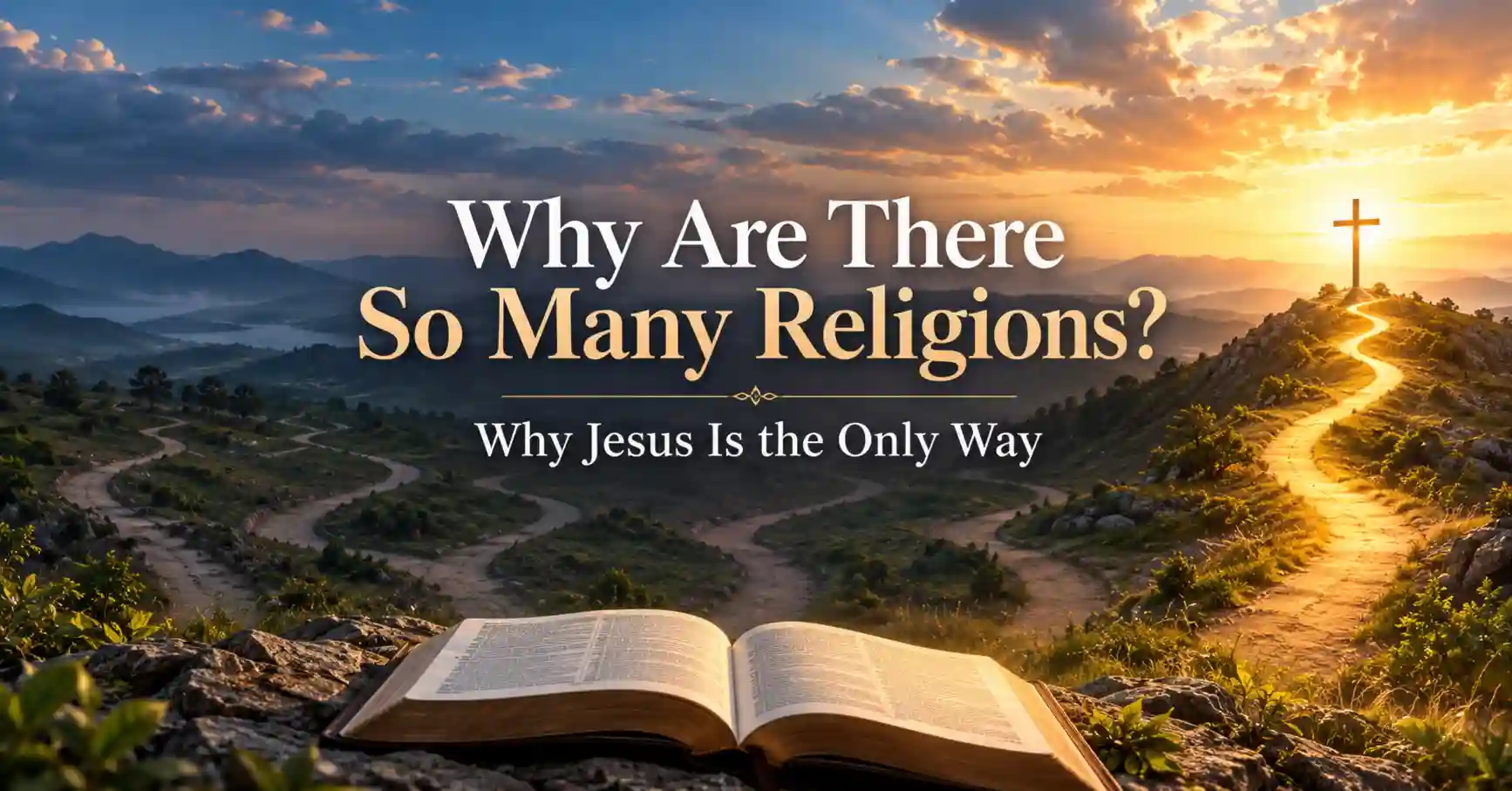
Why Are There So Many Religions? Why Jesus Is the Only Way
Many people look at the thousands of religions in the world and naturally ask:
If there is only one true God, why are there so many religions?
Part of the “False Teachings” Series – Living for the Christ
Some religions believe in one God. Others worship many gods or understand the divine in several forms. Some teach reincarnation, while Christianity teaches resurrection and final judgment. Some offer salvation through religious works, rituals, spiritual knowledge, meditation, or moral improvement. Others deny that a personal Creator exists at all.
Can all these religions simply be different paths leading to the same God?
According to the Bible, the answer is no.
Religions make contradictory claims about God, humanity, sin, salvation, Jesus, and eternity. These claims cannot all be true at the same time.
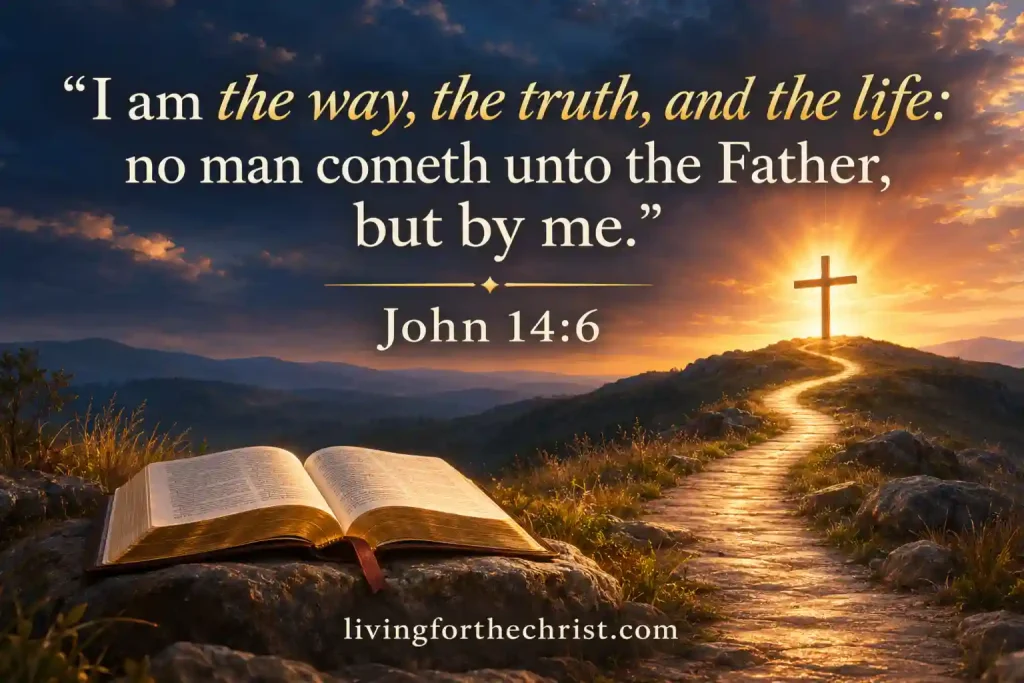
Jesus did not say He was one spiritual path among many:
“I am the way and the truth and the life. No one comes to the Father except through me.”
John 14:6
Jesus is not merely someone who shows us the way. He is the Way.
He does not merely teach certain truths. He is the Truth.
He does not merely help us improve our lives. He is the Life.
In this article, we will examine why so many religions exist, how some of the world’s major religions developed, what their followers generally believe, why Christianity is fundamentally different, why Jesus is truly God, and why no one comes to God the Father apart from Him.
If you are exploring questions about God, faith, and salvation, visit our Bible Questions section or read Who Is Jesus? Understanding His True Identity as God and Savior.
Why Are There So Many Different Religions?
The existence of many religions does not mean that God has provided many ways to reach Him.
Instead, it reveals two important truths about humanity:
- Human beings know there is something beyond themselves.
- Because of sin, human beings continually replace the true God with gods and beliefs of their own making.
God created us to know, worship, and live in fellowship with Him. This helps explain why people across almost every culture and period of history have searched for spiritual meaning.
Human beings ask the same basic questions:
- Why are we here?
- Is there a God?
- Why is there suffering?
- What is wrong with the world?
- What happens after death?
- How can we find peace?
- How can we be made right with God?
Our desire for answers is real, but our sinful hearts do not naturally seek God on His terms.
“There is no one who understands; there is no one who seeks God.”
Romans 3:11
When humanity rejects the true God, it does not usually stop being spiritual. Instead, it creates substitutes.
The Biblical Origin of False Religion
The Bible traces false religion back to humanity’s rebellion against God.
The Serpent Introduced Spiritual Deception
In Genesis 3, Satan questioned God’s Word and tempted Adam and Eve to seek wisdom and independence apart from their Creator.
The serpent asked:
“Did God really say…?”
Genesis 3:1
That question continues to appear in false religion today.
False religion often begins by questioning, changing, adding to, or denying what God has revealed.
Satan then told Eve:
“You will be like God.”
Genesis 3:5
This is one of the oldest spiritual lies: the promise that humanity can achieve divinity, enlightenment, secret knowledge, or spiritual independence apart from submission to God.
Some modern religions and spiritual movements still teach variations of this promise. They tell people to discover the divine within themselves, awaken hidden spiritual power, or realize that they are already part of God.
The Bible teaches that we are made in God’s image, but we are not God. There is an eternal distinction between the Creator and His creation.
Cain Tried to Approach God His Own Way
Genesis 4 records Cain and Abel bringing offerings to God. Hebrews 11:4 tells us that Abel offered his sacrifice by faith.
Cain became angry when his offering was not accepted. Instead of humbling himself and responding to God’s warning, he continued in rebellion.
This illustrates an important truth: sinful humanity wants to approach God according to its own terms.
False religion says:
“I will decide how I approach God.”
True faith says:
“I must come to God in the way He has provided.”
The Tower of Babel Displayed Organized Rebellion
In Genesis 11, humanity gathered to build a city and tower and make a name for itself.
The people were attempting to establish human unity, security, and greatness apart from God. God confused their language and scattered them across the earth.
We should not claim that historians can trace every later religion directly to Babel. The Bible does not provide that kind of religious family tree.
However, Babel clearly displays humanity’s continuing desire to organize life and society independently of God.
Humanity Exchanged the Creator for Creation
Romans 1 gives the clearest biblical explanation for idolatry and false worship.
God has revealed His power and divine nature through creation, but humanity suppresses that truth.
“They exchanged the truth about God for a lie, and worshiped and served created things rather than the Creator.”
Romans 1:25
False religion involves an exchange:
- The Creator is exchanged for creation.
- God’s truth is exchanged for human ideas.
- God’s authority is exchanged for human independence.
- God’s grace is exchanged for human effort.
- The true God is exchanged for gods people can control.
The objects of worship change, but the underlying rebellion remains the same.
Why Do False Religions Continue to Multiply?
People Want a God They Can Control
The true God is holy, sovereign, righteous, and worthy of complete obedience. He defines good and evil and calls sinners to repent.
The sinful heart resists His authority.
A god invented by human beings can be reshaped to match their preferences. Such a god may never judge sin, require repentance, or contradict the desires of the worshiper.
False religion can allow people to feel spiritual while remaining in control of their own lives.
People Inherit Religious Traditions
Most people are introduced to religion through their families and cultures.
Someone born in India may grow up surrounded by Hindu traditions. Someone born in a predominantly Muslim nation may be taught Islam from childhood. Someone raised in a secular home may be taught that belief in God is irrational.
Tradition can shape a person’s identity and worldview. But a belief does not become true simply because it is old, familiar, or widely accepted.
Jesus warned:
“You nullify the word of God for the sake of your tradition.”
Matthew 15:6
Every belief must be tested against what God has revealed.
Human Pride Prefers Earning Over Grace
Many religious systems give people something they must accomplish to become acceptable, enlightened, worthy, or spiritually advanced.
They may require people to:
- Perform rituals
- Keep religious laws
- Accumulate good deeds
- Pursue enlightenment
- Balance good and bad actions
- Gain spiritual knowledge
- Complete certain ordinances
- Achieve a higher spiritual state
This appeals to human pride because it allows us to believe we can contribute to our own salvation.
The gospel teaches something radically different:
“For it is by grace you have been saved, through faith – and this is not from yourselves, it is the gift of God – not by works, so that no one can boast.”
Ephesians 2:8-9
Christianity is not the story of humanity climbing up to God.
It is the story of God coming down to save sinners who could never save themselves.
Satan Produces Counterfeit Spirituality
False religion is not only a product of human imagination. The Bible also teaches that spiritual deception is real.
“Satan himself masquerades as an angel of light.”
2 Corinthians 11:14
Satan does not always present evil in an obviously frightening form. He often makes deception appear beautiful, loving, wise, peaceful, or enlightened.
Paul warned about “deceiving spirits and things taught by demons” in 1 Timothy 4:1. Second Corinthians 4:4 says that the god of this age blinds unbelieving minds so they cannot see the light of the gospel.
A false religion may contain:
- Moral teachings
- Beautiful traditions
- Supernatural experiences
- Impressive rituals
- Kind and sincere followers
- Partial truths
- Christian-sounding language
None of these things prove that its message comes from God.
The most dangerous counterfeit is often something that resembles Christianity while presenting a different Jesus, a different gospel, or a different way of salvation.
You can find more help recognizing these distortions in our False Teachings series.
How Did the Major Religions Begin, and What Do They Believe?
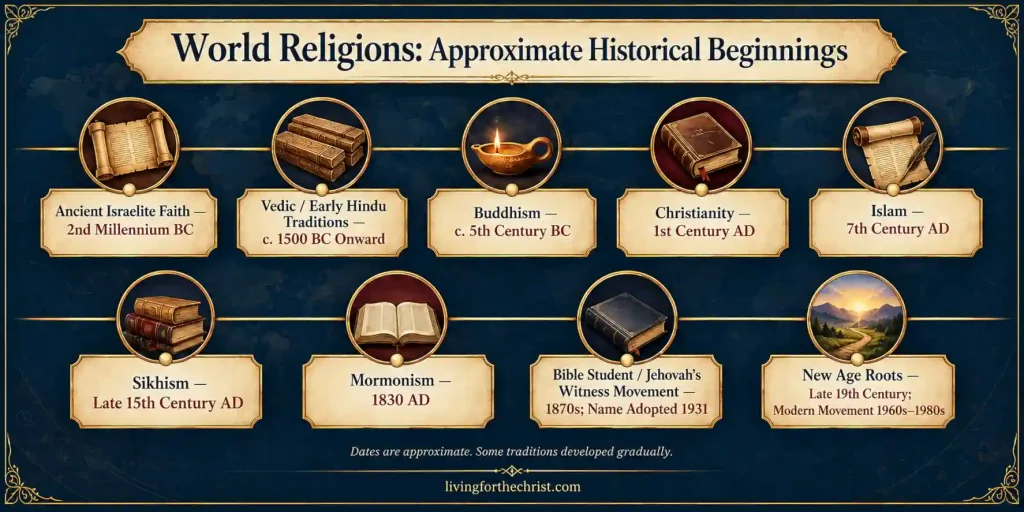
This section is not intended to mock or mistreat anyone. People of every religious background are made in God’s image and should be treated with dignity, compassion, and respect.
However, respecting people does not require us to accept every religious claim as true.
Because each religion contains different branches and schools of thought, these descriptions summarize broadly held beliefs. Individual followers may understand or practice their religion differently.
Hinduism
Historical Origin
Hinduism is not one organized religion with a single founder. It is a large and diverse family of religious, cultural, philosophical, and ritual traditions that developed in South Asia over many centuries.
Its ancient roots are connected to the Vedic traditions of India. Later writings and traditions include the Upanishads, Bhagavad Gita, devotional movements, philosophical schools, and worship centered on various deities.
Even the word “Hinduism” is a broad umbrella term. There is no single Hindu creed accepted by every Hindu.
Core Beliefs
Although Hindu beliefs vary considerably, common ideas include:
- Brahman: Ultimate reality or the highest divine principle.
- Atman: The self or soul, understood differently across Hindu traditions.
- Karma: The belief that actions have consequences affecting present and future existence.
- Samsara: The continuing cycle of birth, death, and rebirth.
- Dharma: Moral, religious, and social duty.
- Moksha: Liberation from the cycle of rebirth.
- Multiple spiritual paths: Liberation may be pursued through devotion, knowledge, disciplined action, meditation, or other paths.
- Deities: Many Hindus worship deities such as Vishnu, Shiva, Krishna, Lakshmi, or Devi. Some understand these as distinct gods, while others see them as manifestations of one ultimate reality.
Because Hinduism is so diverse, it is inaccurate to say that every Hindu believes exactly the same thing about God or the soul.
Hinduism’s View of Jesus
Some Hindus respect Jesus as:
- A wise teacher
- A holy man
- A guru
- An enlightened spiritual master
- One expression or manifestation of the divine
However, Hinduism does not generally recognize Jesus as the eternal God the Son and the exclusive Savior of humanity.
Where Hinduism Conflicts With Christianity
The Bible teaches:
- There is one personal Creator who is distinct from creation.
- Human beings are made in God’s image but are not divine.
- We live once and then face judgment.
- Our deepest problem is sin against God, not merely ignorance or bad karma.
- Salvation is not achieved through repeated lives or multiple spiritual paths.
- Eternal life comes through Jesus Christ alone.
“People are destined to die once, and after that to face judgment.”
Hebrews 9:27
Christianity does not offer liberation from a cycle of reincarnation. It offers forgiveness, resurrection, reconciliation with God, and eternal life through Christ.
Buddhism
Historical Origin
Buddhism began in ancient India with Siddhartha Gautama, who became known as the Buddha, meaning the awakened or enlightened one.
Historians usually place his life around the fifth or sixth century BC, although the precise dates remain debated.
According to Buddhist tradition, Siddhartha left a privileged life and began searching for an answer to human suffering. After pursuing severe asceticism and later rejecting it, he followed what became known as the Middle Way and attained enlightenment through meditation.
His teachings developed into different Buddhist traditions, including Theravada, Mahayana, and Vajrayana Buddhism.
Core Beliefs
Beliefs vary among Buddhist schools, but common teachings include:
- The Four Noble Truths: Life involves suffering or dissatisfaction; craving contributes to suffering; suffering can cease; and the Eightfold Path leads toward its cessation.
- The Noble Eightfold Path: Right understanding, intention, speech, action, livelihood, effort, mindfulness, and concentration.
- Karma: Intentional actions have consequences.
- Rebirth: Beings continue through cycles of existence.
- Impermanence: Created or conditioned things are constantly changing.
- No permanent self: Many forms of Buddhism reject the idea of an eternal, unchanging personal soul.
- Nirvana: Release from craving, ignorance, suffering, and the cycle of rebirth.
- Meditation and ethical conduct: Important practices for spiritual development.
Buddhism is often described as non-theistic because it does not center its teaching on worship of one eternal Creator. Some Buddhist traditions acknowledge various heavenly beings or deities, but these beings are not the sovereign Creator described in the Bible.
Buddhism’s View of Jesus
Some Buddhists respect Jesus as a compassionate teacher, moral example, or spiritually enlightened person.
Buddhism does not recognize Jesus as the eternal Creator, the only mediator, or the risen Savior whose death atoned for sin.
Where Buddhism Conflicts With Christianity
Buddhism and Christianity agree that human life contains suffering and disordered desires, but they diagnose the ultimate problem differently.
Buddhism generally focuses on ignorance, craving, attachment, and suffering.
The Bible identifies humanity’s deepest problem as sin and rebellion against a personal, holy God.
Buddhism offers a path of spiritual practice toward enlightenment or nirvana. Christianity announces that sinners cannot rescue themselves and need a Savior.
Jesus did not come merely to teach detachment from suffering. He came to bear our sin, defeat death, reconcile us to God, and give eternal life.
Judaism
Historical Origin
Judaism requires a careful explanation because the biblical faith of Abraham, Moses, and the prophets did not begin as a false religion.
God truly revealed Himself to Abraham, Isaac, Jacob, Moses, and Israel. He established covenants, gave His law, instituted the sacrificial system, and promised the coming Messiah.
The Old Testament Scriptures are the Word of God.
Jesus was Jewish according to His human ancestry. His earliest disciples were Jewish, and the first Christians understood Jesus as the fulfillment of God’s promises to Israel.
After Jerusalem and the temple were destroyed by the Romans in AD 70, Jewish religious life continued developing without the temple or its sacrifices. Rabbinic Judaism became centered on the Torah, synagogue worship, prayer, religious tradition, and rabbinic interpretation.
Modern Judaism includes Orthodox, Conservative, Reform, Reconstructionist, and other movements, so Jewish beliefs and practices vary considerably.
Core Beliefs
Common Jewish beliefs and practices may include:
- Belief in one God
- The covenant between God and the Jewish people
- The authority or importance of the Torah
- Observance of the commandments, or mitzvot
- Prayer, repentance, charity, and righteous living
- Sabbath and religious festivals
- Synagogue worship and Torah study
- Hope for redemption or a future messianic age
Views concerning the Messiah, the afterlife, Scripture, and the authority of religious tradition vary among Jewish movements.
Judaism’s View of Jesus
Judaism generally does not accept Jesus as:
- The promised Messiah
- God the Son
- The fulfillment of the Old Testament sacrificial system
- The only Savior
- The risen Lord
Some Jewish people may respect Jesus as a teacher or historical Jewish figure, but Judaism does not worship Him as God.
Where Judaism Conflicts With Christianity
Christianity teaches that Jesus fulfilled the Law and the Prophets:
“Do not think that I have come to abolish the Law or the Prophets; I have not come to abolish them but to fulfill them.”
Matthew 5:17
The central division is not whether the God of the Old Testament is real. The central issue is whether Jesus is the Messiah and eternal Son promised in those Scriptures.
Jesus said:
“Whoever does not honor the Son does not honor the Father, who sent him.”
John 5:23
First John 2:23 adds:
“No one who denies the Son has the Father; whoever acknowledges the Son has the Father also.”
Old Testament believers were not saved by perfectly keeping the law. They were saved by God’s grace through faith in His promises. Those promises are ultimately fulfilled in Jesus Christ.
Christians should completely reject antisemitism. The Jewish people gave us the human ancestry of the Messiah, the prophets, the apostles, and the Scriptures.
At the same time, Jewish and Gentile people alike need Jesus.
“For there is no difference between Jew and Gentile – the same Lord is Lord of all and richly blesses all who call on him.”
Romans 10:12
Biblical Christianity
Historical Origin
Christianity became a public movement in the first century AD, but God’s plan of redemption did not begin in the first century.
After humanity fell into sin, God promised that the offspring of the woman would crush the serpent’s head (Genesis 3:15). God promised Abraham that all nations would be blessed through his offspring. The sacrifices given through Moses pointed to the need for atonement. The prophets foretold a coming Messiah, suffering servant, righteous King, and new covenant.
Jesus came within this long history of divine revelation.
He was born into the Jewish people, fulfilled Old Testament prophecy, lived publicly, performed miracles, was crucified under the Roman governor Pontius Pilate, was buried, and rose bodily from the dead.
After His resurrection, His followers proclaimed that they had seen Him alive. The church began preaching His resurrection publicly in Jerusalem, where He had been crucified.
Christianity did not begin with a private revelation received centuries after Jesus. Its earliest message was based on the apostles’ testimony concerning what they had seen and heard.
“God has raised this Jesus to life, and we are all witnesses of it.”
Acts 2:32
Core Beliefs
Biblical Christianity teaches:
- One God: There is one eternal, uncreated God.
- The Trinity: The one God eternally exists as Father, Son, and Holy Spirit.
- Creation: God created everything from nothing and remains distinct from His creation.
- Scripture: The Bible is God’s inspired written Word and final authority.
- Human dignity: Human beings are created in God’s image.
- The fall: Humanity has rebelled against God and is corrupted by sin.
- The incarnation: The eternal Son became truly human without ceasing to be God.
- Christ’s sinless life: Jesus obeyed perfectly and never sinned.
- The atonement: Jesus died in the place of sinners and bore the penalty of sin.
- The resurrection: Jesus rose bodily from the dead.
- Salvation by grace: Salvation is God’s gift, received through repentance and faith in Christ, not earned through works.
- The Holy Spirit: The Spirit gives new life and dwells within believers.
- Christ’s return: Jesus will return, raise the dead, judge humanity, and establish His kingdom in its fullness.
- Eternal destiny: Those in Christ receive eternal life, while those who reject Him remain under judgment.
Christianity’s View of Jesus
Jesus is:
- The eternal Word
- God the Son
- Fully God and fully human
- The Creator of all things
- The promised Messiah
- The Lamb of God
- The only mediator
- The crucified and risen Savior
- The Lord and Judge of all
- The only way to the Father
What Makes Christianity Different
Christianity is not primarily the story of humanity discovering a path to God.
It is the story of God entering history to rescue sinners.
Christianity stands or falls on the bodily resurrection of Jesus.
“If Christ has not been raised, your faith is futile; you are still in your sins.”
1 Corinthians 15:17
The apostles did not proclaim a method of self-improvement. They proclaimed that God had acted in history through Jesus Christ.
Islam
Historical Origin
Islam began in seventh-century Arabia through the teaching of Muhammad, who was born around AD 570.
According to Islamic tradition, Muhammad began receiving revelations through the angel Gabriel. These revelations were later collected in the Quran.
Muslims believe Muhammad was the final prophet in a line that included figures such as Adam, Noah, Abraham, Moses, and Jesus.
Core Beliefs
The six commonly recognized articles of Islamic faith are belief in:
- Allah as the one God
- Angels
- Revealed books
- God’s prophets and messengers
- The Day of Judgment
- Divine decree
Islam also emphasizes five major practices known as the Five Pillars:
- Shahada: Confession that there is no god but Allah and Muhammad is his messenger
- Salat: Prescribed daily prayers
- Zakat: Giving to those in need
- Sawm: Fasting during Ramadan
- Hajj: Pilgrimage to Mecca when able
Muslims believe that people will face judgment and that faith, repentance, obedience, deeds, and Allah’s mercy are important to their final destiny. Different Islamic schools explain these matters in different ways.
Islam’s View of Jesus
Islam teaches that Jesus, called Isa, was:
- Born of the virgin Mary
- A prophet and messenger
- The Messiah
- A miracle worker by God’s permission
- Not God
- Not the divine Son of God
The standard Islamic interpretation of the Quran denies that Jesus was actually crucified as the New Testament describes. Islam therefore rejects the biblical teaching that Jesus died as an atoning sacrifice and rose bodily from the dead.
Muslims often speak respectfully about Jesus, but the Jesus presented in Islam is fundamentally different from the Jesus revealed by His apostles.
Where Islam Conflicts With Christianity
Islam appeared approximately six centuries after the life of Jesus and contradicts the earlier apostolic testimony concerning His identity, crucifixion, and resurrection.
The apostles said:
“That which we have seen and heard we proclaim also to you.”
1 John 1:3
The central conflict concerns Jesus.
The Bible teaches that Jesus is:
- God the Son
- One with the Father in divine nature
- Crucified for sinners
- Bodily raised from the dead
- The only mediator
- Worthy of worship
Islam denies these truths.
A religion cannot deny the identity and saving work of Jesus while still offering another way to God the Father.
Sikhism
Historical Origin
Sikhism began in the Punjab region of South Asia with Guru Nanak, who lived from 1469 to 1539.
The Sikh community continued under nine later human gurus. After the tenth guru, Guru Gobind Singh, the Guru Granth Sahib became Sikhism’s enduring scriptural and spiritual authority.
Sikhism developed in a region influenced by Hindu and Islamic cultures, although Sikhs understand their faith as distinct from both.
Core Beliefs
Common Sikh beliefs include:
- There is one God.
- God is Creator, eternal, and beyond physical form.
- Human beings should remember and meditate on God’s name.
- People should live honestly and serve others.
- Men and women possess equal spiritual dignity.
- Pride, greed, anger, attachment, and lust hinder spiritual life.
- Karma and rebirth affect human existence.
- Liberation involves release from rebirth and union or fellowship with God.
- God’s grace is necessary for liberation.
- The Guru Granth Sahib serves as the final Guru and spiritual authority.
Important Sikh practices include prayer, worship in a gurdwara, honest work, sharing with others, and selfless service.
Sikhism’s View of Jesus
Sikhs may respect Jesus as a teacher, holy person, or messenger. Sikhism does not recognize Him as the eternal God the Son, the only mediator, or the exclusive Savior.
Where Sikhism Conflicts With Christianity
Christianity agrees that there is one God and that compassion, honesty, equality, and service are important.
However, moral values cannot erase sin or reconcile us to God.
Sikhism includes beliefs in karma and rebirth and does not accept Christ’s unique incarnation and atoning work as the only way of salvation.
The Bible teaches:
“For there is one God and one mediator between God and mankind, the man Christ Jesus.”
1 Timothy 2:5
God’s grace does not reach us through repeated lives or a succession of gurus. Saving grace comes through Jesus Christ.
Mormonism
Historical Origin
Mormonism began in the United States through Joseph Smith in the nineteenth century.
Smith claimed to receive visions and additional revelation. The Book of Mormon was published in 1830, and the new church was formally organized that year.
The largest Mormon body is officially called The Church of Jesus Christ of Latter-day Saints.
Core Beliefs
Latter-day Saint teachings include:
- God the Father, Jesus Christ, and the Holy Ghost are distinct beings united in purpose rather than one being as taught in the historic doctrine of the Trinity.
- Human beings lived in a premortal existence as spirit children.
- Jesus was chosen in premortal life to carry out God’s plan of salvation.
- Jesus’ atonement and resurrection are essential to salvation.
- Joseph Smith was a prophet called to restore the true church.
- The Bible is Scripture, but the Book of Mormon, Doctrine and Covenants, and Pearl of Great Price are also regarded as Scripture.
- Priesthood authority was restored through Joseph Smith.
- Baptism and other ordinances are important in the plan of salvation.
- Temple ordinances and eternal family relationships play a significant role.
- Different degrees or kingdoms of glory await people after judgment.
- Faith, repentance, ordinances, covenant faithfulness, and Christ’s atonement are connected within the LDS plan of salvation.
It would be inaccurate to say that Latter-day Saints do not believe Jesus saves or that they completely ignore grace. They speak frequently about Christ and His atonement.
The deeper issue is that their definitions of God, Jesus, revelation, and salvation differ from historic biblical Christianity.
Mormonism’s View of Jesus
Latter-day Saints call Jesus divine, the Son of God, Creator under the Father’s direction, Messiah, Savior, and risen Lord.
However, LDS teaching does not confess the one eternal Triune God in the same sense as biblical Christianity. It treats the Father, Son, and Holy Ghost as three distinct beings united in purpose rather than three Persons sharing the one indivisible divine being.
It also interprets Jesus through scriptures and prophetic claims that appeared approximately eighteen centuries after the apostolic period.
Where Mormonism Conflicts With Christianity
Biblical Christianity teaches:
- There has always been only one God.
- No true gods existed before Him or will exist after Him.
- The Father, Son, and Holy Spirit share the one divine being.
- Jesus is eternally God, not one divine being among others.
- God’s final saving revelation is centered in His Son.
- The apostolic gospel must not be replaced by later revelations.
- Salvation is God’s gift through faith, not something completed through a system of required temple ordinances.
“Before me no god was formed, nor will there be one after me.”
Isaiah 43:10
Paul warned:
“Even if we or an angel from heaven should preach a gospel other than the one we preached to you, let them be under God’s curse!”
Galatians 1:8
Using Christian words does not guarantee that a movement teaches the biblical meaning of those words. We must ask what it means by God, Jesus, grace, gospel, and salvation.
Jehovah’s Witnesses
Historical Origin
The modern Jehovah’s Witness organization developed from the Bible Student movement associated with Charles Taze Russell in the late nineteenth century.
Russell began leading Bible studies in the 1870s and publishing material that challenged historic Christian doctrines. Under later leadership, the name Jehovah’s Witnesses was adopted in 1931.
Core Beliefs
Jehovah’s Witnesses generally believe:
- Jehovah alone is Almighty God.
- The Trinity is false.
- Jesus was Jehovah’s first creation.
- Jesus existed before His human life as Michael the archangel.
- Jehovah created everything else through Jesus.
- Jesus died as a ransom sacrifice.
- Jesus was raised as a spirit being rather than bodily in the historic Christian sense.
- God’s kingdom began ruling from Heaven in a special sense in 1914.
- A limited group of 144,000 will reign with Christ in Heaven.
- Other faithful people may live forever in an earthly paradise.
- Political neutrality, evangelism, and obedience to the organization’s teaching are important.
- The Watch Tower Bible and Tract Society provides authoritative doctrinal instruction.
Jehovah’s Witnesses’ View of Jesus
Jehovah’s Witnesses speak highly of Jesus and believe His ransom is necessary. However, they deny that He is the eternal Almighty God.
They identify His prehuman existence with Michael the archangel and regard Him as a created being.
Where Jehovah’s Witness Teaching Conflicts With Christianity
The Bible places Jesus above all angels:
“For to which of the angels did God ever say, ‘You are my Son’?”
Hebrews 1:5
The Father addresses the Son:
“Your throne, O God, will last for ever and ever.”
Hebrews 1:8
John 1:3 says:
“Through him all things were made; without him nothing was made that has been made.”
If everything created came into existence through Jesus, He cannot belong to the category of created beings.
Jesus also described His resurrection bodily. In Luke 24:39, He told His disciples to touch Him and see that He had flesh and bones.
Biblical Christianity teaches that Jesus is the eternal, uncreated God the Son who rose bodily from the dead.
New Age Spirituality
Historical Origin
The New Age movement is not one organized religion with one founder.
It developed largely through a mixture of nineteenth- and twentieth-century Western occultism, Theosophy, astrology, spiritism, alternative spirituality, psychology, and ideas borrowed or adapted from Eastern religions.
Because it is highly individualistic, two people who identify with New Age spirituality may believe very different things.
Core Beliefs
Common New Age beliefs may include:
- Everything is spiritually connected or ultimately one.
- God is an impersonal energy, consciousness, or universal force.
- Human beings possess inner divinity.
- Truth is personal or discovered within.
- Thoughts can influence or manifest reality.
- Reincarnation allows continued spiritual progress.
- Astrology or divination can provide guidance.
- Spirit guides or channeled beings can reveal higher knowledge.
- Crystals, energy work, or meditation can produce healing or spiritual awakening.
- All religions contain paths to the same spiritual reality.
Not every New Age follower accepts every one of these ideas.
New Age Spirituality’s View of Jesus
Jesus may be described as:
- An enlightened teacher
- A spiritual master
- A highly evolved soul
- One manifestation of divine consciousness
- An example of the spiritual potential within everyone
This is not the Jesus of Scripture.
Where New Age Spirituality Conflicts With Christianity
The Bible teaches:
- God is personal, not an impersonal energy.
- God is distinct from creation.
- Human beings are not divine.
- Truth is objective and revealed by God.
- Reincarnation is false.
- Divination and attempts to contact spirits are forbidden.
- Jesus is the unique eternal Son, not one spiritual master among many.
The promise that we can discover our own divinity repeats the serpent’s ancient temptation:
“You will be like God.”
Genesis 3:5
We are not saved by awakening to divinity within ourselves. We are saved by confessing our sin and receiving new life from Christ.
Atheism and Secular Humanism
Historical Origin
Atheism is not one organized religion and does not have a single founder. It refers broadly to the absence or rejection of belief in a god or gods.
Secular humanism developed as a more organized worldview emphasizing human reason, ethics, freedom, and progress without belief in divine revelation or the supernatural.
Modern secular humanism was strongly shaped by Enlightenment and post-Enlightenment thought, although unbelief and philosophical materialism existed much earlier.
Core Beliefs
Atheists do not all share one complete worldview, but secular humanism commonly teaches:
- The universe should be understood through reason, evidence, and science.
- Supernatural explanations should be rejected or withheld without sufficient evidence.
- Human beings can develop morality without belief in God.
- Meaning and purpose are created by human beings rather than given by a Creator.
- Human welfare, freedom, compassion, and justice should guide ethical decisions.
- Human beings are generally viewed as mortal, with no confirmed existence after death.
Its View of Jesus
Many atheists and secular humanists accept that Jesus was a historical person but regard Him only as a human teacher, religious leader, or figure later surrounded by supernatural claims.
They deny His deity, miracles, resurrection, and authority as Lord.
Where It Conflicts With Christianity
The Bible teaches that creation points to a Creator:
“The heavens declare the glory of God; the skies proclaim the work of his hands.”
Psalm 19:1
Atheists can perform kind and outwardly moral actions. The disagreement is not whether unbelievers can do good things.
The deeper questions are:
- Why do human beings possess objective value?
- Why should moral duties bind us?
- Why is rational thought trustworthy?
- Why does an orderly universe exist?
- Why is there something rather than nothing?
- Can meaning and justice be ultimate if death ends every human life?
Biblical Christianity grounds reason, morality, dignity, purpose, and creation in the character of the eternal God.
Comparing the Central Claims
| Belief system | Understanding of ultimate reality | Main human problem | Proposed answer | View of Jesus |
|---|---|---|---|---|
| Biblical Christianity | One Triune God: Father, Son, and Holy Spirit | Sin and separation from God | Grace through Christ’s death and resurrection | Eternal God the Son and only Savior |
| Hindu traditions | Diverse views of Brahman, deities, self, and ultimate reality | Karma, ignorance, bondage, and rebirth | Liberation through various spiritual paths | Often respected but not the exclusive Savior |
| Buddhism | No single sovereign Creator at the center of classical teaching | Suffering, craving, attachment, and ignorance | Eightfold Path, enlightenment, and nirvana | Teacher or moral figure, not Creator and Savior |
| Rabbinic Judaism | One God and covenant relationship with the Jewish people | Understood through sin, disobedience, exile, and human moral failure | Repentance, prayer, Torah, mitzvot, and God’s mercy | Not accepted as God the Son and Messiah |
| Islam | One God understood without the Trinity | Sin, disobedience, and failure to submit to God | Faith, repentance, obedience, deeds, and God’s mercy | Prophet and Messiah, but not God the Son or crucified Savior |
| Sikhism | One Creator God | Ego, attachment, karma, and rebirth | Devotion, remembrance, service, right living, and grace | Respected by some but not the unique God-man and Savior |
| Mormonism | Father, Son, and Holy Ghost as distinct beings united in purpose | Sin and mortality within the LDS plan of salvation | Christ’s atonement, faith, repentance, ordinances, and covenant faithfulness | Divine Savior, but defined through a different doctrine of God |
| Jehovah’s Witnesses | Jehovah alone as Almighty God; Trinity rejected | Sin and death | Jesus’ ransom plus faith and obedient devotion | First-created being identified with Michael |
| New Age spirituality | Divine energy, universal consciousness, or spiritual oneness | Ignorance of spiritual identity or imbalance | Awakening, self-realization, or spiritual practices | Spiritual master or enlightened teacher |
| Secular humanism | Natural universe without divine revelation | Ignorance, harmful systems, and human limitations | Reason, ethics, education, and social progress | Human teacher rather than divine Savior |
These religions are not simply using different words to describe the same truth.
Their central claims contradict one another.
Can All Religions Be True?
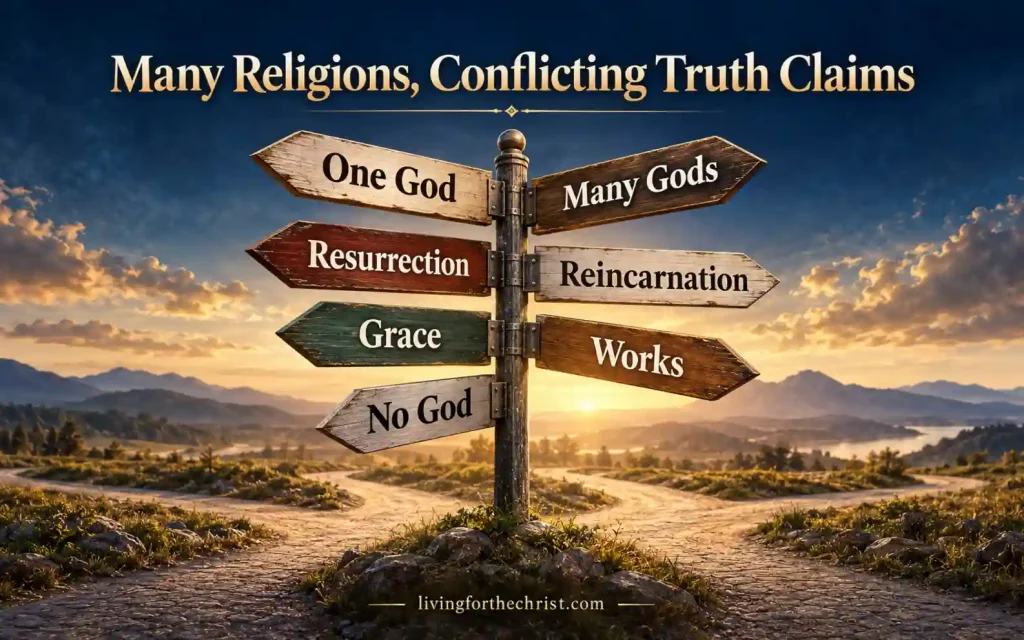
All religions cannot be equally true because they make mutually exclusive claims.
For example:
- Either there is one God, many gods, or no God.
- Either God is personal or impersonal.
- Either Jesus is God or He is not.
- Either Jesus was crucified or He was not.
- Either Jesus rose bodily or He did not.
- Either we live once or experience multiple lives.
- Either salvation is through Jesus alone or it is available through other paths.
These claims cannot all be true in the same way at the same time.
Saying that all religions are true may sound tolerant, but it ignores what those religions actually teach.
Why Christianity Is Fundamentally Different
Christianity is not true merely because it is old, popular, comforting, or meaningful to Christians.
A religion’s age does not prove its truth. An ancient belief can be false, and a recent claim is not refuted simply because it is recent.
Religious claims must be examined.
Christianity is unique because its central message is not about humanity discovering a path to God. It is about God entering history to rescue sinners.
Religion Says “Do”
Man-made religion tells people what they must do to reach salvation, enlightenment, or acceptance.
The Gospel Says “Done”
Jesus completed the work necessary for salvation.
On the cross, He declared:
“It is finished.”
John 19:30
The gospel is not good advice about how to save ourselves. It is good news about what Jesus has accomplished.
Learn more in What Is the Gospel?
Why Is Jesus the Only Way to God?
Jesus is the only way because He alone solves the problem separating humanity from God.
Our problem is not that we merely lack religious information. Our problem is sin.
“For all have sinned and fall short of the glory of God.”
Romans 3:23
God is perfectly holy. Good deeds cannot erase sins already committed.
We need:
- A sinless representative
- A perfect sacrifice
- A substitute to bear judgment
- A mediator to reconcile us to God
- A conqueror who can defeat death
- A Savior who can give spiritual life
Only Jesus fulfills every requirement.
Jesus Alone Reveals the Father Perfectly
Jesus said:
“Anyone who has seen me has seen the Father.”
John 14:9
This does not mean Jesus is the Father. It means the Son perfectly reveals the Father because He shares the same divine nature.
Hebrews 1:3 describes Jesus as “the radiance of God’s glory and the exact representation of his being.”
Religious teachers speak about what they believe God is like. Jesus came from the Father and reveals Him perfectly.
Jesus Alone Is Both God and Man
To reconcile God and humanity, the mediator had to represent humanity while possessing the divine power and worth necessary to save.
Jesus is fully God and fully human.
As a true man, He could obey, suffer, and die in our place.
As true God, He has authority over sin, death, judgment, and eternal life.
“For in Christ all the fullness of the Deity lives in bodily form.”
Colossians 2:9
No angel, prophet, priest, saint, guru, or religious leader possesses this identity.
Jesus Alone Lived Without Sin
Every human religious founder shared humanity’s problem of sin.
Jesus did not.
“He committed no sin, and no deceit was found in his mouth.”
1 Peter 2:22
Because He was sinless, He could offer Himself for sinners.
Jesus Alone Bore the Penalty for Sin
Jesus did not die merely as a martyr or example of love. He died as a substitute.
“He himself bore our sins in his body on the cross.”
1 Peter 2:24
At the cross, God’s justice and mercy met. Sin was not ignored. Its penalty was borne by Christ.
Read Why Did Jesus Have to Die? for a deeper explanation.
Jesus Alone Rose Bodily From the Dead
Jesus is not a dead religious teacher whose followers preserved His philosophy.
He is the risen Lord.
The apostles based their message on what they claimed to have witnessed:
“God has raised this Jesus to life, and we are all witnesses of it.”
Acts 2:32
The resurrection vindicated Jesus’ claims and demonstrated His victory over sin and death.
Jesus Alone Is the Mediator
“For there is one God and one mediator between God and mankind, the man Christ Jesus.”
1 Timothy 2:5
One God.
One mediator.
We do not need Mary, departed saints, angels, gurus, or religious leaders to provide access to God. Through Jesus, believers come directly to the Father.
Read Should Christians Pray to Mary or Saints?
Jesus Alone Gives Eternal Life
Jesus said:
“I give them eternal life, and they shall never perish.”
John 10:28
A prophet may announce God’s promise of life. Jesus gives life by His own authority.
He declared:
“I am the resurrection and the life.”
John 11:25
Jesus does not merely know where eternal life can be found. He is the resurrection and the life.
🎬 Watch: Is Jesus the Only Way to Heaven?
This video from Got Questions Ministries explains why Jesus Christ is the only way to God, why other religions cannot provide salvation, and how forgiveness and eternal life are received through faith in Christ alone.
Why Jesus Is the True and Living God
The Bible does not present Jesus as merely a prophet, created being, teacher, or spiritual guide.
Jesus is the eternal Son who possesses the fullness of the divine nature.
Jesus Is Called God
“In the beginning was the Word, and the Word was with God, and the Word was God.”
John 1:1
The Word was “with God,” showing the Son’s distinction from the Father.
The Word “was God,” showing the Son’s full deity.
John then explains:
“The Word became flesh and made his dwelling among us.”
John 1:14
Thomas looked at the risen Christ and declared:
“My Lord and my God!”
John 20:28
Jesus accepted his confession.
The Father also addresses the Son as God in Hebrews 1:8:
“Your throne, O God, will last for ever and ever.”
Jesus Uses God’s Divine Name
In Exodus 3:14, God revealed Himself as “I AM.”
Jesus later declared:
“Before Abraham was born, I am!”
John 8:58
His audience understood the seriousness of the claim and attempted to stone Him.
Jesus Is Eternal
Jesus prayed:
“Father, glorify me in your presence with the glory I had with you before the world began.”
John 17:5
Before creation existed, the Son shared glory with the Father.
Jesus did not become divine. He has always existed as God the Son.
Jesus Created Everything
“Through him all things were made; without him nothing was made that has been made.”
John 1:3
If everything created came into existence through Jesus, He cannot be part of creation.
There are two categories:
- The uncreated Creator
- Everything that was created
Scripture places Jesus in the first category.
Jesus Sustains Creation
“In him all things hold together.”
Colossians 1:17
Jesus did not merely begin creation. He continually sustains it.
Jesus Forgives Sin
When Jesus forgave a paralyzed man, the religious leaders asked:
“Who can forgive sins but God alone?”
Mark 2:7
Jesus then healed the man to demonstrate His authority to forgive.
Jesus Receives Worship
Faithful angels refuse worship. When John attempted to worship an angel, the angel said:
“Worship God!”
Revelation 22:9
Jesus repeatedly received worship without correcting those who worshiped Him.
He received worship because worship rightfully belongs to Him.
Jesus Gives Life and Judges Humanity
Jesus said:
“The Son gives life to whom he is pleased to give it.”
John 5:21
The Father has also entrusted judgment to the Son.
Jesus possesses divine authority over life, death, salvation, and final judgment.
Is Jesus the Father?
No.
Saying that Jesus is God does not mean Jesus is God the Father.
There is one true and living God who eternally exists in three distinct Persons:
- God the Father
- God the Son
- God the Holy Spirit
The Father is God.
The Son is God.
The Holy Spirit is God.
Yet the Father is not the Son. The Son is not the Spirit. The Spirit is not the Father.
They are not three gods. They are one God.
At Jesus’ baptism, the Son was in the water, the Holy Spirit descended like a dove, and the Father spoke from Heaven (Matthew 3:16-17).
Jesus also prayed to the Father. He was not speaking to Himself. The Father and Son are distinct Persons who share the one divine being.
This is the biblical doctrine of the Trinity.
In What Sense Is Jesus the Only True and Living God?
The Bible teaches there is only one true God:
“The Lord is the true God; he is the living God, the eternal King.”
Jeremiah 10:10
Because Jesus fully shares the one divine nature, He is truly the living God.
However, we should phrase this carefully.
Jesus is not the only Person who is God. The Father and Holy Spirit are also fully God. Jesus is God the Son, one of the three divine Persons of the one true and living God.
We can correctly say:
Jesus is the true and living God, and there is no true God apart from the Father, Son, and Holy Spirit.
Jesus is not:
- A lesser god
- A separate god
- A created god
- An angel who became divine
- A human being who achieved godhood
- One divine manifestation among many gods
He is eternally God the Son.
He shares:
- God’s eternal existence
- God’s divine name
- God’s glory
- God’s authority
- God’s power
- God’s work of creation
- God’s authority to forgive
- God’s right to receive worship
- God’s power to give life
- God’s authority to judge
If Jesus were not truly God, His claims would be blasphemous.
Because He is God the Son, we must worship, trust, obey, and follow Him.
Why Can’t God Save Through Other Religions?
God chose to save through His Son.
The Father declared:
“This is my Son, whom I love; with him I am well pleased. Listen to him!”
Matthew 17:5
The Father does not direct people toward multiple religious founders. He directs us to Jesus.
If salvation could be obtained through sincere religious practice, moral effort, another mediator, or another religion, the cross would have been unnecessary.
Paul wrote:
“If righteousness could be gained through the law, Christ died for nothing!”
Galatians 2:21
The Son of God did not endure betrayal, humiliation, crucifixion, judgment, and death merely to create one optional path among many.
He died because sinners could not be saved any other way.
Isn’t It Arrogant to Say Christianity Is the Only True Faith?
Christians should never treat unbelievers arrogantly.
We were not saved because we were wiser, better, or more deserving. Salvation is entirely the result of God’s grace.
There is no room for boasting at the cross.
However, humility does not mean pretending contradictory beliefs are equally true.
Christians do not claim Jesus is the only way because we invented that teaching. We say it because Jesus said it.
If Jesus truly is the only Savior, hiding that truth would not be loving.
Biblical conviction should produce:
- Humility
- Compassion
- Patience
- Gentleness
- Courage
- Gratitude
- A desire for others to be saved
People trapped in false religion are not our enemies. They are people made in God’s image who need the same grace we need.
Can Someone Be Sincere and Still Be Wrong?
Yes.
Sincerity describes how strongly someone believes something. It does not determine whether that belief is true.
A person can sincerely take the wrong medicine, trust an unsafe bridge, or follow incorrect directions. Sincerity cannot protect someone from the consequences of error.
The same is true spiritually.
“There is a way that appears to be right, but in the end it leads to death.”
Proverbs 14:12
A person may be sincere, morally disciplined, generous, and devoted while trusting in something that cannot save.
This is why every spiritual claim must be tested against God’s Word.
What About People Who Have Never Heard About Jesus?
This is a difficult and emotional question.
The Bible assures us that God is perfectly just, wise, holy, and merciful.
“Will not the Judge of all the earth do right?”
Genesis 18:25
God will never judge anyone unfairly.
Creation reveals God’s existence and power, and human conscience shows that we are morally accountable. However, creation does not explain the full gospel of Christ’s death and resurrection.
That is why Jesus commanded His followers to take the gospel to every nation.
“Go into all the world and preach the gospel to all creation.”
Mark 16:15
Scripture does not present ignorance or another religion as an alternative means of salvation:
“Salvation is found in no one else.”
Acts 4:12
We can trust God to judge perfectly while obeying His command to make Jesus known.
How Should Christians Respond to Other Religions?
Know the True Gospel
The best way to recognize a counterfeit is to know the truth well.
Study Scripture in context rather than relying only on sermons, traditions, or social media posts.
Ask What a Religion Teaches About Jesus
The identity of Jesus is the dividing line.
Ask:
- Is Jesus eternal or created?
- Is He God the Son or merely a prophet?
- Did He die for sin?
- Did He rise bodily?
- Is His work sufficient?
- Is He the only mediator?
- Is He worshiped as Lord?
A religion that presents a different Jesus presents a different gospel.
Do Not Participate in False Worship
Christians should treat others respectfully, but we should not participate in prayers, ceremonies, or spiritual practices that honor another god or contradict Scripture.
“You shall have no other gods before me.”
Exodus 20:3
Love for people does not require compromise with false worship.
Speak With Gentleness and Respect
First Peter 3:15 tells believers to explain their hope with gentleness and respect.
We can firmly reject false teaching without insulting the people who have been taught it.
Share the Whole Gospel
Do not stop at telling someone that their religion is wrong.
Explain:
- Who God is
- What sin is
- Why good works cannot save
- Who Jesus is
- Why Jesus died
- That He rose bodily
- That salvation is received through repentance and faith
Pray for God to Open Hearts
Only God can remove spiritual blindness and bring someone from death to life.
We can explain the truth and answer questions, but the Holy Spirit must open the heart and reveal Christ.
How Do I Come to God Through Jesus?
You come to God by recognizing that you are a sinner who cannot save yourself.
Believe that Jesus Christ is the eternal Son of God who became human, lived without sin, died for sinners, and rose bodily from the dead.
Turn from sin and self-rule and trust in Christ alone.
“If you declare with your mouth, ‘Jesus is Lord,’ and believe in your heart that God raised him from the dead, you will be saved.”
Romans 10:9
Salvation is not found in:
- Church attendance
- Baptism
- Religious rituals
- Family tradition
- Good deeds
- Christian knowledge
- Trying to become a better person
These things cannot replace genuine repentance and faith.
Read What Is Repentance? to understand what it means to turn from sin and toward Christ.
Key Takeaways
- False religion began with humanity’s rebellion against God and rejection of His truth.
- Culture, tradition, spiritual deception, and human pride help false religions spread.
- The major religions developed at different times and make contradictory claims.
- All religions cannot be equally true.
- Biblical Judaism pointed forward to the Messiah, but modern Judaism rejects Jesus as that Messiah.
- Christianity centers on God’s action in history through Jesus Christ.
- Jesus alone is fully God and fully human, lived without sin, died for sinners, and rose bodily.
- Jesus is the true and living God, but He is not God the Father.
- The Father, Son, and Holy Spirit are three distinct Persons of the one true God.
- Jesus is the uncreated Creator, not an angel, prophet, guru, or spiritually advanced human being.
- Christians should reject false teaching while treating its followers with compassion and respect.
- Salvation is freely offered to everyone who repents and trusts in Jesus Christ.
Reflection Questions
- Do I believe in the biblical Jesus or a version of Jesus shaped by culture and personal preference?
- Am I trusting in Christ alone, or am I quietly depending on my goodness, church attendance, or religious works?
- Do I understand the gospel well enough to recognize a different Jesus?
- Have I avoided speaking about Christ because I was afraid His exclusive claims might offend someone?
- Do I treat people of other religions with compassion while remaining faithful to biblical truth?
- Is there someone in my life who needs to hear who Jesus truly is?
- Do I worship Jesus as God, or do I merely admire Him as a teacher?
A Prayer for Truth and Salvation
Heavenly Father,
Thank You for revealing Yourself through creation, Your Word, and Your Son.
Protect me from deception. Help me recognize every false teaching that changes who Jesus is or offers another way of salvation.
Lord Jesus, I believe You are the eternal Son of God. You are the Creator, Savior, risen Lord, and only mediator between God and humanity.
Thank You for living the sinless life I could never live, dying in the place of sinners, and rising victoriously from the dead.
Forgive me for trusting in myself and going my own way. Help me turn from sin and trust completely in You.
Give me compassion for those who have been raised in false religion or deceived by false teaching. Keep me from pride, anger, and cruelty. Teach me to speak Your truth with gentleness, patience, love, and courage.
Open spiritually blind eyes and draw people from every nation and religious background to saving faith in Jesus Christ.
In Jesus’ name,
Amen.
Final Thoughts
There are many religions because the human heart is deeply spiritual but also deeply affected by sin.
People search for meaning, inherit traditions, create gods in their own image, trust in religious works, and become vulnerable to spiritual deception.
But the existence of many counterfeits does not mean there is no original truth.
God has revealed Himself.
He spoke through the prophets. He gave His written Word. He entered human history in the Person of Jesus Christ.
Jesus lived without sin, died in the place of sinners, rose bodily from the dead, and now reigns as Lord.
He is not one path among many.
He is the Way.
He is not one version of truth.
He is the Truth.
He does not merely offer advice about life.
He is the Life.
There is one true and living God: Father, Son, and Holy Spirit.
There is one mediator between God and humanity.
There is one gospel that saves.
There is one Savior.
His name is Jesus Christ.