Elections, Emergency Preparedness, and Eternity: Where Is Your Hope?
Lately, I have been seeing people share warnings about preparing for extended periods without electricity, water, and other necessities. Some posts mention having enough supplies for 90 days. People are discussing food storage, backup power, and what their families would do if everyday services suddenly stopped.
Alongside those discussions, the midterm elections have brought attention to our country’s future.
I understand wanting to protect our families. When you have people depending on you, you think about how you would feed them, keep them safe, and meet their needs.
But as I read these discussions, another question keeps coming to mind:
Are we giving the same attention to preparing for eternity?
We spend so much time thinking about what might happen here on earth. Yet how often do we stop and consider where we will spend forever when this life ends?
That question deserves our attention, whatever happens in an election or the next news cycle.
What Are Governments Actually Recommending?
Before discussing the spiritual side, we need to be careful about the information we share.
Some social media posts mention preparing for 90 days without essential services. However, the official sources reviewed for this article do not establish a widespread government warning that households should expect three months without electricity or water.
The guidance varies:
- European Union: The European Commission’s preparedness strategy encourages essential supplies for at least 72 hours during emergencies. Its November 3, 2026 announcement again emphasized preparedness for the first 72 hours of a crisis.
- The Netherlands: Government guidance encourages people to be able to manage for the first 72 hours if essential services fail.
- Sweden: Authorities advise households to prepare to manage for at least one week without electricity, running water, or the ability to buy food.
These are preparedness recommendations. They do not, by themselves, establish that a particular outage is about to happen or tell us how long an actual emergency would last.
As Christians, we should care about that distinction.
Before passing along a frightening claim, we should check its source, read what was actually said, and be willing to correct information that proves inaccurate.
Our responsibility to speak truthfully applies to what we share online, too.
Preparing for an Emergency Can Be Wise
There is nothing wrong with keeping food, water, and basic supplies available for your family.
Proverbs 22:3 describes a prudent person recognizing danger and taking shelter. The principle encourages us to respond wisely when we recognize a risk.
Preparing for a power outage does not mean you have stopped trusting God. We regularly make practical arrangements for our families while depending on Him.
The deeper issue is what is happening in our hearts.
Are we making sensible preparations and continuing with our responsibilities? Or are we becoming so consumed with possible disasters that fear is directing our days?
It is possible to keep adding supplies while becoming increasingly anxious. There will always be another scenario to consider and another warning to read.
We need wisdom about our practical needs, and we need to bring our worries before the Lord.
What the Elections Can Reveal About Our Hearts
Elections matter. Decisions made by those in authority affect families, communities, and the freedoms we exercise. Christians have good reason to care about public life and to consider political questions through Scripture.
But election seasons can also reveal how much confidence we have placed in human leadership.
When an outcome goes the way we hoped, we may feel secure. When it does not, we may feel as though everything has been lost.
Psalm 146:3–5 warns against placing our ultimate trust in human rulers and directs our hope toward the Lord.
No elected official can forgive our sins, change the human heart, or give us eternal life. Even leaders we support remain fallible people who need God’s wisdom and grace.
First Timothy 2:1–2 calls us to pray for those in authority. That responsibility continues whether we voted for them or opposed them.
We can pray for their salvation, for wisdom, for justice, and for decisions that protect those entrusted to their care.
We should also examine our own conduct.
Are our conversations marked by honesty and self-control? Do we speak about people with contempt? Are we spending so much time following political arguments that prayer and Scripture have become an afterthought?
Our response to an election is part of our Christian witness.
Whatever the political climate, our daily responsibility is to follow Christ faithfully. For practical encouragement, read What It Means to Follow Jesus Daily.
Does This Mean We Are in the End Times?
When unsettling events happen, it is natural for Christians to think about Christ’s return.
But we should be careful about declaring that a particular election, emergency announcement, or power outage fulfills a specific prophecy.
In Matthew 24:6, Jesus spoke about wars and reports of wars while telling His disciples not to be alarmed. Such events would occur, but they did not mean the end had immediately arrived. Later in the chapter, He taught that no one knows the day or hour of His return (Matthew 24:36). www.biblegateway.com
Christians differ in how they understand some details of biblical prophecy. Our responsibility to follow Jesus faithfully remains clear.
We are called to practice discernment, resist deception, love others, and remain ready for His return.
We do not need to solve every prophetic question before we can obey what God has already told us.
And we should not attach God’s authority to predictions He has not given us.
Jesus Spoke About a Man Who Prepared for Years
In Luke 12:16–21, Jesus tells the parable of a rich man whose land produced an abundant harvest.
The man decided to tear down his barns and build larger ones. He believed he had enough stored away to enjoy many comfortable years.
But that very night, his life was required of him.
Jesus told this parable in the context of a warning about greed. The man treated his possessions as the foundation of his security while neglecting God. Jesus concluded by warning about storing up treasure for ourselves while failing to be rich toward God.
The passage does not condemn responsible saving or keeping emergency supplies. It confronts the belief that an abundance of possessions can secure our lives.
That should make each of us pause.
We can prepare carefully for the years we hope to have and still neglect our relationship with the One before whom we will stand.
The man’s possessions could not give him another day of life. Neither can ours.
Have we made plans for nearly everything except eternity?
We Do Not Need a Crisis Before We Take Eternity Seriously
It is easy to think we will give spiritual matters more attention later.
Later, when life settles down. Later, when we are older. Later, when we have fewer responsibilities.
But James 4:13–15 reminds us that we do not know what tomorrow will bring. Our lives are brief, and our plans depend on the Lord.
That truth applies even when the news is calm and everything at home seems normal.
We already need God.
Every one of us has sinned. Every one of us will face death unless Christ returns first. And every one of us needs the forgiveness and eternal life that only Jesus can give.
This deserves more than an occasional thought when a headline frightens us.
If you already belong to Christ, troubling headlines do not mean you must live in constant doubt about your salvation. First John 5:13 explains that believers can know they have eternal life.
Let these concerns encourage you to walk closely with Him and rest in His promises.
If you have never trusted Christ, take time to consider the gospel and your relationship with God.
What Does It Mean to Be Ready for Eternity?
Being ready for eternity begins with our relationship with Jesus Christ.
Church attendance, baptism, a Christian upbringing, and acts of kindness cannot remove our guilt before a holy God.
Romans 3:23 teaches that all have sinned and fallen short of God’s glory. Our need reaches deeper than physical safety or a more stable country. We need reconciliation with God.
The good news is that God has provided the Savior we need.
Jesus Christ, the Son of God, lived without sin, died for our sins, and rose from the dead. Through Him, sinners can receive forgiveness and be brought into a right relationship with God.
If you would like a fuller explanation of why we need a Savior and what Jesus accomplished for us, read What Is the Gospel?.
Ephesians 2:8–10 teaches that salvation is God’s gift of grace, received through faith. Good works cannot earn salvation; they belong to the life God calls believers to live in Christ.
Understanding the relationship between faith and good works matters. I explore this further in Are You Saved by Faith Alone?.
We are called to repent and believe the gospel: to turn from sin toward God and place our trust in Jesus Christ.
Consider honestly what you are depending on for salvation.
Is your confidence in Christ and what He has accomplished? Or is it in being a decent person, belonging to a church, or having repeated a prayer sometime in the past?
If you are unsure, read How Can I Know If I Am Saved? Biblical Signs of True Salvation.
You do not have to make yourself good enough before coming to Jesus. Come to Him recognizing your need for His mercy.
🎬 While we consider how to prepare for uncertain days, we also need to consider eternity. In this message, Billy Graham explains the hope found in Jesus Christ and what it means to be ready to meet God.
Trusting God When We Feel Afraid
Even believers who know these truths can become frightened.
We may worry about our children, our finances, our health, or how we would manage if essential services were interrupted. God invites us to bring those concerns to Him.
In Matthew 6:25–34, Jesus teaches His followers about the Father’s care and calls them to seek His kingdom and righteousness. He also directs their attention to today rather than carrying tomorrow’s troubles in advance.
This does not promise that Christians will never experience loss, shortages, or suffering. Faithful believers throughout history have endured all of those things.
But we can depend on God’s presence and faithfulness through circumstances we cannot control. Romans 8:35–39 assures believers that suffering cannot separate them from His love in Christ.
Jesus knows and cares for those who belong to Him. For encouragement from His promises, read John 10 Bible Study: Jesus the Good Shepherd and the Door of the Sheep.
When anxiety rises, we can pray honestly:
“Father, I am afraid of what I cannot control. Please help me act wisely, fulfill today’s responsibilities, and trust You with what I cannot see.”
We may need to pray that more than once.
We may also need to put down our phones, step away from repeated warnings, and give our attention to God’s Word.
If fear is disrupting your sleep or daily responsibilities, speak with someone you trust. Seeking support from your pastor, a counselor, or a healthcare professional is compatible with trusting God.
What Can I Do Today?
You do not have to figure out every possible emergency at once. Begin with manageable steps:
- Check reliable local guidance. Learn which emergencies are relevant to your area and how to receive official alerts.
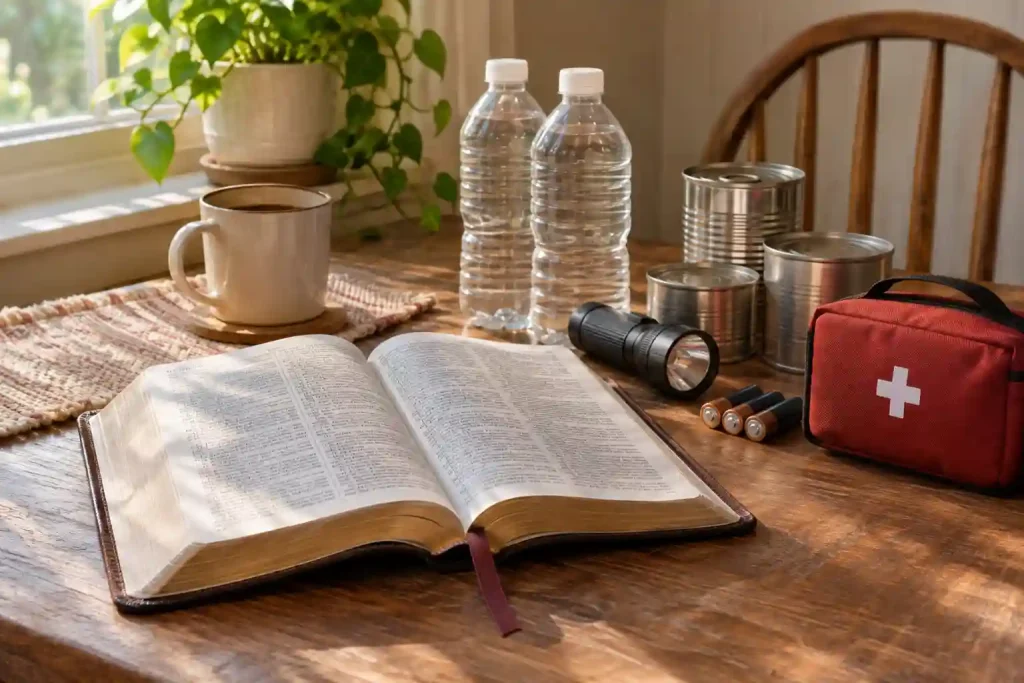
- Review what you already have. Consider drinking water, food, flashlights, batteries, and ways to receive information.
- Think about individual needs. Include children, pets, disabilities, and anyone who depends on powered equipment. Discuss medication or medical equipment arrangements with the appropriate healthcare professional.
- Prepare within your means. Add useful supplies gradually while continuing to meet everyday responsibilities.
- Talk with your family. Write down important contact information and agree on how you would reconnect if normal communication became unavailable.
- Make room for prayer and Scripture. Give God your attention before spending another hour reading alarming predictions.
- Check on someone else. Ask a neighbor, relative, or church member whether they need help making preparations.
These are starting points. Your local emergency management guidance can help you adapt a plan to your household and circumstances.
A small, thoughtful step can be more useful than hours spent worrying.
What If I Cannot Afford Extra Supplies?
Some readers may already be struggling to afford groceries. Being told to store weeks or months of supplies can feel overwhelming.
God knows your circumstances.
Your ability to purchase emergency supplies is not a measure of your faith, and financial hardship is not evidence that He has abandoned you.
Begin with what is possible. You may already have useful items at home. Writing down contact information, discussing a family plan, and learning where to find reliable local updates are steps that do not require a large purchase.
Talk with trusted relatives, your church, or local community organizations about available support.
Galatians 6:2 calls believers to carry one another’s burdens. Asking for help is consistent with the mutual care Christians are called to practice.
If you have enough to share, consider helping someone who does not. A church’s response to uncertainty should include practical care for people with fewer resources.

Remember the People Around You
Christian preparedness should include concern for others.
An elderly neighbor may need someone to check on them. A family may struggle to afford extra groceries. Someone with a disability may need help making arrangements.
James 2:15–17 challenges us to respond to material needs with action rather than offering kind words alone.
Whatever resources we have, we can ask God how to use them faithfully.
We can build relationships now, learn who may need assistance, and work with our churches to care for people. Those opportunities exist before any emergency occurs.
And as we care for physical needs, we can lovingly share the hope we have in Christ.
Questions to Bring Before God
Take a few quiet moments to consider:
- Am I giving more attention to alarming posts than to God’s Word?
- Has my hope become overly dependent on a political outcome?
- Am I checking information before sharing it?
- Have I neglected prayer while trying to plan for every possibility?
- Who around me could use practical help or encouragement?
- Am I trusting Jesus Christ for my salvation?
These questions are for me, too.
It is easy to recognize fear or misplaced priorities in someone else. We need to let Scripture examine our own hearts.
A Prayer for Wisdom and Trust
Heavenly Father,
You know the concerns we carry for our families, our country, and the future.
Give us wisdom to prepare responsibly and discernment to recognize what is true. Help us resist fear, speak honestly, and pray faithfully for those in authority.
Search our hearts and show us where we have placed too much confidence in people, possessions, or our own plans.
Please provide for those who are struggling to meet their daily needs. Help Your church recognize those needs and respond with generosity and compassion.
For anyone reading who does not know You, open their heart to the truth of Jesus Christ and their need for salvation.
Thank You for the forgiveness and eternal hope we have through His death and resurrection. Teach us to live faithfully today while trusting You with tomorrow.
In Jesus’ name,
Amen.
As you consider how to prepare your household for uncertain days, take time to consider where your hope rests.
Have you entrusted your life—and your eternity—to Jesus Christ?