
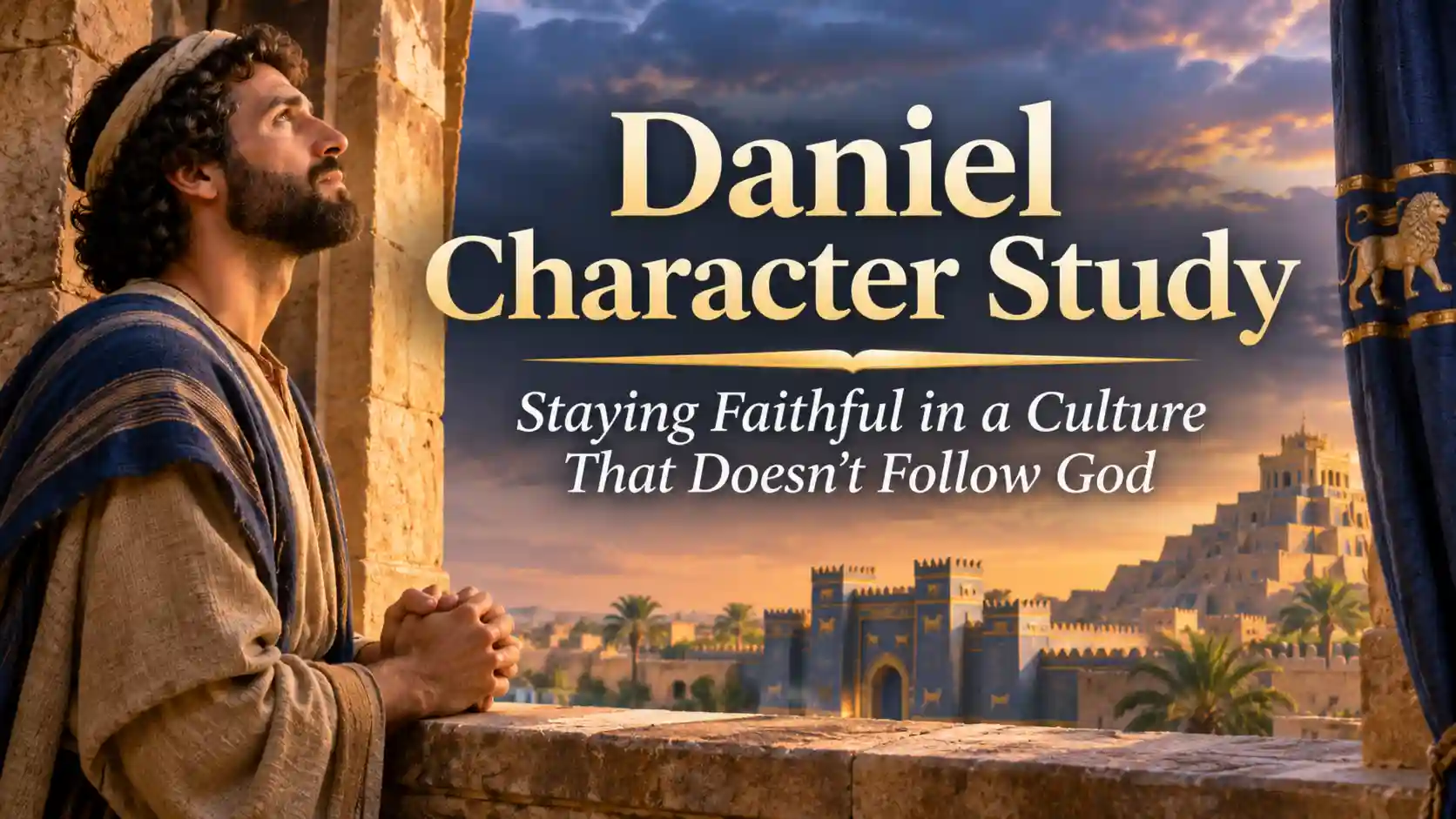
Daniel Character Study: Staying Faithful in a Culture That Doesn’t Follow God
How do you stay faithful to God when the culture around you believes something completely different?
How do you stand for what is right without becoming hostile toward everyone who disagrees with you?
How do you obey God when doing so could cost you something?
Daniel faced all of those questions.
He was taken from his homeland, placed in a foreign culture, given a new name, educated in a different system, surrounded by people who worshiped other gods, and eventually threatened with death because he continued praying to the true God.
Yet Daniel remained faithful. He did not completely isolate himself from the world around him.
He learned. He worked.
He served kings. He accepted positions of tremendous responsibility.
But there was one thing Daniel refused to surrender:
His loyalty to God.
Daniel’s story is especially relevant for Christians today because it shows us what it can look like to live faithfully among people who do not necessarily share our beliefs.
Let’s look at who Daniel was, what he experienced, the character traits that defined his life, and what Christians can learn from him today.
Explore More Bible Character Studies
Daniel at a Glance
Name: Daniel
Babylonian name: Belteshazzar
Home: Judah
Taken to: Babylon
Known for: Prayer, wisdom, integrity, courage, prophecy, and faithfulness to God
Key chapters: Daniel 1, 2, 5, 6, 7, and 9
Key character traits: Faithful, courageous, humble, disciplined, wise, prayerful, and trustworthy
Friends: Hananiah, Mishael, and Azariah—better known by their Babylonian names Shadrach, Meshach, and Abednego
Main lesson from his life: You can live in a culture that does not follow God without allowing that culture to determine your convictions.
Who Was Daniel in the Bible?
Daniel was a young Jewish man from Judah who was taken to Babylon after King Nebuchadnezzar came against Jerusalem. Daniel 1 tells us that Nebuchadnezzar ordered that some young men from Israel’s royal family and nobility be brought into his service.
They were selected for qualities including physical fitness, intelligence, knowledge, aptitude for learning, and the ability to serve in the king’s palace.
Among them were:
Daniel, Hananiah, Mishael, and Azariah.
Most people know Daniel’s three friends by the Babylonian names later given to them:
Shadrach, Meshach, and Abednego.
Daniel was given the Babylonian name Belteshazzar.
We often hear Daniel described as a teenager when he entered Babylon. That is possible, but the Bible does not tell us Daniel’s exact age, so we should not present a specific age as fact.
What Scripture does tell us is that Daniel was among the young men selected for training in the Babylonian court. His life had changed dramatically.
Daniel had been taken away from:
- His homeland
- His familiar culture
- The temple in Jerusalem
- Much of the community he knew
- The future he probably expected to have
He was now living under the authority of a foreign empire. Babylon could change Daniel’s location.
It could educate him in Babylonian literature. It could even give him another name.
But Babylon could not determine whom Daniel worshiped.
That becomes one of the defining themes of his life.
Why Was Daniel Taken to Babylon?
Daniel’s exile was part of a much larger story. God had repeatedly warned Judah through His prophets about idolatry and disobedience. The people and their leaders continued to reject His warnings. Second Chronicles 36:15–21 explains how Jerusalem’s eventual destruction and exile followed that persistent rebellion. Jeremiah 25:8–12 foretold Babylonian domination and a period of seventy years.
Daniel was among those taken during an earlier stage of Babylon’s conquest, before Jerusalem and the temple were destroyed. Daniel 1:2 emphasizes that God gave Jehoiakim into Nebuchadnezzar’s hand. Even in judgment, God remained sovereign. Daniel’s personal circumstances were painful, but God had not abandoned His purposes for His people.
A Simple Timeline of Daniel’s Life
The following overview follows the major events of Daniel’s life. The visions in chapters 7–12 overlap earlier events and are not arranged in strictly chronological order.
| Event | Scripture |
|---|---|
| Taken to Babylon; resolves not to defile himself | Daniel 1 |
| Interprets Nebuchadnezzar’s dream after prayer | Daniel 2 |
| Warns Nebuchadnezzar about pride | Daniel 4 |
| Interprets the writing on the wall | Daniel 5 |
| Serves under Darius and is delivered from the lions’ den | Daniel 6 |
| Receives visions during several reigns | Daniel 7–12 |
| Studies Jeremiah and prays for his people | Daniel 9 |
Daniel Was Surrounded by a Culture That Did Not Worship God
Daniel did not choose to live in Babylon. He was taken there.
Babylon had its own gods, values, political system, language, customs, and worldview. Daniel was expected to learn the language and literature of the Babylonians and prepare for service in the king’s court.
This gives us an important detail about Daniel.
Daniel did not refuse to learn simply because the culture around him was pagan.
He could learn Babylonian literature without worshiping Babylonian gods. He could serve a foreign king without making that king his god.
He could participate in society without surrendering his faith. That distinction is important for Christians today.
Following Christ does not require us to completely withdraw from everyone who believes differently. Christians live, work, study, shop, communicate, and build relationships alongside people with many different beliefs.
The question is not whether we will encounter ideas that differ from Scripture. We will.
The question is:
Will the culture around us become the authority over what we believe?
Daniel’s answer was no.
Daniel 1: Daniel Made Up His Mind Before the Pressure Came
One of the most important statements about Daniel appears very early in his story.
Daniel 1:8 says Daniel resolved or purposed in his heart that he would not defile himself with the king’s food and wine.
Christians and Bible scholars have offered different explanations for precisely why Daniel considered these provisions defiling. Possible concerns include Israel’s dietary laws or some connection between the royal provisions and pagan practices.
The text does not explain every detail. But Daniel’s decision is clear.
Daniel had determined that obedience to God mattered more than the privileges being offered to him.
Notice something important:
Daniel settled the issue before the pressure became greater.
Decide What You Believe Before You Are Pressured to Compromise
Many spiritual compromises do not begin with someone announcing:
“I no longer want to follow God.”
They happen gradually. A little compromise here.
A conviction ignored there. Silence because speaking feels uncomfortable.
A boundary moved because everyone around us is doing something different. Daniel shows us the importance of establishing our convictions from Scripture before the moment of greatest pressure arrives.
Ask yourself:
What have I already decided I will not compromise, even when obedience becomes uncomfortable?
What Daniel Was Willing to Adapt To—and What He Would Not Compromise
Daniel’s life helps us understand an important distinction. He did not resist everything simply because it was Babylonian.
Daniel accepted many aspects of life in Babylon.
He:
- Learned the language and literature of Babylon
- Received training for government service
- Worked within a foreign political system
- Served rulers who did not share his faith
- Interacted with people whose beliefs were very different from his
- Was known publicly by the Babylonian name Belteshazzar
But there were boundaries. Daniel would not knowingly defile himself in Daniel 1.
He would not stop praying to God in Daniel 6. He would not pretend that human kings possessed wisdom that belonged to God.
He would not soften God’s message simply because a ruler might dislike hearing it. This is an extremely helpful lesson for Christians living in modern culture.
Not Every Cultural Difference Requires a Battle
Daniel did not oppose something merely because it was different from what he had known in Judah. He could adapt where adaptation did not require disobedience.
But when obedience to Babylon would require disobedience to God, Daniel knew where the line was. That gives us a better model than either extreme.
We don’t have to copy everything around us. But we also don’t have to treat every cultural difference as an attack on our faith.
The question is:
Does this require me to disobey God?
If the answer is no, there may be room for wisdom and Christian freedom. If the answer is yes, obedience to God must come first.
Daniel Was Convicted Without Being Disrespectful
Something else about Daniel 1 is easy to miss. Daniel did not respond with arrogance.
He did not insult the Babylonian officials. He did not create unnecessary conflict.
Daniel 1:8 says that he asked the chief official for permission not to defile himself.
When concerns arose, Daniel proposed a test. There was conviction.
But there was also respect. This gives Christians an important example.
Standing for truth does not require becoming rude. We do not have to compromise biblical convictions.
But neither should we treat every disagreement as an excuse for hostility. Daniel shows us that:
Courage and respect can exist together.
God Gave Daniel Wisdom
Daniel 1:17 tells us that God gave Daniel and his friends knowledge and understanding. Daniel was also given understanding concerning visions and dreams.
Later, King Nebuchadnezzar had a troubling dream and demanded that his wise men tell him both the dream itself and its interpretation. The request was humanly impossible.
Daniel did not pretend he possessed supernatural knowledge on his own. Instead, he turned to God.
Daniel 2: Daniel Prayed Before He Acted
When Daniel learned that the king’s decree threatened the lives of Babylon’s wise men—including Daniel and his friends—Daniel asked for time. Then he went to Hananiah, Mishael, and Azariah and urged them to plead with God for mercy concerning the mystery.
God revealed the mystery to Daniel. What did Daniel do?
He praised God. Before rushing to the king to show everyone how gifted he was, Daniel worshiped.
Daniel acknowledged that wisdom and power belong to God. This becomes another defining characteristic of his life.
When Daniel needed wisdom, he sought God.
Prayer Was Not Daniel’s Last Resort
How often do we reverse that?
Something happens.
We worry. We imagine every possible outcome.
We ask everyone for advice. We search endlessly for answers.
And eventually we remember:
I should pray.
Daniel’s life repeatedly places prayer near the center of his response. Prayer did not make Daniel passive.
He still acted.
Prayer prepared Daniel to act wisely.
Daniel Gave God the Credit
When Daniel stood before Nebuchadnezzar, he had an incredible opportunity to make himself look important. The king desperately wanted an answer.
Daniel had it. Yet Daniel made clear that human wise men could not reveal the mystery.
Then he pointed away from himself:
There is a God in heaven who reveals mysteries.
Daniel possessed extraordinary gifts. He had wisdom.
He interpreted dreams. Kings trusted him.
He rose to positions of influence. Yet he understood where his abilities came from.
Spiritual Maturity Doesn’t Say, “Look How Great I Am.”
It says:
“Look what God has done.”
When God gives us abilities, opportunities, knowledge, influence, or success, it can become very easy to quietly begin taking the credit. Daniel teaches us to remain humble even when God gives us remarkable opportunities.
Daniel’s Prayer Life: More Than a Crisis Habit
Prayer deserves special attention in any character study of Daniel because it appears repeatedly throughout his life.
Daniel Prayed When He Needed Wisdom — Daniel 2
Daniel and his friends sought God’s mercy when their lives were threatened. Daniel did not rely merely on his intelligence.
Daniel Had a Regular Prayer Routine — Daniel 6
Daniel 6 tells us that he prayed three times a day.
Most importantly, Scripture says he did this just as he had done before.
The crisis did not create Daniel’s prayer life. It exposed a prayer life that already existed.
Daniel Continued Praying When It Became Dangerous — Daniel 6
Daniel’s prayer habits did not change simply because obedience suddenly carried a cost.
Daniel’s Reading of Scripture Led Him to Prayer — Daniel 9
Daniel read Jeremiah’s prophecy concerning Jerusalem. He didn’t merely study prophecy as an intellectual exercise.
What he read drove him to seek God.
Daniel’s Prayer Included Confession — Daniel 9
Daniel approached God with humility. He confessed the sins of his people and appealed to God’s mercy.
What Can We Learn From Daniel’s Prayer Life?
Daniel didn’t merely pray when everything had gone wrong. Prayer was part of the structure of his life.
That raises an important question:
If a crisis arrived tomorrow, would prayer feel familiar to us—or would we suddenly be trying to build a prayer life in the middle of the emergency?
Daniel’s example encourages us to seek God now. Not merely when we need something.
Daniel’s Friends Faced the Fiery Furnace
An important distinction needs to be made when studying Daniel.
Daniel was not one of the three men thrown into the fiery furnace in Daniel 3.
That event involved his friends:
Shadrach, Meshach, and Abednego.
When Nebuchadnezzar commanded people to bow before the golden image he had made, the three men refused. They told the king that God was able to rescue them.
But their faith did not depend on receiving the outcome they wanted. They made clear that even if God did not deliver them from the furnace, they still would not worship the king’s gods or bow to his image.
Their faith was not:
“We will obey God if He guarantees our safety.”
It was:
“We will obey God regardless of the outcome.”
Although this event focuses on Daniel’s friends rather than Daniel himself, it reveals the kind of faithful community surrounding him.
Daniel Shows Us Why Faithful Friends Matter
Daniel was not standing entirely alone in Babylon. When he needed prayer in Daniel 2, he went to his friends.
Christians need other Christians. There will be times when you need someone to:
- Pray with you
- Encourage you
- Remind you of Scripture
- Help you resist temptation
- Speak truth when you are discouraged
- Stand beside you when following God becomes difficult
Daniel’s friends could not make his decisions for him. But they could stand with him.
The same is true for us.
Daniel Was Willing to Tell Powerful People the Truth
Daniel did not only give kings messages they wanted to hear. In Daniel 4, Nebuchadnezzar told Daniel another troubling dream.
Its meaning was not flattering. Daniel explained that it concerned judgment on the king and urged Nebuchadnezzar to turn away from sin and show mercy to the oppressed.
Imagine the courage required to deliver that message to one of the world’s most powerful rulers. Daniel did it.
But Daniel did not appear eager to condemn him. The text portrays Daniel as disturbed by what the dream meant.
Daniel could speak difficult truth while still caring about the person receiving it.
Truth Without Love Can Become Harsh
Love Without Truth Can Become Compromise
Daniel demonstrates that conviction and concern for another person do not have to be enemies.
Daniel 5: The Writing on the Wall
Years later, Daniel was summoned before King Belshazzar.
During a great feast, Belshazzar used vessels that had been taken from the temple in Jerusalem while praising gods made of gold, silver, bronze, iron, wood, and stone.
Then a mysterious hand appeared and wrote on the wall. The terrified king needed someone to explain the message.
Daniel was called. He reminded Belshazzar of what had happened to Nebuchadnezzar because of his pride.
Then Daniel confronted Belshazzar. He knew what had happened to Nebuchadnezzar.
Yet he had not humbled himself.
Daniel explained that the message announced judgment. Daniel had no guarantee that the king would appreciate what he had to say.
But his responsibility was not to make God’s message comfortable. His responsibility was to faithfully communicate it.
Daniel 6: Daniel’s Integrity Made Him Stand Out
Daniel eventually continued serving under another ruler.
Daniel 6 identifies this ruler as Darius the Mede.
Daniel distinguished himself among the administrators because of his exceptional qualities, and the king planned to place him over the whole kingdom. This made other officials jealous.
So they looked for grounds to bring charges against Daniel concerning his conduct in government. But they encountered a problem.
They could find no corruption or negligence in him. Think about that.
Daniel held significant political responsibility. His enemies were actively searching for evidence they could use against him.
And they could not find legitimate wrongdoing. They eventually realized that the only way to trap Daniel was to create a conflict involving his obedience to God’s law.
What Would People Find If They Closely Examined Our Lives?
Daniel’s faith wasn’t limited to obviously religious moments. It affected his work.
He was trustworthy. Responsible.
Consistent. His integrity was part of his witness.
Faithfulness to God should affect the way Christians:
- Work
- Handle money
- Keep promises
- Treat coworkers
- Use authority
- Fulfill responsibilities
- Behave when nobody appears to be watching
Daniel’s enemies disagreed with him. But they could not honestly accuse him of corruption.
That is a powerful testimony.
Daniel Refused to Stop Praying

Daniel’s enemies persuaded the king to establish a decree forbidding anyone from praying to any god or human being except the king for thirty days. The punishment was the lions’ den.
Daniel learned that the decree had been issued. What did he do?
He went home. He prayed.
Three times a day.
Just as he had done before.
That phrase matters. Daniel did not suddenly develop courage because a crisis arrived.
The crisis revealed the faithfulness that was already there.
Private Habits Prepare Us for Public Tests
Daniel had already built a life of prayer. So when obedience became dangerous, he didn’t need to invent a new spiritual life overnight.
He continued doing what he had already been doing. That raises an important question:
What spiritual habits are we developing now that will sustain us when life becomes difficult?
Prayer. Scripture.
Worship. Fellowship.
Obedience. Trust.
These may seem ordinary when life is peaceful. But ordinary faithfulness prepares us for extraordinary trials.
Daniel Was Thrown Into the Lions’ Den

Daniel’s enemies caught him praying. The king realized he had been trapped by the decree but could not simply undo what had been enacted according to the law described in the chapter.
Daniel was thrown into the lions’ den. The king spent the night fasting and was unable to sleep.
At dawn, he hurried to the den. Daniel was alive.
Daniel testified that God had sent His angel and shut the lions’ mouths. God had preserved him.
But we need to be careful about the lesson we draw from this story.
The lesson is not:
“If you trust God, nothing bad will ever happen to you.”
Something terrible did happen to Daniel. He was falsely targeted.
He was condemned. He was thrown into a den of lions.
Hebrews 11:33–38 describes both believers who escaped danger and believers who suffered greatly for their faith. Faithfulness does not guarantee physical deliverance.
Daniel’s story teaches something deeper:
God remains worthy of obedience even when faithfulness carries a cost.
Daniel Didn’t Know the Outcome Before He Obeyed
This may be one of the most important lessons from Daniel’s life. Sometimes we say we trust God when what we really mean is:
“I trust God to give me the outcome I want.”
Biblical faith goes deeper. Daniel continued praying before he knew what would happen.
His friends refused to bow before they knew whether they would survive the furnace. Faithfulness says:
God is able.
But faithfulness also says:
Even when I cannot control the outcome, I will still obey God.
What Daniel Teaches Us About Success
Daniel became influential. He served rulers.
He was trusted with enormous responsibility. It would therefore be easy to turn Daniel’s story into a formula:
“Be faithful to God and God will make you successful.”
But that is not the complete message of Daniel. Sometimes Daniel’s faithfulness resulted in favor and advancement.
At other times, the same faithfulness resulted in opposition and a lions’ den. His three friends experienced the same reality.
Their obedience led directly to a fiery furnace before God delivered them.
Biblical Faithfulness Is Not a Formula for Getting Promoted
Sometimes obedience brings opportunities. Sometimes obedience costs us opportunities.
Sometimes people respect our convictions. Sometimes people oppose them.
Our goal cannot simply be:
“If I obey God, what will I get?”
Daniel’s life points us toward a better question:
“Whether this brings favor or opposition, will I remain faithful to God?”
The greatest success in Daniel’s life was not his government position. It was his faithfulness.
Daniel Studied Scripture
Daniel wasn’t only a man of visions and dramatic miracles. He was also a student of God’s Word.
Daniel 9 tells us that he understood from the writings connected with the prophet Jeremiah that Jerusalem’s desolation would last seventy years. Daniel read Scripture.
He believed what God had said. And then he prayed.
This is important because people sometimes become fascinated with Daniel primarily because of prophecy. There certainly is a great deal of prophecy in the book.
But Daniel himself demonstrates a healthy response to God’s Word. He read it.
He took it seriously. He responded to it.
Bible Study Should Lead to Changed Hearts
The purpose of Scripture study isn’t merely accumulating information. Daniel’s study moved him toward:
- Prayer
- Confession
- Humility
- Worship
- Dependence on God
Our Bible study should do the same.
Ask:
What is God showing me?
What needs to change in me?
What should I confess?
What should I believe?
What should I obey?
Daniel Confessed Sin Even Though He Was Faithful
Daniel 9 contains a powerful prayer of confession. In Daniel 9:20, Daniel explicitly refers to confessing both his own sin and the sin of his people. Something striking happens in it.
Daniel repeatedly speaks corporately:
We have sinned.
Daniel does not stand over everyone else saying:
“Look at how wicked they are.”
He approaches God humbly and identifies himself with his people while appealing to God’s mercy. Daniel is portrayed throughout the book as unusually faithful.
Yet his faithfulness did not produce self-righteousness.
Faithfulness Should Make Us Humble
Spiritual maturity should not produce:
“Look how much better I am than everyone else.”
It should deepen our awareness that we depend on God’s mercy. The closer we walk with God, the less reason we have to boast in ourselves.
Daniel and Jesus: The Everlasting Kingdom
Daniel’s story ultimately points beyond Daniel. One of the most important visions in the book appears in Daniel 7.
Daniel sees “one like a son of man” coming with the clouds of heaven.
This figure receives authority, glory, and sovereign power. His dominion is everlasting.
His kingdom will not be destroyed.
The phrase Son of Man becomes especially important when we reach the New Testament.
Jesus repeatedly refers to Himself as the Son of Man, and His words about coming with the clouds draw directly on the imagery of Daniel 7. Daniel’s vision therefore helps us look beyond the rise and fall of earthly kingdoms toward God’s everlasting kingdom.
Jesus explicitly draws on Daniel’s vision in Matthew 26:63–64 and Mark 13:26. In John 18:36, He explains that His kingdom is not of this world. Hebrews 12:28 encourages believers to worship God with reverence and gratitude because they are receiving a kingdom that cannot be shaken. These passages help us understand why earthly power never deserves our ultimate allegiance.
Daniel Was Faithful—but Daniel Was Not the Savior
Daniel is an extraordinary biblical example. But the purpose of a Christian character study is not simply:
“Try harder to be like Daniel.”
Daniel needed God’s mercy just as we do. Our ultimate hope is not in developing enough courage, discipline, or integrity to save ourselves.
Our hope is Jesus Christ. Daniel watched kingdoms rise and fall.
Babylon did not last. The rulers Daniel served did not last.
Every human kingdom is temporary. But the kingdom associated with the Son of Man in Daniel 7 is everlasting.
Daniel teaches us how to remain faithful while we live among temporary kingdoms. Jesus gives us the eternal King to whom our ultimate loyalty belongs.
Daniel Remained Faithful Across Decades
Another remarkable aspect of Daniel’s life is its endurance. Daniel didn’t have one brave moment.
He continued faithfully through changing rulers, political systems, responsibilities, dangers, and stages of life. Many people can demonstrate courage for five minutes.
Daniel demonstrated a pattern of faithfulness. Kings changed.
Governments changed. Daniel’s circumstances changed.
Daniel’s God did not.
Christianity Is Not About One Emotional Moment
Following Jesus is a lifetime. There may be seasons when faith feels exciting.
There will be ordinary seasons. There may be painful seasons.
There may be times when obedience costs something. The goal isn’t merely to start faithfully.
It is to continue faithfully.
Don’t Turn Daniel Into Only a “Culture War” Story
Because Daniel lived among people who did not worship his God, it can be tempting to reduce his story to:
“Daniel fought the culture.”
But that isn’t quite what the text shows. Daniel spent much of his life serving within Babylonian and later government systems.
He worked alongside people who did not share his faith. He treated rulers respectfully.
He became trusted because of his service. He wasn’t looking for a confrontation every day.
Daniel drew a line when obedience to human authority conflicted with obedience to God. That distinction matters.
Daniel Didn’t Fight Everything
He didn’t reject education because it came from Babylon. He didn’t refuse government service because the king was pagan.
He didn’t treat everyone around him as an enemy. But Daniel also didn’t allow acceptance, career advancement, or political pressure to become more important than obedience.
For Christians today, that gives us an important balance:
Engagement without compromise.
Conviction without unnecessary hostility.
Respect without surrender.
What Daniel Teaches Christians Living in Modern Culture
Daniel’s world was very different from ours. We should not force every detail of ancient Babylon into a modern situation.
But the principles demonstrated through his life remain relevant. Christians today live among people who may:
- Believe differently about God
- Follow another religion
- Have no religious belief
- Define morality differently
- Disagree with biblical teachings
- Consider some Christian beliefs outdated
Daniel shows us two responses to avoid.
One is compromise:
“I’ll change what I believe so that I fit in.”
The other is unnecessary hostility:
“Anyone who disagrees with me is my enemy.”
Daniel demonstrates another way. He served.
He worked. He learned.
He showed respect. He developed relationships.
He demonstrated integrity. He prayed.
And when obedience to human authority conflicted with obedience to God, Daniel chose God.
Daniel Shows Us When Human Authority Has a Limit
Daniel was not rebellious toward government as a lifestyle. For much of his life, he faithfully served rulers who did not worship his God.
But Daniel 6 reveals a clear boundary. When the decree required Daniel to stop praying to God, Daniel continued praying.
The New Testament later expresses the same basic principle when the apostles declare in Acts 5:29:
“We must obey God rather than human beings.”
Other passages such as Romans 13 teach Christians to respect governing authorities. Those truths belong together.
Daniel respected rulers. He served rulers.
But he did not give rulers the place that belonged to God.
Eight Character Traits We See in Daniel
| Trait | Scripture | Application today |
|---|---|---|
| Conviction | Daniel 1:8 | Establish biblical boundaries. |
| Wisdom | Daniel 2:17–23 | Seek God before making decisions. |
| Humility | Daniel 2:27–30 | Give God credit for your abilities. |
| Courage | Daniel 4:27 | Speak difficult truths with compassion. |
| Integrity | Daniel 6:4 | Be trustworthy even when no one is watching. |
| Prayerfulness | Daniel 6:10 | Develop consistent spiritual habits. |
| Repentance | Daniel 9:4–20 | Confess sin and seek God’s mercy. |
| Perseverance | Daniel 6:28 | Remain faithful through changing circumstances. |
Five Major Lessons From Daniel’s Life
1. Decide Your Convictions Before the Test Comes
Daniel resolved in his heart before the greatest crises arrived. Know Scripture.
Know what you believe. Determine beforehand that obedience to God matters.
2. You Can Be Respectful Without Compromising
Daniel did not confuse courage with rudeness. Christians can speak truth firmly while treating people with dignity.
3. Build a Prayer Life Before You Need One
The lions’ den did not create Daniel’s prayer life. It revealed it.
4. Your Integrity Is Part of Your Witness
Daniel’s enemies examined his life and couldn’t find ordinary corruption to use against him. How we live matters alongside what we say we believe.
5. Faithfulness Is More Important Than Fitting In
Daniel could have made life easier by simply going along with everything around him. He chose faithfulness instead.
That decision shaped his life.
Key Bible Passages From Daniel’s Life
If you want to study Daniel more deeply, start with these passages.
Daniel 1:8
Daniel 1:8 (KJV excerpt)
“But Daniel purposed in his heart that he would not defile himself with the portion of the king’s meat, nor with the wine which he drank.”
Daniel resolves not to defile himself.
Lesson: Establish convictions before pressure comes.
Daniel 2:17–23
Daniel and his friends seek God concerning Nebuchadnezzar’s dream, and Daniel responds to God’s answer with praise.
Lesson: Seek God for wisdom and give Him the credit.
Daniel 2:28
Daniel 2:28 (KJV excerpt)
“But there is a God in heaven that revealeth secrets”
Daniel directs Nebuchadnezzar’s attention toward the God who reveals mysteries.
Lesson: Use your gifts to point toward God rather than yourself.
Daniel 4:27
Daniel urges Nebuchadnezzar to turn from sin and show mercy.
Lesson: Speak difficult truth with concern for the person hearing it.
Daniel 6:4
Daniel 6:4 (KJV excerpt)
“forasmuch as he was faithful, neither was there any error or fault found in him.”
Daniel’s enemies cannot find corruption or negligence in his conduct.
Lesson: Integrity matters.
Daniel 6:10
Daniel 6:10 (KJV excerpt)
“he kneeled upon his knees three times a day, and prayed, and gave thanks before his God, as he did aforetime.”
Daniel continues his established pattern of praying three times a day despite the decree.
Lesson: Build spiritual habits before the crisis arrives.
Daniel 7:13–14
Daniel 7:14 (KJV excerpt)
“his dominion is an everlasting dominion, which shall not pass away, and his kingdom that which shall not be destroyed.”
Daniel sees one like a son of man receiving an everlasting dominion.
Lesson: Human kingdoms are temporary; God’s ultimate kingdom is not.
Daniel 9:2–5
Daniel 9:4–5 (KJV excerpt)
“O Lord, the great and dreadful God, keeping the covenant and mercy to them that love him, and to them that keep his commandments; We have sinned, and have committed iniquity”
Daniel reads Jeremiah, seeks God, and confesses sin.
Lesson: Scripture should move us toward prayer, repentance, and worship.
Common Questions About Daniel
How Old Was Daniel When He Was Taken to Babylon?
The Bible does not tell us Daniel’s exact age. Daniel 1 describes him among the young men selected for royal training, but Scripture does not give a specific number.
For that reason, claims that Daniel was exactly 15, 16, or 17 years old should be treated as estimates rather than biblical facts.
What Does the Name Daniel Mean?
The Hebrew name Daniel is commonly understood to mean “God is my judge” or “God is judge.”
Why Was Daniel Called Belteshazzar?
Daniel 1 says the chief official gave Daniel and his friends Babylonian names.
Daniel was called Belteshazzar.
The renaming was part of their new life and training in Babylon.
Was Daniel in the Fiery Furnace?
No.
The three men thrown into the fiery furnace in Daniel 3 were Shadrach, Meshach, and Abednego.
Daniel does not appear in the account of the furnace, and Scripture does not explain why he was absent from that account.
Why Did Daniel Pray Three Times a Day?
Daniel 6 tells us that Daniel prayed three times daily and that this was his established practice.
The chapter does not tell us that Daniel began this habit because of the decree. His three-times-daily routine is a helpful example, not a biblical requirement for Christians.
Quite the opposite—he continued praying just as he had done before.
Was Daniel a Prophet?
Daniel received numerous visions and revelations from God concerning future events.
Jesus also refers to “Daniel the prophet” in Matthew 24:15.
Did Daniel Ever Return to Jerusalem?
The Bible does not record Daniel returning to Jerusalem.
Daniel remained active during the transition from Babylonian to Persian rule, but Scripture does not tell us that he personally returned with the Jewish exiles.
We therefore should not claim either that he definitely returned or that we know exactly where he spent the final years of his life beyond what Scripture records.
How Long Did Daniel Live in Babylon?
Scripture does not give Daniel’s birth or death dates, so we cannot calculate his exact lifespan. However, the book presents him serving across multiple reigns and continuing into the period after Babylon fell.
His story therefore spans many years.
What Was Daniel’s Greatest Character Trait?
Several answers could reasonably be given—prayerfulness, courage, wisdom, integrity, or perseverance.
But perhaps the trait that ties everything together is faithfulness.
Whether Daniel was being trained, promoted, threatened, questioned, or thrown into danger, his loyalty to God remained central.
What Does Daniel Teach Christians Today?
Daniel teaches Christians that it is possible to participate responsibly in society without allowing society to become the authority over our faith. His life demonstrates conviction without unnecessary hostility, courage without arrogance, prayer without passivity, and service without compromise.
How to Live Like Daniel in Today’s World
| Situation | A faithful response |
|---|---|
| An employer asks you to falsify a record. | Explain respectfully why you cannot do so and offer an honest alternative. |
| Friends pressure you to compromise. | Maintain your boundaries without insulting your friends. |
| Someone mocks your faith. | Respond gently; you do not have to win every argument. |
| You face uncertainty. | Pray, seek wise counsel, and take responsible action. |
| Family members do not share your faith. | Show Christ’s love through patience, service and honest conversation. |
| You receive recognition. | Thank God and acknowledge others who helped. |
| Social media presents conflicting claims. | Examine them against Scripture before sharing or accepting them. |
For more practical encouragement, read What It Means to Follow Jesus Daily.
What If You Haven’t Been Faithful Like Daniel?
Perhaps Daniel’s example reminds you of times when you have compromised your convictions, neglected prayer, or remained silent out of fear. His story is not meant to leave you hopeless. It is an invitation to turn back to God.
First John 1:9 assures believers that God forgives and cleanses those who confess their sins. Romans 8:1 reminds us that there is no condemnation for those who are in Christ Jesus. Ephesians 2:8–10 teaches that salvation is God’s gift through faith, not something we earn through good works. Good works follow from the new life God gives us.
You cannot change yesterday’s decisions, but you can confess your sin, receive God’s forgiveness and take the next faithful step today. Read How Do I Repent According to the Bible? and How Can I Know If I Am Saved?.
Seven-Day Daniel Bible Study Reading Plan

Read the assigned passage slowly, write down what it reveals about God, and pray about one way to respond. Use this plan individually, with your family or in a small group.
| Day | Read | Reflect on |
|---|---|---|
| 1 | Daniel 1 | What convictions need to guide my choices? |
| 2 | Daniel 2 | How can I depend on God for wisdom? |
| 3 | Daniel 3 | Will I trust God regardless of the outcome? |
| 4 | Daniel 4–5 | Where do I need humility? |
| 5 | Daniel 6 | How can I strengthen my prayer life and integrity? |
| 6 | Daniel 7:9–14 | How does God’s everlasting kingdom change my priorities? |
| 7 | Daniel 9:1–20 | What should I confess, and how can I pray for others? |
Reflection Questions for a Daniel Character Study
Take some time to prayerfully consider these questions:
- Where are you currently feeling pressure to compromise what you believe?
- Are there biblical convictions you need to settle before greater pressure comes?
- When you disagree with someone, do you combine conviction with respect?
- Is prayer your first response to difficulty or your last resort?
- If someone closely examined your work, relationships, finances, and private behavior, would they see integrity?
- Are you more concerned with fitting in or remaining faithful to Christ?
- Do you give God credit for your abilities and accomplishments?
- Do you have faithful Christians who will pray with you and encourage you?
- Is studying Scripture changing the way you live?
- Are you willing to obey God even when you cannot control the outcome?
- Are there cultural differences you have mistakenly treated as biblical issues?
- Is there an area where you have been calling something “Christian freedom” when you know God is asking you to obey?
Daniel Challenge: Put the Study Into Practice
Reading about Daniel is valuable. Living out what we learn is even more important.
Choose one area to focus on this week.
Prayer
Set aside a consistent time each day to pray. Don’t wait for an emergency.
Integrity
Choose to do the right thing this week even when nobody else would know if you didn’t.
Courage
Identify one area where fear of what other people think has been influencing your obedience to God. Ask God for courage.
Humility
Think of something God has enabled you to accomplish. Deliberately thank Him for it instead of taking all the credit yourself.
Scripture
Read one chapter of Daniel each day. Don’t rush simply to finish.
Ask:
What does this chapter reveal about God?
What does it reveal about people?
Is there something I need to believe, change, or obey?
Christian Community
Reach out to another Christian and ask if there is something you can pray about together. Daniel had friends who sought God with him.
We need faithful relationships too.
A Prayer Based on Daniel’s Life
Heavenly Father,
Help me remain faithful to You no matter what is happening around me.
Give me wisdom like Daniel to know when to speak, courage to stand when obedience is difficult, and humility to remember that every good gift comes from You.
Help me not to compromise Your truth simply because I want to fit in. Teach me to speak truth with grace and conviction without becoming proud, harsh, or self-righteous.
Build in me a consistent life of prayer so that I seek You not only when I am in trouble but every day. Give me integrity when no one is watching.
Help me know the difference between a cultural preference and something that would require me to disobey You. Surround me with faithful people who will encourage me to follow You.
When I cannot control the outcome, help me trust You anyway. And above all, keep my eyes on Jesus and remind me that every earthly kingdom is temporary, but Your kingdom is everlasting.
May my life point people toward You rather than toward myself. In Jesus’ name,
Amen.
Final Thoughts: Dare to Be Faithful Like Daniel
Daniel lived in Babylon. But Babylon never became the authority over Daniel’s heart.
He learned its language. He studied its literature.
He served its rulers. He performed his responsibilities with excellence.
He adapted where he could adapt. But when obedience to the culture around him would have required disobedience to God, Daniel knew where his loyalty belonged.
That may be one of the greatest lessons from his life. Christians do not need to run from everyone who sees the world differently.
We do not need to treat people who disagree with us as enemies. And we do not need to oppose everything simply because it comes from the surrounding culture.
But neither should we change God’s truth simply to make ourselves more acceptable. Daniel shows us another way:
Be present without being compromised.
Be courageous without being cruel.
Be respectful without surrendering truth.
Work with integrity.
Pray consistently.
Know God’s Word.
Choose your convictions carefully.
Trust God with the consequences.
And remember that Daniel’s story ultimately points beyond Daniel. Earthly kings came and went.
Babylon fell. Governments changed.
But Daniel saw a kingdom that would never be destroyed. Our ultimate hope isn’t that we can become strong enough to handle every difficult situation.
Our hope is Jesus Christ. The culture around us will continue changing.
Circumstances will change. People will change.
But God does not. And just as Daniel learned to remain faithful in Babylon, Christians today can remain faithful wherever God has placed us.
Keep Learning About Daniel
Want to review Daniel’s story in a fun way?
Try the Daniel in Babylon adventure in our free Living for the Christ Bible Adventure Game.
Choose Beginner or Advanced mode, answer Bible questions, and read the Scripture references as you work through Daniel’s story.
Discover What Other Biblical Lives Can Teach Us
Daniel’s life is just one of many powerful examples of faith, courage, and obedience found in Scripture. Through the lives of other biblical figures, we can discover valuable lessons about trusting God, overcoming failure, growing spiritually, and remaining faithful through life’s challenges.