
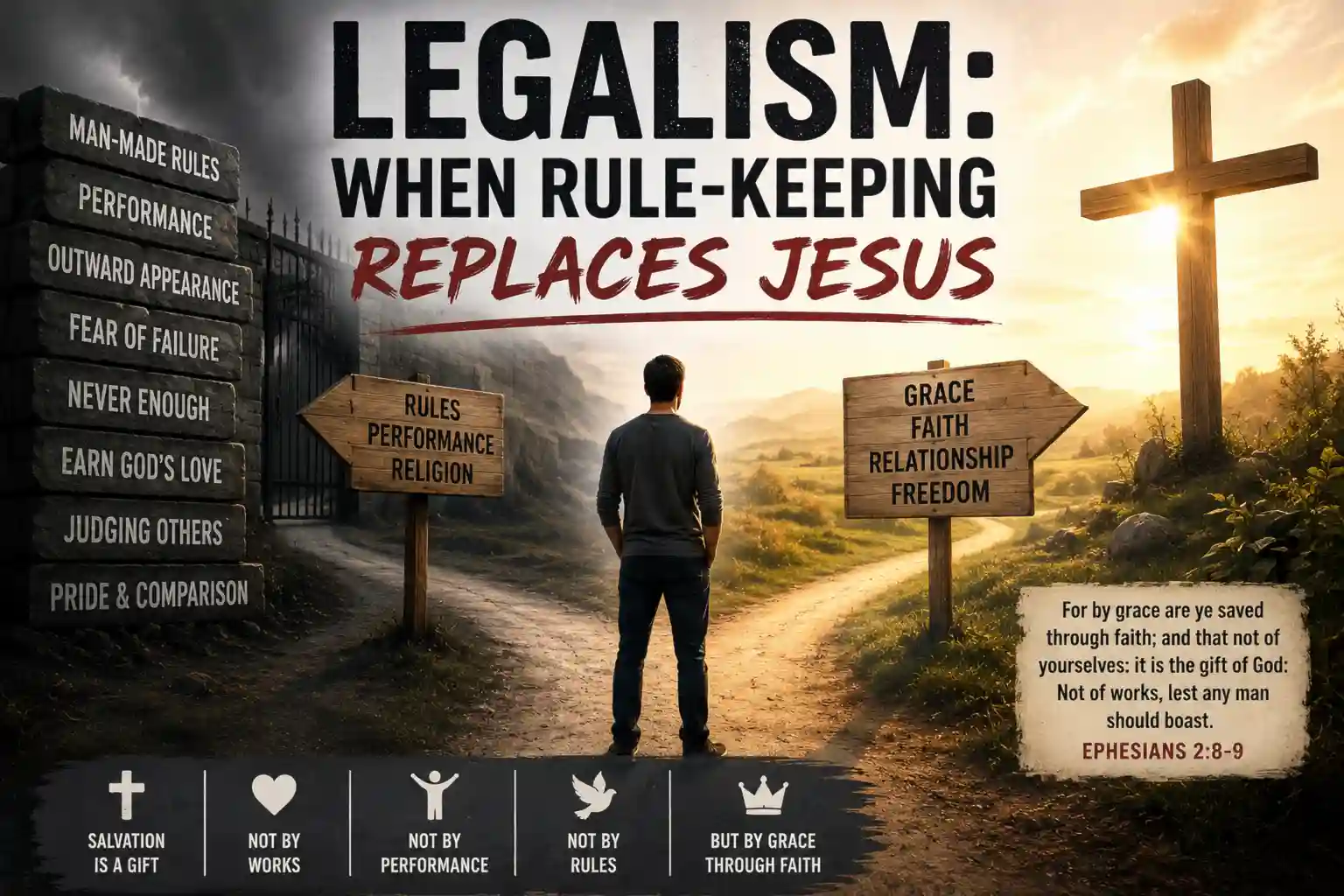
Legalism: When Rule-Keeping Replaces Jesus
Many Christians have encountered teachings that add extra rules to the Christian life.
Some are told that watching television is sinful, wearing jewelry is worldly, women should never wear makeup, playing cards is evil, or that certain clothing choices determine whether someone is truly godly.
While God does call believers to holiness and obedience, legalism goes beyond Scripture by turning human traditions, personal convictions, and man-made rules into standards of righteousness.
In this study, we’ll examine what the Bible teaches about legalism, how it differs from genuine holiness, and why salvation has always been by grace through faith in Jesus Christ alone.
Part of the “False Teachings” Series – Living for the Christ
Introduction: When Rules Replace Grace

Legalism is one of the most dangerous false teachings because it often looks spiritual on the outside. It sounds holy. It sounds disciplined. It sounds serious about God.
But underneath legalism is a subtle distortion of the Gospel.
Instead of salvation by grace through faith in Jesus Christ, legalism teaches that acceptance with God must be earned, maintained, or proven through human effort, rule-keeping, traditions, or outward performance.
The Bible teaches obedience matters. Holiness matters. Repentance matters.
But legalism turns obedience into a requirement for earning God’s love instead of a response to already being saved by grace.
That difference changes everything.
Many believers struggle with legalism without even realizing it. Some live in constant fear that they are “never doing enough.” Others judge the salvation of everyone around them based on outward standards instead of the fruit of the Spirit.
I personally think legalism can become spiritually exhausting because it shifts your focus away from Jesus and onto yourself. Instead of resting in Christ, you constantly measure your worth by performance.
And that is not the freedom Jesus came to give us.
What Is Legalism?
Legalism is the belief that a person can earn, maintain, or prove righteousness before God through works, rules, traditions, or external behavior rather than through faith in Jesus Christ alone.
Legalism often adds human requirements onto salvation.
Examples include:
- “You must follow certain man-made rules to be truly saved.”
- “Christians must dress a certain way to be accepted by God.”
- “If you fail spiritually, God no longer loves you.”
- “Your salvation depends on your performance.”
- “Grace alone is not enough.”
- “Real Christians follow our extra rules.”
Legalism can appear in churches, denominations, online ministries, cults, and even inside individual hearts.
It is not limited to one denomination or church style. Legalism can appear in strict traditional churches, modern churches, independent ministries, social media preaching, and even inside our own hearts if we are not careful.
Sometimes it looks strict and controlling.
Sometimes it looks prideful and self-righteous.
Sometimes it looks fearful and anxious.
But at its core, legalism shifts trust away from Jesus and places it onto human effort.
The Gospel vs Legalism
The Gospel says:
- Jesus saves sinners completely through grace.
- Salvation is a gift.
- We are justified by faith in Christ.
- Good works are the fruit of salvation, not the cause of it.
Legalism says:
- Grace is not enough by itself.
- Human effort helps secure righteousness.
- Outward rule-keeping becomes the measure of spirituality.
- Acceptance with God depends on performance.
The difference is massive.
The Gospel produces humility, gratitude, repentance, and love for God.
Legalism often produces fear, pride, judgment, comparison, burnout, or hidden hypocrisy.
🎥 Watch: John MacArthur on the Danger of Legalism
Legalism teaches that acceptance with God is earned through human effort, rule-keeping, and religious performance. In this biblical message, John MacArthur explains why salvation is by God’s grace and why true Christianity is about what Christ has done for us, not what we can do for Him.
What the Bible Says About Salvation by Grace
One of the clearest passages against legalism is:
Ephesians 2:8-9:
“For it is by grace you have been saved, through faith—and this is not from yourselves, it is the gift of God— not by works, so that no one can boast..”
Salvation is not something we achieve.
It is something Jesus accomplished.
Another powerful warning comes from:
Galatians 2:16:
“Knowing that a man is not justified by the works of the law, but by the faith of Jesus Christ…”
The book of Galatians strongly confronts legalism because false teachers were trying to add law-keeping onto the Gospel.
Paul warned that adding human works to salvation corrupts the message of Christ.
Galatians 3:3 also says:
“Are you so foolish? After beginning by means of the Spirit, are you now trying to finish by means of the flesh?”
Paul was warning believers not to drift back into performance-based religion after beginning by faith.
Jesus Confronted Legalism Repeatedly
Many of Jesus’ strongest rebukes were directed toward religious leaders who focused on outward rule-keeping while neglecting the condition of the heart.
The Pharisees looked righteous externally, but many were spiritually proud and self-righteous.
Jesus said in:
Matthew 23:27:
“Woe to you, teachers of the law and Pharisees, you hypocrites! You are like whitewashed tombs, which look beautiful on the outside but on the inside are full of the bones of the dead and everything unclean.”
Legalism often focuses heavily on appearances while ignoring inward transformation.
Jesus cares about the heart.
True Christianity is not external performance without inward surrender.
The Older Brother and Religious Pride
One of the clearest pictures of legalism appears in the parable of the prodigal son in Luke 15.
The younger brother openly sinned and eventually repented.
But the older brother outwardly obeyed while inwardly becoming bitter, prideful, angry, and self-righteous.
He believed his obedience made him more deserving.
That mindset reflects the heart of legalism.
Outward obedience without humility, grace, love, and relationship with God can still leave a heart spiritually cold.
Modern Examples of Legalism
One reason legalism can become confusing is because it often mixes genuine biblical principles with man-made rules.
Some Christians have personal convictions about certain activities, clothing choices, entertainment, or lifestyles. Personal convictions can be good and honoring to God.
The problem begins when human convictions are elevated to the level of biblical commands or treated as requirements for salvation and spiritual acceptance.
Over the years, many believers have heard teachings such as:
- Watching television is automatically sinful
- Christians should never wear jewelry
- Women wearing makeup is sinful
- Wearing shorts is ungodly
- Playing cards or board games is evil
- Video games are always sinful
- Christians should never listen to secular music
- Certain hairstyles are worldly
- Christians cannot celebrate birthdays or holidays
- Women must follow extra man-made appearance rules to be godly
- Outward appearance becomes the main measurement of spirituality
In some legalistic environments, outward appearance becomes the primary measurement of spirituality.
But the Bible teaches that true transformation begins in the heart.
This does not mean Christians should live carelessly or ignore holiness. Some forms of entertainment truly can be sinful. Some clothing choices can become immodest. Some activities can become idols or temptations.
The issue is not whether Christians should seek wisdom and holiness.
The issue is whether human opinions and extra rules are being treated as equal to God’s Word.
A believer may personally choose to avoid certain things out of conviction before God. That can be completely sincere and honorable.
But Scripture warns against judging other believers based on man-made standards.
Colossians 2:20-23 warns against human religious regulations that only appear spiritually impressive outwardly while missing true heart transformation.
True Christianity is not about creating endless external rules.
It is about following Jesus with a transformed heart led by the Holy Spirit.
When Good Things Become Legalism
One reason legalism can be difficult to recognize is because it often takes good and biblical practices and turns them into measures of spiritual worth.
The Bible encourages believers to pray, gather with other Christians, study Scripture, serve others, and grow in their faith.
These are all good things.
The problem begins when those practices become a way of earning God’s favor or judging the spirituality of others.
Examples might include:
- Believing that missing a church service automatically makes someone a bad Christian
- Shaming believers who miss church because of illness, work, family responsibilities, or other circumstances
- Thinking that attending multiple church services each week makes someone more saved
- Believing that praying for hours automatically makes a person more righteous than other believers
- Measuring spirituality by how many chapters of the Bible someone reads each day
- Treating spiritual disciplines as a way to earn God’s approval rather than grow closer to Him
- Looking down on Christians who do not follow the same religious routines
Prayer is good.
Church attendance is good.
Bible reading is good.
Fasting is good.
Serving is good.
But none of those things save us.
They are expressions of our relationship with God, not requirements for earning His love.
The Pharisees were often diligent in religious activities, yet Jesus rebuked them because their hearts were far from God.
God is not impressed by religious performance. He desires genuine faith, humility, obedience, and a heart that loves Him.
What Legalism Can Look Like Online
Today, legalism spreads rapidly through social media platforms, short videos, online ministries, and fear-based preaching.
Many believers constantly encounter messages such as:
- “If you do this one thing, you are going to hell.”
- “Real Christians would never wear this.”
- “Everything is demonic.”
- “True believers never watch TV or play games.”
- “If you struggle with sin, you are not saved.”
- “Christians must follow our extra rules to please God.”
Some online ministries create a constant atmosphere of fear, condemnation, and spiritual anxiety.
Instead of pointing people toward the grace, truth, and freedom found in Christ, the focus becomes endless rule-checking and outward behavior monitoring.
Fear-based preaching can emotionally overwhelm believers, especially newer Christians who are still learning Scripture.
This is why believers must compare every teaching carefully with the Word of God instead of blindly following personalities online.
Legalism vs Personal Convictions
This is an important distinction many Christians struggle to understand.
A personal conviction is when a believer feels led by conscience and wisdom to avoid something in order to honor God.
For example:
- A Christian may choose not to watch certain movies
- Someone may avoid alcohol because of past struggles
- A believer may choose modest clothing standards
- Someone may avoid specific games or entertainment
Those convictions can be sincere and healthy.
The problem begins when personal convictions become universal salvation rules for everyone else.
The Bible teaches that believers can have different convictions on non-salvation issues.
Romans 14 discusses disputes over personal convictions and warns believers not to judge one another over disputable matters.
Legalism says:
“If you do not follow my extra rules, you are less spiritual or not truly saved.”
Biblical Christianity says:
“Follow Scripture, pursue holiness, walk in wisdom, and obey God from the heart.”
That is a major difference.
Conviction vs Condemnation
Many believers coming out of legalistic environments struggle to tell the difference between conviction from the Holy Spirit and condemnation rooted in fear.
Godly conviction:
- Leads toward repentance
- Draws you closer to Christ
- Produces hope and restoration
- Is specific and loving
- Leads to spiritual growth
Condemnation:
- Produces hopelessness
- Creates constant fear and shame
- Makes believers feel rejected by God
- Focuses only on failure
- Pushes people away from God instead of toward Him
Romans 8:1 says:
“There is therefore now no condemnation to them which are in Christ Jesus…”
That verse does not excuse sin.
But it reminds believers that salvation rests in Christ, not in perfect performance.
Common Signs of Legalism
1. Constant Fear of Losing God’s Love
Legalism often creates anxiety instead of peace.
A person may constantly feel they are failing God no matter how hard they try.
2. Measuring Spirituality by Outward Rules
Legalistic systems often focus heavily on external standards while neglecting love, humility, mercy, and genuine transformation.
3. Adding Human Rules to Salvation
This is one of the biggest warning signs.
When man-made traditions become requirements for salvation or spiritual acceptance, legalism is present.
4. Pride and Spiritual Comparison
Legalism often leads people to compare themselves to others.
Instead of humility, it can create self-righteousness.
5. Forgetting Grace
Legalism minimizes the finished work of Christ.
The focus shifts from what Jesus did to what you must do.
6. Fear-Based Control
Some legalistic teachings constantly use fear to control believers.
Instead of pointing people toward Jesus, they keep people trapped in anxiety and spiritual exhaustion.
Signs You May Be in a Legalistic Church
Not every strict church is legalistic. Some churches simply emphasize holiness and biblical obedience.
But legalism often reveals itself through certain unhealthy patterns.
Possible warning signs include:
- Salvation constantly feels uncertain
- Leaders create extra biblical rules
- Grace is rarely emphasized
- Fear is used heavily in preaching
- Outward appearance becomes the main focus
- Questioning leadership is discouraged
- Spiritual worth is measured by rule-following
- People hide struggles instead of confessing sin honestly
- Christians are judged primarily by external behavior
- Relationship with Christ becomes overshadowed by religious performance
A healthy church should encourage holiness while still emphasizing grace, repentance, humility, and the finished work of Jesus Christ.
Questions to Ask When Someone Adds Extra Rules
When you hear strong religious rules being added onto Christianity, ask questions like:
- Is this clearly taught in Scripture?
- Is this being treated like a salvation issue?
- Is grace being minimized?
- Is outward appearance becoming the focus?
- Is fear being used to control people?
- Does this teaching point people toward Jesus or toward human performance?
- Is this a biblical command or a personal conviction?
- Is love, mercy, humility, and repentance being ignored while external rules are emphasized?
These questions can help believers recognize when human traditions are slowly replacing the Gospel.
Does This Mean Obedience Doesn’t Matter?
No.
The Bible absolutely teaches Christians should obey God.
True salvation produces change.
Real faith produces fruit.
Jesus said in:
John 14:15:
“If you love me, keep my commandments.”
But obedience is the result of salvation – not the way we earn it.
A healthy Christian life includes:
- Repentance
- Spiritual growth
- Holiness
- Obedience
- Fighting sin
- Loving God
The difference is motivation.
Legalism obeys to earn acceptance.
The Gospel obeys because we are already accepted in Christ.
Healthy Christianity Is Not Lawlessness
When people begin rejecting legalism, some swing to the opposite extreme and believe obedience no longer matters at all.
But biblical freedom is not rebellion against God.
Grace is not permission to live however we want.
Sin still matters.
Holiness still matters.
Repentance still matters.
Following Jesus still involves surrender, growth, and obedience.
The difference is that Christians obey because they love Christ and have been saved by grace – not because they are desperately trying to earn salvation through performance.
Biblical Christianity avoids both legalism and lawlessness.
Legalism vs Genuine Holiness
This is important because some people confuse holiness with legalism.
Biblical holiness means becoming more like Christ through the work of the Holy Spirit.
Legalism means trusting rules or performance to establish righteousness.
The Bible calls believers to holiness, but never teaches that human effort can save us apart from Christ.
How Legalism Hurts Believers
Legalism can deeply damage people spiritually and emotionally.
Some believers raised in legalistic environments constantly live in fear that God is angry with them.
Others become exhausted trying to maintain impossible standards.
Some eventually walk away from church entirely because Christianity begins to feel like endless pressure instead of relationship with Christ.
Legalism can also create hidden hypocrisy.
When outward appearance becomes more important than genuine repentance, people may begin hiding struggles instead of honestly bringing them before God.
In many legalistic systems, appearing righteous becomes more important than actually being transformed.
This is one reason Jesus repeatedly confronted outward religious hypocrisy.
Why Legalism Is Spiritually Dangerous
Legalism can:
- Distort the Gospel
- Create spiritual pride
- Produce hypocrisy
- Lead to burnout and despair
- Push people away from Jesus
- Replace relationship with rule-keeping
- Keep people trapped in fear
In many cases, legalism creates outward religion without inward transformation.
A person may look spiritual externally while their heart remains distant from God.
The Freedom Found in Christ
Jesus did not come to place believers into bondage.
He came to save sinners and reconcile them to God.
Galatians 5:1 says:
“It is for freedom that Christ has set us free. Stand firm, then, and do not let yourselves be burdened again by a yoke of slavery”
Jesus also said in Matthew 11:28-30:
“Come to me, all you who are weary and burdened, and I will give you rest. Take my yoke upon you and learn from me, for I am gentle and humble in heart, and you will find rest for your souls. For my yoke is easy and my burden is light..”
Freedom in Christ does not mean living in sin.
It means no longer trying to earn salvation through works.
It means resting in the finished work of Jesus while growing in obedience out of love.
Reflection Questions
- Am I trusting more in Jesus or in my own performance?
- Do I measure spirituality mostly by outward appearance?
- Am I walking in freedom or constant fear?
- Have I added extra rules God never commanded?
- Do I show grace toward other believers?
- Am I more focused on appearances or heart transformation?
- Does my faith produce peace and humility or constant anxiety and comparison?
How to Guard Yourself Against Legalism

Stay Grounded in Scripture
False teaching often thrives where people do not study the Bible carefully.
Keep Jesus at the Center
The Christian life is about Christ – not religious performance.
Remember That Salvation Is a Gift
You cannot earn what Jesus already purchased at the cross.
Pursue Holiness Through the Spirit
True transformation comes through surrender to God, not mere external behavior modification.
Walk in Humility
Legalism often feeds pride.
The Gospel reminds us we are saved entirely by grace.
Final Thoughts
Legalism can look spiritual while quietly pulling people away from the true Gospel.
The answer to legalism is not rebellion against holiness.
The answer is returning to Jesus Christ Himself.
We are not saved by rule-keeping.
We are saved by grace through faith in the finished work of Christ.
And when someone truly understands that grace, it does not produce careless living.
It produces love, gratitude, repentance, worship, and a genuine desire to follow God.
That is the difference between dead religion and true relationship with Christ.
If you have spent years trapped in fear, shame, performance-based religion, or endless pressure to “measure up,” Jesus invites you to come to Him.
The answer is not abandoning holiness.
The answer is discovering the freedom, truth, grace, and rest found in Christ alone.
A Prayer for Those Struggling With Legalism
Father, help us to rest fully in the finished work of Jesus Christ. Protect us from pride, fear, self-righteousness, and man-made religion that pulls our focus away from You. Help us pursue holiness with humble hearts led by the Holy Spirit rather than trying to earn Your love through performance. Give us wisdom to recognize false teachings and help us walk in both truth and grace.
In Jesus’ name, amen.
FAQs
Is makeup a sin?
The Bible does not specifically teach that wearing makeup is automatically sinful. However, Scripture does teach modesty, humility, and guarding the heart from pride or vanity.
Is jewelry sinful in Christianity?
Jewelry itself is not universally forbidden in Scripture. The Bible warns against vanity and placing outward appearance above inward godliness.
Are Christians allowed to watch TV?
Watching television is not automatically sinful. The content we consume matters, and Christians should use wisdom and discernment.
Are video games sinful?
Video games themselves are not automatically sinful, but anything can become sinful if it promotes evil, becomes an idol, or controls our lives.
What is the difference between holiness and legalism?
Holiness is becoming more like Christ through the Holy Spirit. Legalism is trusting rules or outward performance to establish righteousness.
Can Christians have different convictions?
Yes. Romans 14 teaches that believers may have different convictions on disputable matters and should avoid judging one another unfairly.
Did Jesus preach against legalism?
Yes. Jesus repeatedly confronted religious leaders who focused on outward rule-keeping while neglecting humility, mercy, and genuine heart transformation.
Read Me Next
👉 The Prosperity Gospel: What the Bible Really Teaches
👉 Salvation by Grace Through Faith Explained
👉 What Does Repentance Really Mean?
👉 Can You Lose Your Salvation?
👉 Signs of a False Teacher
👉 Are You Truly Saved? (coming soon)
👉 What Is Works-Based Salvation? (coming soon)
👉 Hyper-Grace vs Biblical Grace (coming soon )


